Hub 03 · Sourdough Baking Gear
Best mixing bowl for sourdough
Capacity is the decision almost everyone gets wrong, and material is the one almost nobody thinks about. Neither of them makes better bread, but the wrong bowl makes a worse morning.
We earn a commission if you buy through our links, at no extra cost to you. We have not tested this equipment. Here is what we did instead.
Quick picks
Tap a row for the full write-up · Prices open on Amazon
| # | Product | Best for | Price |
|---|---|---|---|
| 01 | 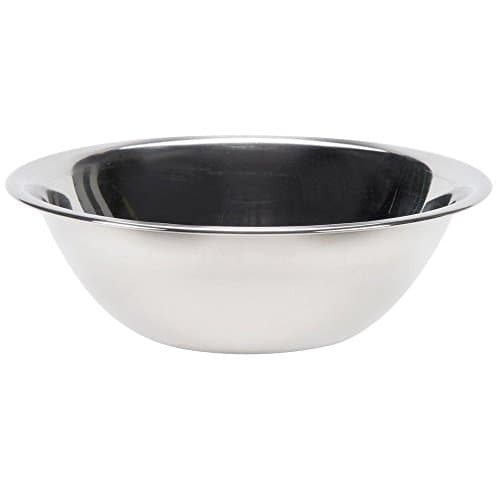 Vollrath 47938 8-Quart Economy Mixing Bowl A restaurant part at a restaurant price: eight quarts of 26-gauge stainless, a beaded rim you can actually grip with a wet hand, and a flat bottom that does not rock on a counter. | The one to buy | |
| 02 | 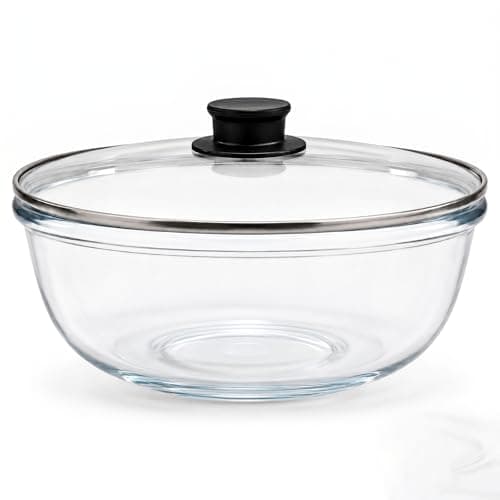 JBHO 6.7-Quart Sourdough Proofing Bowl with Glass Lid The combination that is otherwise hard to buy: a large clear bowl, a glass lid included, and a listing that states borosilicate rather than soda-lime glass. | Watching the rise, with a lid | |
| 03 | 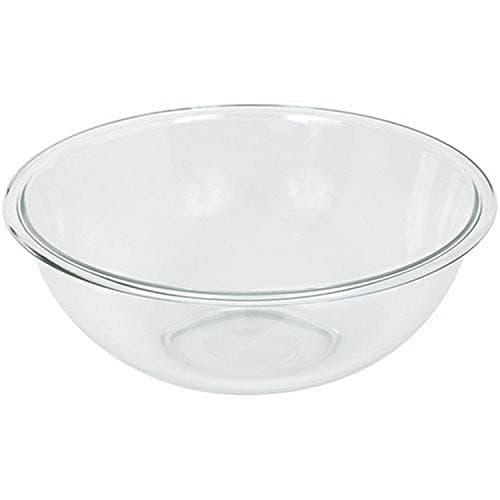 Pyrex 326 4-Quart Glass Mixing Bowl The bowl most American kitchens already have one of, and it is genuinely good for a single loaf: clear sides to read the rise, a wide mouth for folds, and oven, microwave, freezer and dishwasher rated. | The glass standard | |
| 04 | 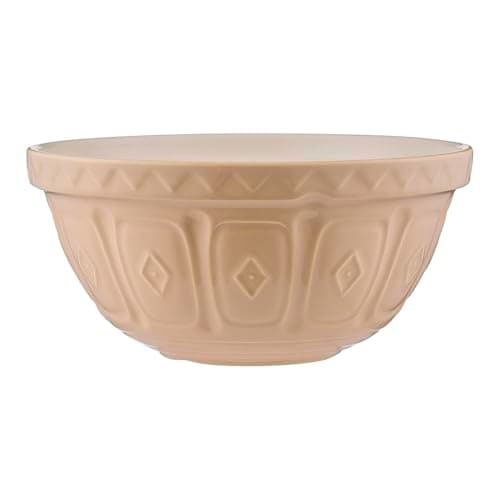 Mason Cash Cane Collection S6 Mixing Bowl, 6.35 Qt The heavy cane-pattern earthenware bowl that has been in British baking photographs for a century, and the one with a real functional argument behind the looks: thermal mass. | Holding dough temperature | |
| 05 | 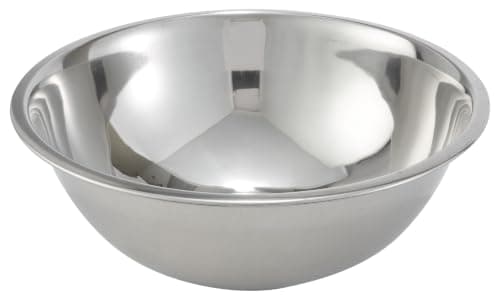 Winco 8-Quart Stainless Steel Mixing Bowl The cheapest honest route to an eight-quart stainless bowl, which is the capacity that actually matters for bulk fermentation. | Cheapest 8-quart |
#ad · We earn a commission on Amazon purchases. Prices come from Amazon and change.
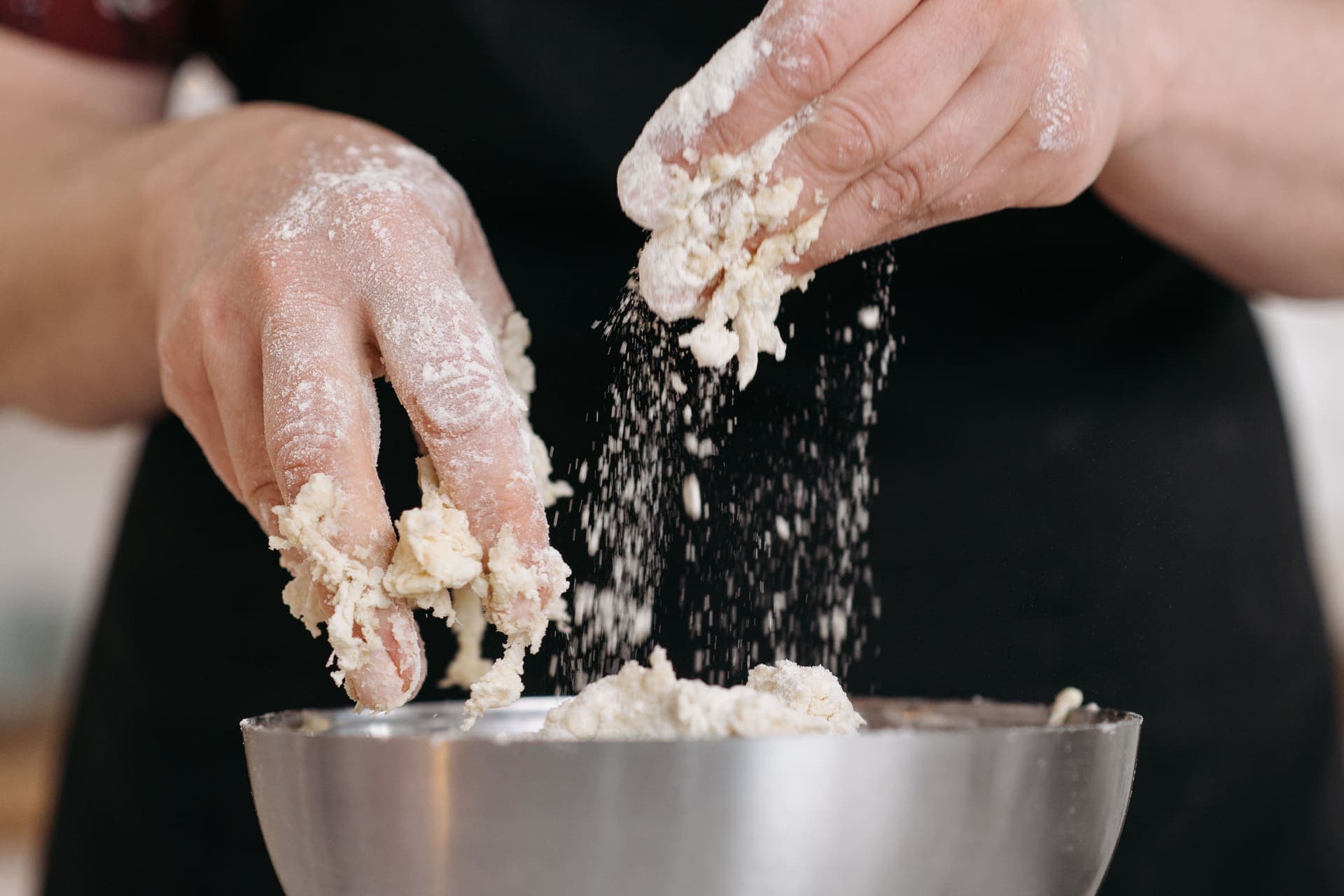
The mixing bowl is the one piece of sourdough equipment you almost certainly already own, which is exactly why nobody writes about it and why a lot of people are using the wrong one. It does three jobs. It holds the mix, it holds the bulk ferment, and — whether you intended it to or not — it holds the temperature. The first job any bowl can do. The third one is where they differ, and it is the one nobody shops for.
So this page is ordered by the things that actually differ between bowls: capacity, which is the decision most people get wrong; material, which decides both whether you can see the rise and how fast your dough drifts toward room temperature; and then width, weight and whether a lid comes in the box. None of these make better bread. The wrong one makes a worse morning.
Capacity is the decision, and four quarts is not enough
Here is the arithmetic, because it is arithmetic rather than anything we tested. A standard single loaf is about a kilogram of dough once the flour, water, salt and starter are in. Dough is a little denser than water, so a kilogram of it occupies a bit under a liter. Bulk fermentation roughly doubles that, so you finish somewhere under two liters.
A four-quart bowl holds 3.8 liters, which sounds like twice what you need until you account for the rest of it: the dough has to sit in the bottom without climbing the flare, you need to get a whole hand in alongside it to do stretch-and-folds, and a cover has to sit above the dough without touching it. Four quarts does a single loaf, tightly. It does not do a comfortable single loaf, and it does not do a double batch at all.
Six to eight quarts is the band worth buying in, and eight is the one we would pick, because the price difference between a six and an eight-quart stainless bowl is about two dollars. If you only ever bake one loaf and you already own a four-quart bowl, you do not need to buy anything — you need to know that the dough climbing the side is a capacity problem rather than a recipe problem.
What the material does to your dough temperature
This is the part that gets left out. Dough temperature is the variable that sets how long bulk fermentation takes — King Arthur puts the ideal range for wheat doughs at 75 to 78F — and the bowl is in contact with the dough for the entire time. A thin stainless bowl weighs under a pound and has almost no thermal mass, so it reaches room temperature within minutes and then holds the dough there. A thick earthenware bowl weighs several pounds and changes temperature slowly, so a dough mixed warm stays warm longer in a cool kitchen.
Be proportionate about this. It is real physics and it is a modest effect: a cold room will win against any bowl eventually, and no bowl substitutes for putting the dough somewhere warm. But if your kitchen runs cold in winter and your bulk ferments keep overrunning, the bowl is one of the variables, and it is the one you were not counting. The way to find out is to measure the dough rather than guess, and the cheaper fixes are in finding a warm spot and whether you need a proofing box.
Whether you can see the rise
An opaque bowl — stainless or earthenware — means judging the ferment from above, by how domed and jiggly the surface is. A clear bowl lets you read it from the side, which is genuinely easier to learn from, because you can see the bubble structure through the wall rather than inferring it.
One honest caveat, and it is the reason we have a separate page about this: a bowl has flared sides, so a doubling in volume does not look like a doubling in height. If reading the rise precisely is what you want, a straight-sided container turns volume into readable height and is the better tool for the job — that is the whole argument of best dough proofing container. Buy a bowl because you want to mix and ferment in one vessel; buy the container because you want to measure.
The glass question nobody mentions: Pyrex is not borosilicate
If you reach for glass, know what the glass is. Pyrex began as borosilicate in 1915, but Corning moved to thermally tempered soda-lime glass from around the 1950s on cost grounds, and all US Pyrex made since 1998 is soda-lime. The difference is not cosmetic: borosilicate tolerates roughly three times the thermal shock, around a 183C swing against about 55C for soda-lime.
That matters here more than it does for most kitchenware, because of how bakers use warm water. Hitting a target dough temperature in winter means mixing with genuinely warm water, and the failure case is pouring it into a glass bowl taken straight from a cold cupboard. A 55C swing is not a large margin. The practical rule is dull but sufficient: let the bowl sit out and come to room temperature, and never pour boiling water into cold glass. Bowls that state borosilicate on the listing have a much larger margin — if the claim is true, which is not something we can verify from a listing.
Width, depth and the stretch-and-fold problem
A wide, shallow bowl is easier to work in. You can get a flat hand under the edge of the dough, lift and fold without barking a knuckle on the rim, and scrape the whole thing out in one movement. A narrow, deep bowl makes the rise easier to read and the folds more awkward. Since most of the handling happens in the first two hours and most of the reading happens at the end, wide usually wins.
Two details worth checking on a listing. A flat base stops the bowl rocking on the counter while you mix one-handed; a fully rounded base rocks but scrapes out more cleanly. And a beaded or rolled rim gives you something to grip when your hands are covered in dough, which a raw cut edge does not.
Weight, and why the cheap bowl slides
The Vollrath weighs 0.96 of a pound. Full of stiff dough it is stable, but during the initial mix — one hand in the bowl, flour not yet hydrated — a light bowl travels across the counter. The fix costs nothing: a damp tea towel folded under the base. The earthenware bowl has the opposite problem and the opposite virtue: it never moves, and it is genuinely heavy to lift, tip and wash.
The lid question
A lid is a convenience decision, not a dough decision. The job is only to stop the surface drying and skinning, and a plate does that, as does a damp cloth, a reusable bowl cover or a shower cap. A fitted glass lid in the box is genuinely nicer than hunting for a plate that fits, and it is the main reason to choose one bowl over another at the same price. What it is not is airtight: a resting lid still lets a long cold retard dry the surface slightly, which is why bakers who retard overnight tend to end up with a sealed container instead.
How to choose, in order
- Pick capacity first. Six to eight quarts for one loaf with room to work; eight or more if you ever double. This is the only decision that will actually annoy you daily if you get it wrong.
- Decide whether you need to watch the rise. If you are still learning what a finished bulk looks like, glass earns its weight. If you can read a domed surface already, stainless is lighter, cheaper and unbreakable.
- Factor in how cold your kitchen is. If it runs cold, thermal mass is worth something and earthenware is the bowl that has it. If it runs warm, this consideration disappears entirely.
- Decide whether you want the lid in the box. If not, a plate you already own is genuinely fine.
- Measure your fridge shelf before buying. If you cold retard, the bowl has to physically fit with its cover on, and a 13-inch bowl does not go everywhere.
What a bowl will not do
It will not improve the loaf. Nothing about the vessel changes the fermentation chemistry, and the same dough in a stainless bowl and an earthenware one makes the same bread in the same kitchen. It will not shape a loaf, and it is a poor substitute for a cane basket at the proofing stage — that trade-off is laid out in banneton vs bowl. It will not hold temperature against a genuinely cold room; thermal mass slows a drift, it does not prevent one. And a flared bowl will not let you read a rise precisely however hard you squint at it.
One thing it also will not do is hurt your dough by being metal. The caution about metal on this site is about reactive metals in prolonged contact with a salty, acidic brine — the situation in a weeks-long vegetable ferment — and it does not transfer to a few hours of dough in stainless steel, which is non-reactive and is what commercial bakeries bulk ferment in.
Buying advice, short version
Buy an eight-quart stainless bowl. It is cheap, unbreakable, light enough to handle one-handed and large enough that capacity never becomes the problem; the Vollrath is the one with a published gauge and a beaded rim. Buy glass instead if you are still learning to judge a bulk ferment and want to watch it happen, and take the one with a lid if you can. Buy the earthenware bowl if your kitchen is cold and you want the object as much as the function, which is a legitimate reason to buy something. And if you already own a four-quart bowl, bake in it this weekend — just stop blaming the recipe when the dough reaches the rim.
A stand mixer bowl is not on this list on purpose. A mixer is optional for sourdough and warms the dough measurably when you use one, which is the case we make in do you need a stand mixer for sourdough. A plain bowl and your hands remain the default here.
Every pick, in order
The full write-ups
Pick 01 · The one to buy
Vollrath 47938 8-Quart Economy Mixing Bowl
Vollrath
A restaurant part at a restaurant price: eight quarts of 26-gauge stainless, a beaded rim you can actually grip with a wet hand, and a flat bottom that does not rock on a counter. Eight quarts is the number that matters -- a kilogram of dough needs room to double without climbing the rim, and 4-quart bowls are where most first bulk ferments go wrong.
Capacity
8 qt (7.6 L)
Material
26-gauge stainless steel, mirror finish
Size
13.28 in diameter, 4.5 in high, 6 in base
Weight
0.96 lb
Care
Dishwasher safe
Specs compiled from: Manufacturer published specification sheet
What is good
- Eight quarts lets a one-kilogram dough double with room to spare
- Beaded edge gives a real grip when your hands are covered in dough
- Under a pound, so you can tip and scrape one-handed, and it will not chip or crack
What is not
- Opaque -- you cannot watch the rise from the side, which is the single biggest reason to buy glass instead
- Steel tracks room temperature fast, so a cold kitchen cools the dough quicker than glass or earthenware would
- At under a pound it is light enough to slide on a counter while you mix; wet cloth underneath fixes it
- No lid, so you are using a plate, a shower cap or plastic wrap
#ad Disclosure · Price as of October 17, 2026
Pick 02 · Watching the rise, with a lid
JBHO 6.7-Quart Sourdough Proofing Bowl with Glass Lid
JBHO
The combination that is otherwise hard to buy: a large clear bowl, a glass lid included, and a listing that states borosilicate rather than soda-lime glass. If the lid matters to you -- and it does if you are tired of plastic wrap -- this is the straightforward answer. The borosilicate claim is the listing's, not a figure we can verify.
Capacity
6.7 qt, per the listing
Glass
Borosilicate, per the listing (unverified)
Lid
Glass lid included
Sold as
A sourdough proofing and dough-rising bowl
Specs compiled from: Product-type description; capacity and material as listed by sellers
What is good
- Big enough for a double batch and clear enough to read the rise against the side
- A glass lid included means no plastic wrap and no hunting for a plate that fits
- If the borosilicate claim holds, it tolerates a far bigger temperature swing than US Pyrex does
What is not
- We cannot verify the glass composition -- a listing claim is not a published specification
- Glass this size is heavy and it will break if you drop it, unlike the stainless options
- A resting glass lid is not an airtight seal, so a long cold retard still dries the surface a little
- No published dimensions, so check it against your fridge shelf before buying
#ad Disclosure · Price as of October 17, 2026
Pick 03 · The glass standard
Pyrex 326 4-Quart Glass Mixing Bowl
Pyrex
The bowl most American kitchens already have one of, and it is genuinely good for a single loaf: clear sides to read the rise, a wide mouth for folds, and oven, microwave, freezer and dishwasher rated. Know what the glass is, though. All US Pyrex since 1998 is tempered soda-lime, not the borosilicate the name used to mean, and soda-lime tolerates a much smaller temperature swing.
Capacity
4 qt (3.8 L)
Glass
Tempered soda-lime; all US Pyrex since 1998
Care
Dishwasher, microwave, oven and freezer safe, per the seller
Made
USA, per the product name
Specs compiled from: Manufacturer published specification sheet
What is good
- You can read the rise against the side, which is the whole argument for glass
- Rated for oven, microwave, freezer and dishwasher, so it is not only a mixing bowl
- Cheap, ubiquitous, and a lid is sold separately if you want one
What is not
- Four quarts is tight for a one-kilogram dough and too small for a double batch
- Tempered soda-lime glass has roughly a third the thermal-shock resistance of borosilicate -- do not pour boiling water into a cold one
- Heavy for its capacity, and it breaks
- No lid in the box
Pick 04 · Holding dough temperature
Mason Cash Cane Collection S6 Mixing Bowl, 6.35 Qt
Mason Cash
The heavy cane-pattern earthenware bowl that has been in British baking photographs for a century, and the one with a real functional argument behind the looks: thermal mass. A thick earthenware bowl changes temperature slowly, so a dough mixed at 78F drifts toward a cold room far more slowly than it would in thin steel. You pay for that in weight and in money.
Capacity
6.35 qt (6 L)
Material
Chip-resistant earthenware
Size
13.5 in diameter
Care
Dishwasher and freezer safe; oven safe to 320F (160C)
Made
Portugal
Specs compiled from: Manufacturer published specification sheet
What is good
- Thermal mass genuinely steadies dough temperature through a long bulk in a cool kitchen
- Six-plus quarts and a wide mouth, so folds are easy and a double batch fits
- Heavy enough that it does not move while you mix, which no stainless bowl manages
What is not
- The most expensive bowl here by a wide margin, and the premium buys thermal mass and looks, not better bread
- Genuinely heavy to lift, tip and wash, especially full
- Opaque, so the rise has to be judged from above rather than read off the side
- Oven safe only to 320F -- this is a mixing bowl, not a baking dish
#ad Disclosure · Price as of October 17, 2026
Pick 05 · Cheapest 8-quart
Winco 8-Quart Stainless Steel Mixing Bowl
Winco
The cheapest honest route to an eight-quart stainless bowl, which is the capacity that actually matters for bulk fermentation. It does the same job as the Vollrath for roughly half the money. The catch is information: the listing names no model number, so the gauge, the rim detail and the exact dimensions are not something we can quote you.
Capacity
8 qt, per the listing
Material
Stainless steel; gauge not stated on the listing
Model
Not named on the listing
Specs compiled from: Product-type description; capacity and material as listed by sellers
What is good
- The right capacity for bulk fermentation at the lowest price on this page
- Stainless, so it will not chip, crack or break however you treat it
- Light and nests, which matters if your cupboard is already full
What is not
- The listing names no model, so gauge and dimensions are unknown rather than bad -- Winco sells several 8 qt bowls
- Thin economy bowls flex when you press into stiff dough and can warp over time
- Opaque, light enough to slide on a counter, and no lid
#ad Disclosure · Price as of October 17, 2026
How we picked
We have not tested any of this equipment. What we did instead: compiled the published specifications from each manufacturer’s own listing, checked them against the task a beginner is actually trying to do, read the care instructions, and named the thing we would skip. Where a pick is a product type rather than a brand, it is because the category is sold mostly unbranded and the type is the real decision.
Frequently asked
Questions
+What size mixing bowl do I need for sourdough?
Six to eight quarts for a single loaf. A one-kilogram dough is a bit under a liter and roughly doubles, so the dough itself needs about two liters — but you also need room to get a hand in for folds and headroom under the cover. Four quarts works for one loaf tightly and not at all for a double batch.
+Is stainless steel or glass better for sourdough?
Stainless is lighter, cheaper and unbreakable; glass lets you watch the rise from the side and has slightly more thermal mass. Neither makes better bread. Pick glass while you are still learning what a finished bulk ferment looks like, and stainless once you can read a domed surface from above.
+Can you bulk ferment sourdough in a metal bowl?
Yes. Stainless steel is non-reactive and is what commercial bakeries ferment in. The widespread caution about metal and fermentation concerns reactive metals in long contact with a salty, acidic brine, which is a vegetable-ferment problem rather than a dough problem. A few hours of dough in a stainless bowl is not a concern.
+Is Pyrex still made from borosilicate glass?
Not in the United States. Pyrex began as borosilicate in 1915, Corning shifted to thermally tempered soda-lime glass from about the 1950s on cost grounds, and all US Pyrex since 1998 is soda-lime. Borosilicate tolerates roughly three times the thermal shock — about a 183C swing against about 55C — so the name no longer tells you what the glass is.
+Can I pour warm water into a glass mixing bowl?
Warm, yes. Hot into cold glass, no. Tempered soda-lime glass tolerates a swing of roughly 55C, and a bowl out of a cold cupboard plus near-boiling water can exceed that. Let the bowl come to room temperature first and mix with warm rather than boiling water, which is what hitting a target dough temperature calls for anyway.
+Do I need a lid for the bulk ferment bowl?
You need something that stops the surface drying, which can be a plate, a damp cloth, a reusable cover or a shower cap. A fitted lid in the box is more convenient and no more effective. No bowl lid is airtight, so an overnight cold retard is better served by a sealed container.
+Is a mixing bowl the same as a dough proofing container?
No, and the difference is the sides. A bowl flares, so a doubling in volume does not read as a doubling in height; a proofing container has straight sides that turn volume into a height you can measure. A bowl is the better single vessel for mixing and folding, and a container is the better instrument for measuring a rise.
+Should I bulk ferment in the same bowl I mixed in?
Yes, and it saves washing a second thing. There is no benefit to transferring dough to a fresh vessel after mixing, and every transfer knocks a little gas out of a dough that has started working. The only reason to move it is if the mixing bowl is too small, which is the capacity problem this page is about.
Sources
Where the facts on this page came from
- King Arthur Baking — desired dough temperature (the 75-78F target range)
- Pyrex — glass composition history: borosilicate to tempered soda-lime, and relative thermal shock resistance
- Vollrath — 47938 8-quart economy mixing bowl specifications (26 gauge, dimensions, weight)
- Mason Cash Cane S6 published specifications (6.35 qt, 13.5 in, earthenware, oven safe to 320F, made in Portugal)
- Pyrex 326 4-quart published specifications (4 qt / 3.8 L, dishwasher, microwave, oven and freezer safe, made in USA)
Read next