Hub 04 · Fermenting Vegetables
Best fermentation crocks
A crock is a capacity upgrade, not a quality one. It ferments the same way a jar does — it just does five liters at once with a seal you never think about.
We earn a commission if you buy through our links, at no extra cost to you. We have not tested this equipment. Here is what we did instead.
Quick picks
Tap a row for the full write-up · Prices open on Amazon
| # | Product | Best for | Price |
|---|---|---|---|
| 01 | Ohio Stoneware fermentation crock A water-sealed stoneware crock with stone weights, made in the United States and sold in sizes from a few liters upward. | A first real crock | |
| 02 | Humble House Sauerkrock The same water-seal principle in a design meant to be looked at, sold with fitted ceramic weights. | A crock you keep on the counter | |
| 03 | 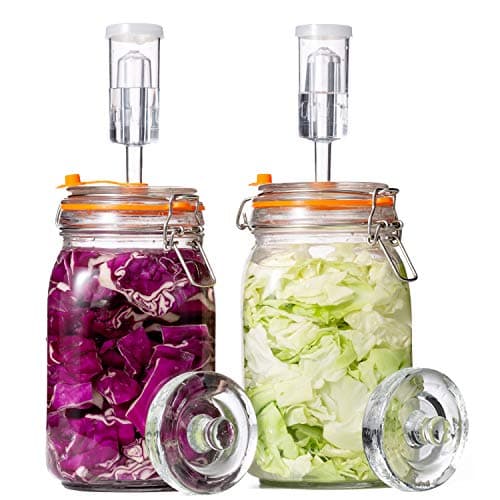 Glass fermentation crock with airlock A crock-shaped glass vessel with a water seal or a lid airlock. | Seeing inside a crock | |
| 04 | European stoneware fermenting crock The traditional European shape, usually sold in larger capacities than the American crocks. | Large batches |
#ad · We earn a commission on Amazon purchases. Prices come from Amazon and change.
A fermentation crock is a heavy vessel with a channel of water around the rim. The lid sits down into that water, so gas pushes out through the water and nothing gets back in. It is an elegant mechanism with no valve to fail and no part to replace.
It also ferments cabbage in exactly the same way a mason jar with a silicone cap does. What you are buying is capacity and thermal stability, not a better ferment.
The size question decides everything
This is the mistake people make, and it is expensive. A crock ferments badly when it is half empty, because the headspace above the brine is full of air. You cannot buy a five-liter crock and use two liters of it.
So the honest question is: do you process cabbage in volume? A five-liter crock wants roughly five liters of shredded vegetables. If you buy one cabbage at a time, buy jars. The full reasoning is in what size crock you need.
Stoneware or glass?
Stoneware is the traditional material and its thick walls genuinely help: a large mass of ceramic holds a steady temperature through the daily swings of a kitchen, and fermentation is temperature-sensitive. It is opaque, which means you cannot see what is happening.
Glass reverses both. You can watch the brine level and see whether anything has floated, which is a real benefit for a beginner. But thin glass walls track the room temperature closely, and light reaches the ferment — keep it in a dark cupboard either way.
Do not let the water channel run dry
This is the one maintenance task a crock has and the one way the mechanism fails. As the water evaporates the seal breaks and air gets in. Check it every few days over a long ferment and top it up.
Some people use brine rather than plain water in the channel, on the reasoning that a splash back into the crock then does no harm. It is a sensible habit.
Weights come with it, and that matters
Crocks are sold with stone or ceramic weights cut to fit that specific crock, usually as two half-moons so they pass through the mouth. That fit is genuinely hard to replicate with generic weights, and it is a real advantage over assembling a large vessel yourself.
Weights in general, including the free method, are covered in best fermentation weights.
Check the rim before you buy, and after
The water seal depends on an intact channel. A chipped rim is not cosmetic damage on a crock — it is a broken seal. Inspect it on arrival and handle it accordingly, particularly with imported stoneware where a replacement means another long shipment.
One vessel is missing from these picks on purpose, because it works the opposite way round. Korean onggi are fired to stay porous and vent carbon dioxide through the clay rather than through a water moat, and a 2023 study measured less than half the CO2 inside one compared with sealed glass. Onggi versus a fermentation crock sets out what that does and does not prove.
Every pick, in order
The full write-ups
Pick 01 · A first real crock
Ohio Stoneware fermentation crock
Ohio Stoneware
A water-sealed stoneware crock with stone weights, made in the United States and sold in sizes from a few liters upward. The water channel is the whole mechanism: fill it, and gas leaves while nothing gets in.
Material
Glazed stoneware
Seal
Water channel around the rim; lid sits in the water
Weights
Stone weights, usually two half-moons
Sizes
Sold in a range; check the listed capacity
Specs compiled from: Manufacturer product listing and product name
What is good
- The water seal handles the entire airlock problem with no valve to fail
- Stoneware holds temperature steadily, which a glass jar does not
- Stone weights come sized to the crock, unlike generic glass discs
What is not
- The water channel must be topped up or the seal breaks
- Opaque -- you cannot see what is happening inside
- Heavy, expensive and awkward to store between batches
Pick 02 · A crock you keep on the counter
Humble House Sauerkrock
Humble House
The same water-seal principle in a design meant to be looked at, sold with fitted ceramic weights. If a crock is going to live on your worktop rather than in a cupboard, this is the category where that matters.
Material
Glazed ceramic
Seal
Water moat
Weights
Fitted ceramic weights included
Sizes
Several capacities sold
Specs compiled from: Manufacturer product listing and product name
What is good
- Water seal plus fitted weights in one purchase
- Sized ranges that suit a household rather than a restaurant
- Presentable enough to leave out, which means you will actually use it
What is not
- Ceramic chips, and a chipped rim compromises the water seal
- Opaque, same as any crock
- Priced well above a jar-and-lid setup that ferments identically
Pick 03 · Seeing inside a crock
Glass fermentation crock with airlock
Type pick -- glass water-seal vessel
A crock-shaped glass vessel with a water seal or a lid airlock. It gives you the one thing stoneware cannot -- you can watch the ferment -- at the cost of the temperature stability thick stoneware provides.
Material
Glass body
Seal
Water channel or lid-mounted airlock
Weights
Glass weights, usually included
Capacity
Commonly 3-5 liters
Specs compiled from: Product-type description; capacity and material as listed by sellers
What is good
- You can see the brine level and the ferment without opening it
- Glass does not stain or hold smells between batches
- Usually lighter than stoneware at the same capacity
What is not
- Light reaches the ferment; keep it in a dark cupboard anyway
- Thin walls track room temperature swings closely
- Glass at this size breaks in ways stoneware does not
#ad Disclosure · Price as of October 17, 2026
Pick 04 · Large batches
European stoneware fermenting crock
Boleslawiec and similar makers
The traditional European shape, usually sold in larger capacities than the American crocks. Worth it if you ferment a whole cabbage harvest at once; entirely wasted if you ferment a jar at a time.
Material
Glazed stoneware
Seal
Water channel
Capacity
Often 5 liters and up
Weights
Stone weights, usually included
Specs compiled from: Product-type description; capacity and material as listed by sellers
What is good
- The cheapest way to get a large capacity in stoneware
- Traditional shape with a well-proven water seal
- Thick walls hold temperature through a cold pantry
What is not
- Genuinely too large for a first ferment -- you will not fill it
- Heavy enough that moving it full is a two-hand job
- Import shipping makes breakage replacement slow
How we picked
We have not tested any of this equipment. What we did instead: compiled the published specifications from each manufacturer’s own listing, checked them against the task a beginner is actually trying to do, read the care instructions, and named the thing we would skip. Where a pick is a product type rather than a brand, it is because the category is sold mostly unbranded and the type is the real decision.
Frequently asked
Questions
+What is the best size fermentation crock?
Match it to how much you actually ferment at once, because a half-empty crock has too much air above the brine. For most households a 3-5 liter crock is the largest that gets filled; below that, jars are usually the better tool.
+Do you need a fermentation crock?
No. A crock is a capacity upgrade — it ferments the same way a mason jar with an airlock lid does. Buy one when you are regularly fermenting several liters at a time.
+How does a water-seal crock work?
A channel around the rim is filled with water and the lid sits down into it. Carbon dioxide from the ferment pushes out through the water, and nothing gets back in. The channel must be topped up as the water evaporates or the seal breaks.
+Stoneware or glass fermentation crock?
Stoneware holds a steadier temperature, which helps a long ferment, but you cannot see inside. Glass lets you watch the brine level, which is genuinely useful for a beginner, at the cost of tracking room temperature more closely.
Read next