Hub 04 · Fermenting Vegetables
Onggi vs a fermentation crock
One vents carbon dioxide through its walls. The other locks air out behind a water moat. They are opposite solutions to the same problem, and the research favors the one that is harder to own.
We earn a commission if you buy through our links, at no extra cost to you. We have not tested this equipment. Here is what we did instead.
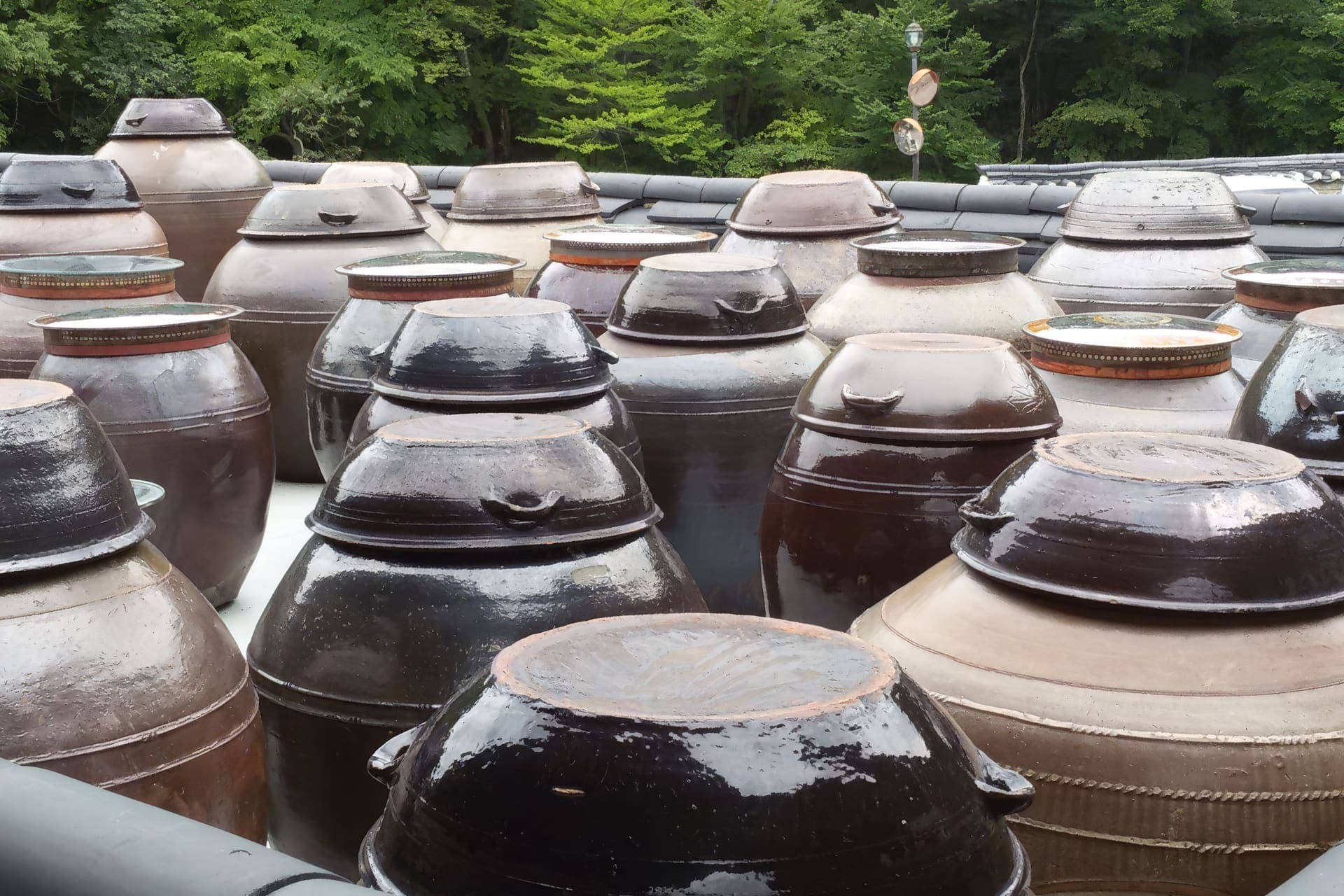
Buy the water-sealed stoneware crock for a first batch, and the onggi when fermenting is already a habit. The crock is the more forgiving object: the moat does the air-exclusion for you, and nothing about it is unfamiliar. The onggi probably makes better kimchi — there is now a measured reason to think so — but it asks more of you, and it breaks.
That is unusual for this site. Normally the cheap, simple answer is also the better-performing one. Here the traditional vessel appears to have a real functional advantage, so it is worth being precise about what the advantage is and what it costs you.
They solve the same problem in opposite directions
A vegetable ferment produces carbon dioxide. That gas is useful — it blankets the surface and keeps oxygen off — right up until there is too much of it, at which point pressure builds and the bacteria doing the work are sitting in their own exhaust.
A water-sealed crock handles this mechanically. The lid sits in a channel of water; gas pushes out through the water and nothing comes back in. It is an airlock made of a groove, and it is why crocks are the default recommendation on our fermentation crock page.
An onggi handles it through the wall of the pot. Onggi are Korean earthenware fired so that the clay body keeps open pores, and the gas leaves through the vessel itself rather than past a seal.
What the research actually measured
This is where the onggi case stops being folklore. In April 2023, Soohwan Kim and David Hu of Georgia Tech published “Onggi’s permeability to carbon dioxide accelerates kimchi fermentation” in the Journal of the Royal Society Interface. They fermented salted cabbage in an onggi and in a sealed glass jar and measured the carbon dioxide and pressure inside both.
Two findings matter for a buying decision:
- Carbon dioxide in the onggi was less than half the level in the glass container. The porous wall vents it continuously instead of letting it accumulate.
- Lactic acid bacteria proliferated 26% more in the onggi kimchi than in the glass. The authors attribute the difference to CO2 buildup in the sealed jar effectively suffocating the bacteria in their own gas.
The mechanism also works as a pressure relief: the porous wall acts as a safety valve, so CO2 rises more slowly than in glass while outside particles are still kept out.
What an onggi actually is
Not simply “a clay pot.” An onggi is earthenware fired in a way that deliberately leaves the clay body porous, and the porosity is a material property rather than a decorative one. Materials research on onggi bodies attributes the pore formation to the clay’s broad particle size distribution and high iron oxide content, and reports that bodies with more open pores show correspondingly higher gas permeability.
That is worth knowing because it tells you what you cannot shop for. The breathability is a consequence of a specific soil and a specific firing, and no onggi sold on the general market publishes its clay source, its firing temperature or its porosity. You are buying a tradition and trusting the maker, which is a different proposition from buying a crock with a stated capacity.
Glazing is a spectrum, not a switch
The obvious assumption is that an onggi must be entirely unglazed or the pores are sealed and the effect is lost. The research is more interesting than that.
A 2008 study in the Journal of the Korean Packaging Association compared kochujang fermented in three onggi types — unglazed, glazed on the outside only, and fully glazed. The outside-glazed vessels produced higher protease activity and higher amino nitrogen, free amino acid and total nucleotide content, and the authors concluded that onggi of medium porosity suited kochujang fermentation. An earlier 2005 comparison across glass, polypropylene, PET, stainless steel and onggi likewise found higher protease activity and amino nitrogen in the onggi.
The practical reading: more porous is not automatically better, there is an optimum, and it is not one you can select for from a product listing. Those studies are also about kochujang, a fermented chili and soybean paste, rather than about kimchi or sauerkraut.
The pores clog — and this is the honest catch
The 2005 vessel study records something that almost no enthusiastic account of onggi mentions. Water loss and salt concentration in the onggi were comparable to the sealed vessels it was tested against, and the reason given was gradual clogging of the micropores during storage.
In other words the breathability is not a permanent property of the object. It declines as the pores fill with the things you ferment in it. Nobody publishes a figure for how fast, so we cannot tell you whether that matters over one season or over twenty — but it means the measured advantage belongs to a new or well-maintained onggi rather than to earthenware as such, and it is a strong argument for hot water and a brush over anything that leaves residue.
Living with one
A crock asks you to top up a water moat. An onggi asks for slightly more attention, in three specific places:
- Brine level is the whole safety story. There is no moat and no seal, so the only thing keeping air off the vegetables is brine and a lid. Our page on whether fermenting is safe explains why submersion is the mechanism rather than a precaution.
- It evaporates. A porous wall loses water through itself, which is exactly how Kim and Hu measured the permeability in the first place. Over a long ferment the level drops and the brine concentrates.
- It is opaque and heavy and it breaks. You cannot watch the ferment, a 16 liter jar full of cabbage is a two-person lift, and a chip or a thermal shock ends it. There is no warranty on handmade earthenware and no spare part.
None of that is difficult. All of it is more involvement than a crock, which is the real reason we put the crock first for a first batch rather than any doubt about the ferment.
Side by side
| Onggi | Water-sealed crock | |
|---|---|---|
| How gas escapes | Through the porous wall | Out through the water moat |
| How air is excluded | Brine level and a lid; no seal | The moat, mechanically |
| Measured CO2 behavior | Less than half a sealed jar (Kim & Hu 2023) | Vents, but not measured in that study |
| Published specifications | None. No porosity, thickness or firing figure | Capacity; material |
| Forgiveness | Low. Brine level matters, evaporation matters | High. Top up the moat |
| Can you see the ferment | No, opaque | No, opaque |
| Failure mode | Chips and cracks; it is earthenware | Chips; moat dries out |
| Dishwasher | No | No |
| Cost | Higher per liter, handmade | Lower per liter |
What size, and why they are that shape
Onggi are wide-bellied and narrow-necked, and the shape is functional rather than decorative: the belly holds the volume, the narrower mouth reduces the surface area exposed to air, and the curve lets you pack vegetables down against the walls. It is the opposite of the straight-sided, wide-mouth design we recommend for glass jars, where the whole point is that a weight can drop straight in.
That shape has a consequence for size. A wide-mouth quart jar is easy to pack and easy to empty. A narrow-necked 16 liter jar is neither, and you are reaching into it up to your elbow. So the size question is not only about how much kimchi you eat:
- 8 liters (2 gallons) takes one large head of cabbage, can be lifted full by one person, and is the honest size for finding out whether you like fermenting this way.
- 16 liters (4.2 gallons) is a cabbage-season batch, several heads at once, and the scale at which the vessel is doing something a jar cannot. It is also heavy, awkward to clean, and a two-person lift when full.
One detail worth reading on the listing rather than assuming: BALWOO describes the 16 liter jar as a kimchi fermentation crock, and describes the 8 liter primarily for rice, grain and sauce storage. Same body, same maker, different stated purpose — and since the listing is the only specification that exists for either, it is the only thing you have to go on.
Our crock sizing page works through the cabbage-to-volume arithmetic, and it transfers directly: the rule of roughly a pound and a half of cabbage per liter of vessel does not care what the vessel is made of.
So which one
Buy the crock if
This is your first vessel
The moat removes the main way a first batch goes wrong, the capacity is published, and it costs less per liter. Nothing about owning it is a skill.
Buy the onggi if
You already make kimchi regularly
You know how to manage brine level, you want the vessel the food was developed in, and the 2023 CO2 result is reason enough. Sixteen liters is a real batch.
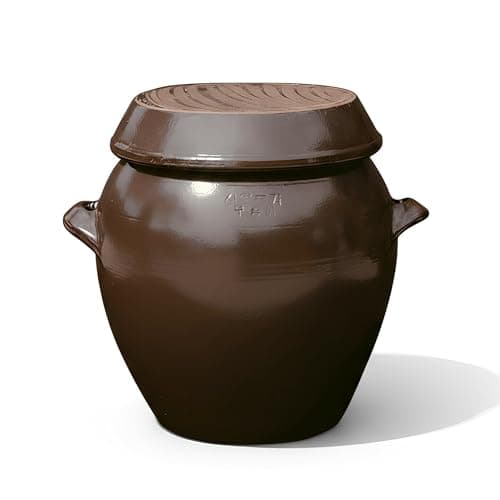
BALWOO Onggi Korean Clay Jar, 16 L (4.2 gal)
#ad Disclosure · Price as of October 17, 2026
If the onggi appeals but 16 liters and that price do not, the 8 liter is the honest way to try one — one large head of cabbage, about two thirds the cost. Read BALWOO’s listing first, though: for that size they lead on rice, grain and sauce storage rather than on fermenting, and the listing is the only specification that exists for any of these jars.
One practical warning before you order. These are handmade, heavy, breakable objects shipped in a box, and a large onggi is exactly the kind of parcel that arrives chipped. Check the return policy before buying rather than after, open the box with the courier’s label still readable, and inspect the rim and the base before you wash it — a hairline crack in the base is the failure that will not show itself until the jar is full of brine on a kitchen floor.
The honest gap in both of these
Neither vessel tells you anything about its own temperature, and temperature is what decides a ferment. Thick earthenware and thick stoneware both buffer a swinging kitchen, which is genuinely useful — but if your kitchen sits below 60F, the NCHFP’s wording is that kraut “may not ferment,” and no pot fixes that. That is a temperature-control problem, and it is cheap to solve.
Frequently asked
Questions
+Is an onggi better than a fermentation crock?
+Do onggi need to be unglazed to work?
+Can you ferment sauerkraut in an onggi?
+Do you need a weight in an onggi?
+How do you clean an onggi?
Sources
Where the facts on this page came from
- Kim & Hu (2023), Journal of the Royal Society Interface — onggi CO2 permeability and kimchi fermentation
- Georgia Tech — summary of the onggi fermentation study
- Journal of the Korean Packaging Association (2008) — unglazed, outside-glazed and fully glazed onggi compared for kochujang fermentation
- Effects of Vessel on the Quality Changes during Fermentation of Kochujang (2005) — onggi against glass, PP, PET and stainless steel, and the micropore clogging finding
- National Center for Home Food Preservation — sauerkraut fermentation temperature and duration
Read next