Hub 04 · Fermenting Vegetables
Crock or mason jar?
They ferment the same way. The crock does more at once and holds a steadier temperature; the jar costs a tenth as much and lets you watch.
We earn a commission if you buy through our links, at no extra cost to you. We have not tested this equipment. Here is what we did instead.
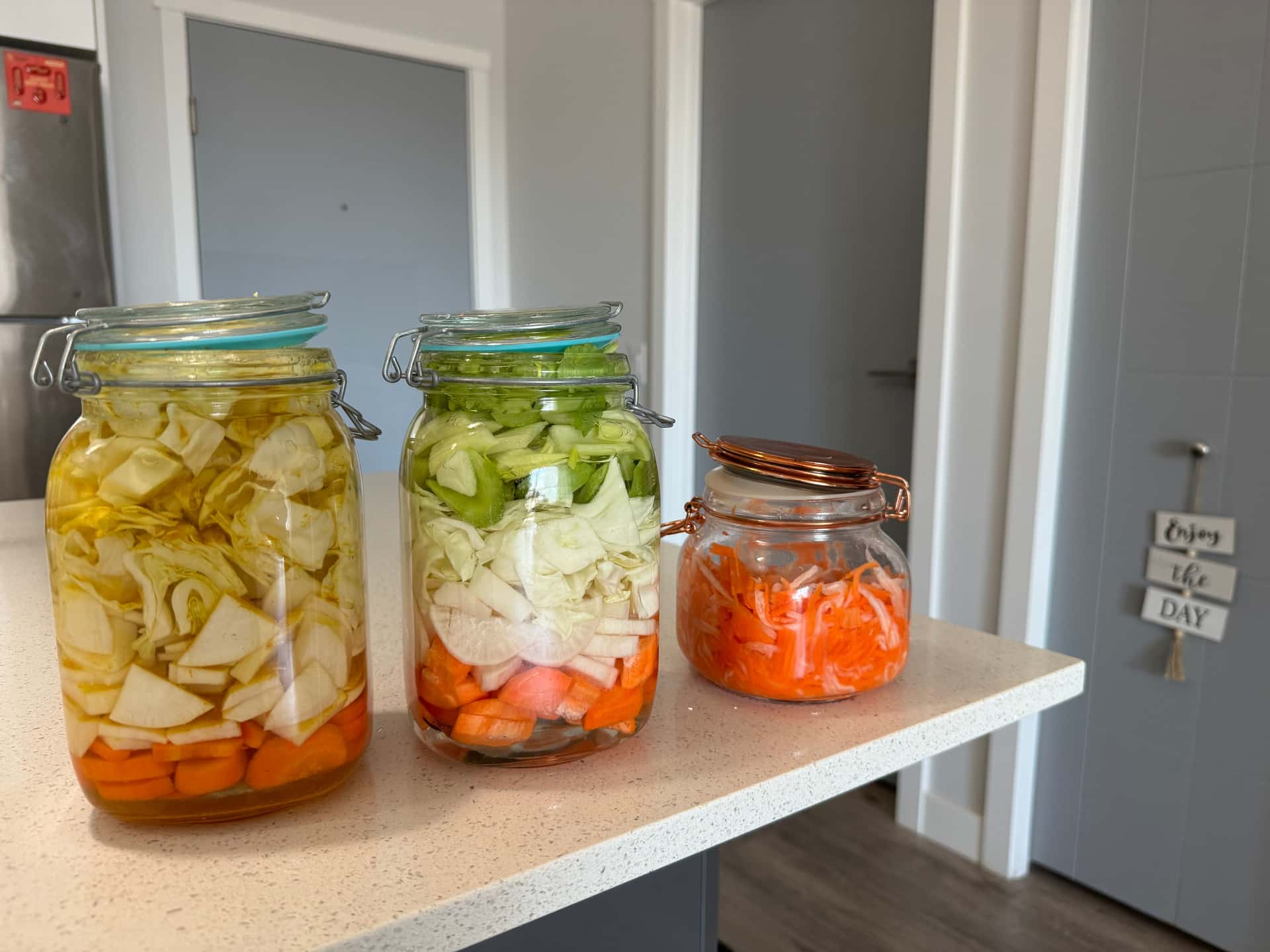
Use jars if
This is your first batch, or your tenth
Cheaper, visible, and four jars means four different ferments running at once instead of one large batch you have to like. This is the right answer for nearly every household.
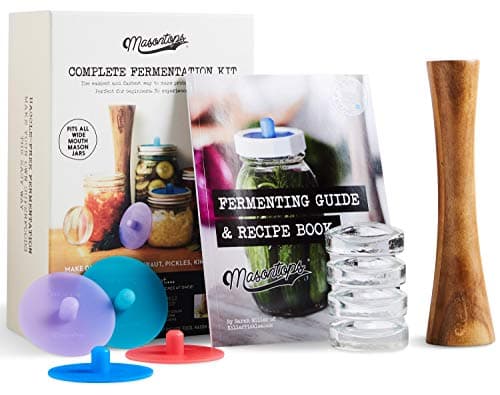
Masontops Complete Mason Jar Fermentation Kit
#ad Disclosure · Price as of October 17, 2026
Buy a crock if
You process cabbage in volume
A garden harvest, or a household that eats a lot of kraut. The thick walls also hold a steadier temperature, which genuinely helps a long ferment.
| Mason jar | Crock | |
|---|---|---|
| Typical capacity | 1 quart to half a gallon | 3 liters and up |
| Cost | A few dollars plus a lid and weight | Many times that |
| Can you see inside | Yes | No, unless it is glass |
| Temperature stability | Tracks the room closely | Thick walls smooth out swings |
| Airlock | Silicone valve or bubbler | Water channel, no parts |
| Running several ferments | Easy — one jar each | One batch at a time |
| Storage between batches | Stacks in a cupboard | Heavy and bulky |
The variety argument is the strongest one
A crock commits you to one large batch of one thing. Four quart jars let you run sauerkraut, kimchi, dilled carrots and a jar of something experimental at the same time, and if the experiment is bad you lose a quart rather than five liters.
For someone learning, that is worth more than any advantage on the crock side. You get four data points a fortnight instead of one.
Where the crock genuinely wins
Thermal mass. Fermentation rate is temperature-dependent, and a thin glass jar in a kitchen that swings from 17C at night to 23C in the afternoon is fermenting at a varying rate all week. Several kilograms of stoneware smooths that out.
The water seal. No valve, no silicone, nothing to replace — just a channel of water you top up. It is the most robust airlock mechanism in the category.
Fitted weights. Crock weights come cut to the vessel, usually as half-moons. Getting equivalent coverage in a large jar is fiddly.
The half-empty problem
A crock filled to a third is a crock with a lot of air above the brine, and that headspace is a real disadvantage. You cannot scale a crock down the way you can simply use a smaller jar.
This is why buying a large crock speculatively goes wrong so often, and why the size question deserves its own page — what size crock do you need.
What we would actually do
Buy six wide-mouth quart jars, a matched lid-and-weight kit, and a bag of non-iodized salt. Ferment through a winter. If by spring you are running four jars at a time and wishing they were one vessel, buy the crock then — and you will know exactly what size.
There is a third vessel in this argument that neither seals nor sits open: an onggi breathes through its own walls, which is a genuinely different mechanism and has the only measured evidence behind it in this category.
Frequently asked
Questions
+Is a fermentation crock better than a mason jar?
Not for the ferment itself — the process is identical. A crock handles more volume and holds a steadier temperature; a jar costs a fraction as much and lets you see what is happening. For a first batch, use jars.
+Can you make sauerkraut in a mason jar?
Yes, and it is the standard home method. A wide-mouth quart jar, a lid that vents gas, and a weight to keep the cabbage under the brine is everything the process needs.
+Can you fill a crock only part way?
You can, but it ferments less well — the air above the brine is a real disadvantage. A crock wants to be filled close to its working capacity, which is why buying a large one speculatively often disappoints.
Read next