Hub 04 · Fermenting Vegetables
Best cabbage shredder for sauerkraut
Even shred thickness is not cosmetic in a ferment -- it decides how evenly the salt draws water out. That is the whole case for a dedicated tool.
We earn a commission if you buy through our links, at no extra cost to you. We have not tested this equipment. Here is what we did instead.
Quick picks
Tap a row for the full write-up · Prices open on Amazon
| # | Product | Best for | Price |
|---|---|---|---|
| 01 | 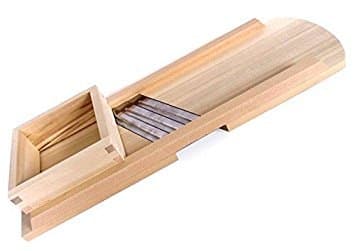 K&K Keramik Beech Wood Cabbage Shredder, Standard A traditional German beech board with fixed blades, 25.5 inches long, sat across a bowl or a crock. | Filling a crock in one session | |
| 02 | 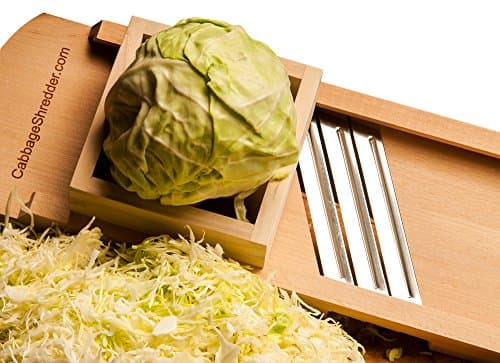 Wooden Cabbage Shredder with Finger-Protection Box A traditional shredder that ships with a sliding guard box and a cut-resistant glove, which is the single most sensible upgrade in this category. | Keeping your knuckles | |
| 03 | 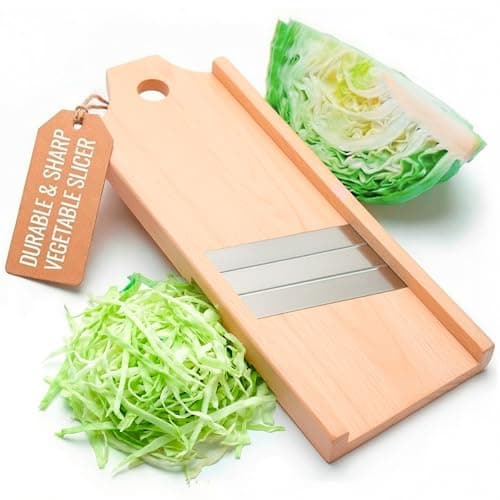 Compact Wooden Slaw Slicer, 17.7 x 7 inch A shorter, cheaper wooden board for people making a mason jar at a time rather than filling a five-liter crock. | A jar of kraut, not a crock | |
| 04 | 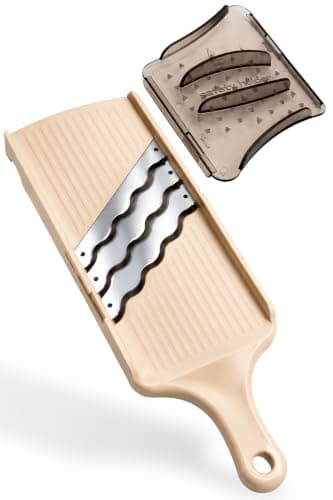 Arnest Japanese Mandoline Cabbage Shredder, 3-Blade A handheld Japanese mandoline with three wave blades, made for shredding cabbage very finely for tonkatsu. | A drawer and a small kitchen | |
| 05 | 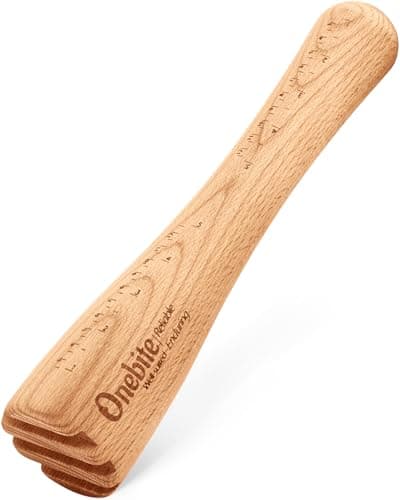 Onebite Sauerkraut Pounder, 12 inch, Beech One piece of pre-oiled beech with depth marks up the shaft and two differently shaped ends -- a curved one for the rounded bottom of a jar and a textured one for pressing. | Knowing how far down you have packed | |
| 06 | 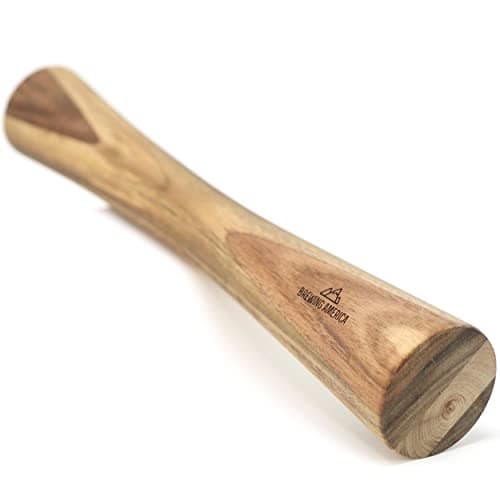 Brewing America Acacia Wood Fermentation Tamper, 12 inch Two inches longer than the mason-jar tampers, which is the difference between reaching the bottom of a half-gallon jar and not. | A deeper vessel |
#ad · We earn a commission on Amazon purchases. Prices come from Amazon and change.
You can make sauerkraut with a chef’s knife, and plenty of people do. The argument for a shredder is not speed, although it is faster. It is consistency: a fixed blade cuts every piece to the same thickness, and in a ferment that is doing real work.
Salt draws water out of cabbage across its cut surface. Shred unevenly and the thin pieces give up their water fast and go soft while the thick ones are still firm, so the brine level rises unpredictably and the texture of the finished kraut is inconsistent. Even thickness means even extraction, which means a brine that covers on schedule and a kraut with one texture instead of three.
Do you need one?
If you make kraut once a year, no. A sharp knife and patience produce good sauerkraut, and we would rather you spent the money on a crock or on better salt. If you make it regularly, or you make it in crock-sized batches, a shredder turns a twenty-minute job into a five-minute one and improves the result at the same time.
A food processor with a slicing disc is the third option and an underrated one. It is fast and the thickness is consistent. What it does badly is the shred length — you get short fragments rather than long strands, and long strands are what give sauerkraut its texture.
How we judged these
- Length, because of where the cabbage lands. A board long enough to bridge a bowl or a crock sends the shred straight into the vessel. A short one means an extra transfer and an extra mess.
- Whether it ships with a guard. Fixed blades set into a wooden board are genuinely dangerous with a bare hand, and the last third of every cabbage is where people get hurt. A guard box changes the risk profile completely.
- Shred thickness, and whether you can change it. Most traditional boards are fixed at one thickness. That is fine — it is the right thickness — but know that you are not getting adjustability.
- Where it will live. A 25-inch board does not go in a drawer. For a lot of kitchens that alone rules the category out, which is why a handheld mandoline is on this list.
- What happens after shredding. Cabbage has to be packed hard enough to release its own brine. That is a separate tool and we have included two, because a shredder alone leaves the job half done.
Wooden board or handheld mandoline
These are different tools that happen to share a category. A traditional board is a large, stable, two-handed implement: you push a whole half-cabbage along it and the shred falls through. A handheld Japanese mandoline is a small tool you hold over a bowl, which shreds finer and faster per stroke but tires your arm on a big head.
For a crock of kraut, the board wins on every axis except storage. For a single mason jar in a small kitchen, the mandoline is the sensible answer and the board is an absurd object to own.
| Wooden board | Handheld mandoline | |
|---|---|---|
| Batch size it suits | A crock, or several jars | One jar at a time |
| Shred | Long strands, medium thickness | Short, very fine |
| Storage | Leans in a corner - it does not fit a drawer | Fits a drawer |
| Effort on a big head | Low - the board takes the weight | High - you support the tool |
| Risk | Real, unless it ships with a guard | Lower, with the supplied holder |
The safety part, plainly
A cabbage shredder is a mandoline with a bigger blade and a heavier board. The injury pattern is exactly the same and it happens at exactly the same moment: the last few inches of the cabbage, when the piece is too small to hold safely and you push it through anyway because you are nearly done.
Two things fix this. A guard box, which holds the cabbage so your hand never approaches the blade — and a rule that the last inch goes in the stockpot rather than through the shredder. A cut-resistant glove is a third layer and worth wearing, but it is not a substitute for either.
You still need to pack it
Shredding is half the job. Sauerkraut makes its own brine: you salt the shredded cabbage, then crush and pack it until the cells break down and release enough liquid to cover. Doing that with a spoon handle is slow and bruises unevenly; a wooden tamper sized to your vessel does it in a couple of minutes.
Match the tamper to the vessel, not to the cabbage. Around ten inches reaches the bottom of a quart mason jar; a half-gallon jar wants twelve, which is what both picks here are. A full crock wants something longer than anything on this page, and honestly a clean fist does that job well.
Once it is packed and under brine, you need to keep it there, which is what weights and airlock lids are for. The full sequence is on how to make sauerkraut in a mason jar.
The short version
Making kraut by the crock, in a kitchen with somewhere to store a big board: buy a traditional wooden shredder, and buy the one with the guard box unless you have used one before. Making a jar at a time in a small kitchen: buy the handheld Japanese mandoline and accept a finer shred. Either way, buy a tamper sized to your jar, because that is the part that actually makes brine.
Every pick, in order
The full write-ups
Pick 01 · Filling a crock in one session
K&K Keramik Beech Wood Cabbage Shredder, Standard
K&K Keramik
A traditional German beech board with fixed blades, 25.5 inches long, sat across a bowl or a crock. It is the tool sauerkraut was made with before food processors, and it still shreds a head of cabbage faster and more evenly than anything else here.
Material
Beech wood, imported from Germany
Size
25.5 x 9.5 x 1.5 inches
Weight
2.3 lb
Blades
Fixed, non-adjustable
Specs compiled from: Manufacturer product listing and product name
What is good
- Long enough to bridge a crock or a large bowl, so the cabbage goes straight where it belongs
- Fixed blades give a consistent shred thickness, which matters for even fermentation
- No motor, no plastic, nothing to fail
What is not
- Ships with no hand guard, and fixed blades in a wooden board are genuinely dangerous with a bare hand
- Non-adjustable, so one thickness is what you get
- Long board needs somewhere to live; it does not fit in a drawer
#ad Disclosure · Price as of October 17, 2026
Pick 02 · Keeping your knuckles
Wooden Cabbage Shredder with Finger-Protection Box
CabbageShredder.com
A traditional shredder that ships with a sliding guard box and a cut-resistant glove, which is the single most sensible upgrade in this category. Same principle as the bare boards, with the part that sends people to the emergency room addressed.
Material
Wood, pre-oiled, made in Poland
Size
22.5 x 7.25 x 2.75 inches
Weight
3.7 lb
Included
Finger-protection box and cut-resistant glove
Specs compiled from: Manufacturer product listing and product name
What is good
- The guard box and glove make it the only option here you can hand to a beginner
- Arrives pre-oiled, so it is ready rather than needing conditioning
- Heaviest board of the group, which means it stays put while you push
What is not
- Guard boxes waste the last portion of every cabbage -- you cannot shred the final inch
- Shorter than the German board, so it bridges a bowl less comfortably
- Costs more than an unguarded board of similar quality
#ad Disclosure · Price as of October 17, 2026
Pick 03 · A jar of kraut, not a crock
Compact Wooden Slaw Slicer, 17.7 x 7 inch
SHSH trade group
A shorter, cheaper wooden board for people making a mason jar at a time rather than filling a five-liter crock. Under eighteen inches means it stores in a normal cupboard, which the full-size boards do not.
Material
Wood
Size
17.7 x 7 x 1.2 inches
Blades
Fixed
Use
Sauerkraut and coleslaw
Specs compiled from: Manufacturer product listing and product name
What is good
- Less than half the price of the imported boards
- Short enough to store in a cupboard rather than leaning in a corner
- Right scale for jar-sized batches, which is what most people actually make
What is not
- No hand guard included, and the same blade risk as any fixed-blade board
- Too short to bridge a big bowl or crock securely
- Unbranded wood with no stated species or finish
#ad Disclosure · Price as of October 17, 2026
Pick 04 · A drawer and a small kitchen
Arnest Japanese Mandoline Cabbage Shredder, 3-Blade
forest Originals
A handheld Japanese mandoline with three wave blades, made for shredding cabbage very finely for tonkatsu. It is a completely different tool from the wooden boards: faster to clean, fits in a drawer, and produces a much finer shred.
Blades
Three stainless wave blades
Size
12.6 x 3.9 x 1.1 inches
Included
Safety holder
Origin
Made in Japan, per the listing
Specs compiled from: Manufacturer product listing and product name
What is good
- Stores in a drawer, unlike every wooden board here
- Three blades cut faster per stroke than a single-blade board
- Ships with a safety holder as standard
What is not
- A very fine shred breaks down faster in a ferment and can go soft
- Handheld means you are supporting the weight, which tires on a big batch
- Narrow -- it takes several passes to work through a large head
#ad Disclosure · Price as of October 17, 2026
Pick 05 · Knowing how far down you have packed
Onebite Sauerkraut Pounder, 12 inch, Beech
Onebite
One piece of pre-oiled beech with depth marks up the shaft and two differently shaped ends -- a curved one for the rounded bottom of a jar and a textured one for pressing. The marks are the point: packing cabbage is guesswork otherwise, and brine level is the thing you are actually trying to reach.
Material
One piece of pre-oiled beech wood
Length
12 inches
Ends
Curved end and textured pressing end, per the listing
Markings
Depth and level marks up the shaft
Specs compiled from: Manufacturer product listing and product name
What is good
- Depth marks turn packing from guesswork into something you can read
- The curved end actually matches the rounded bottom corner of a jar
- Pre-oiled, so it arrives ready rather than needing conditioning
What is not
- Twelve inches is the same reach as the acacia tamper below -- this is a features choice, not a size one
- Beech needs drying and occasional oiling like any untreated hardwood
- Markings will wear with use and are not a calibrated measurement
Pick 06 · A deeper vessel
Brewing America Acacia Wood Fermentation Tamper, 12 inch
Brewing America
Two inches longer than the mason-jar tampers, which is the difference between reaching the bottom of a half-gallon jar and not. Same acacia, same job, more reach.
Material
Acacia wood
Length
12 inches
Head
2.5 inches across
Fits
Mason jars and deeper vessels
Specs compiled from: Manufacturer product listing and product name
What is good
- Reaches the bottom of a half-gallon jar, which a 10-inch tamper does not
- Wider head packs more per push than a narrow dowel
- Cheaper than the branded mason-jar tampers
What is not
- The wider head will not fit a regular-mouth jar at all
- Still too short for a full-size crock
- Same wood care as any untreated hardwood tool
#ad Disclosure · Price as of October 17, 2026
How we picked
We have not tested any of this equipment. What we did instead: compiled the published specifications from each manufacturer’s own listing, checked them against the task a beginner is actually trying to do, read the care instructions, and named the thing we would skip. Where a pick is a product type rather than a brand, it is because the category is sold mostly unbranded and the type is the real decision.
Frequently asked
Questions
+Do I need a cabbage shredder to make sauerkraut?
No. A sharp knife makes good sauerkraut. A shredder makes it faster and, more usefully, more evenly — and even thickness means the salt draws water out of every piece at the same rate, which gives a more consistent texture.
+How thick should cabbage be shredded for sauerkraut?
Medium rather than fine. Traditional shredder boards are fixed at roughly the right thickness. A very fine shred has more cut surface, releases water faster, and is more likely to go soft over a long ferment.
+Can I use a food processor to shred cabbage for sauerkraut?
Yes, with a slicing disc, and the thickness will be consistent. What you lose is strand length — a processor produces short fragments rather than the long strands that give sauerkraut its characteristic texture.
+Are cabbage shredders dangerous?
They carry the same risk as any mandoline, and injuries almost always happen on the last few inches of the cabbage. Use a shredder that ships with a guard box, wear a cut-resistant glove, and put the final stub in the stockpot rather than through the blade.
+What is a kraut pounder for?
Packing the salted cabbage down hard enough to break the cells and release brine. Sauerkraut ferments in liquid it produces itself, so if the cabbage is not packed properly there is not enough brine to cover it.
+What size tamper do I need?
Match it to the vessel. Around ten inches reaches the bottom of a quart mason jar; a half-gallon jar wants about twelve. Check the head diameter too — a wide head will not pass through a regular-mouth jar at all.
Read next