Hub 03 · Sourdough Baking Gear
Best dough proofing container
Shape is the whole decision. A straight-sided column tells you how far the dough has risen; a low wide box lets you get your hands in.
We earn a commission if you buy through our links, at no extra cost to you. We have not tested this equipment. Here is what we did instead.
Quick picks
Tap a row for the full write-up · Prices open on Amazon
| # | Product | Best for | Price |
|---|---|---|---|
| 01 | 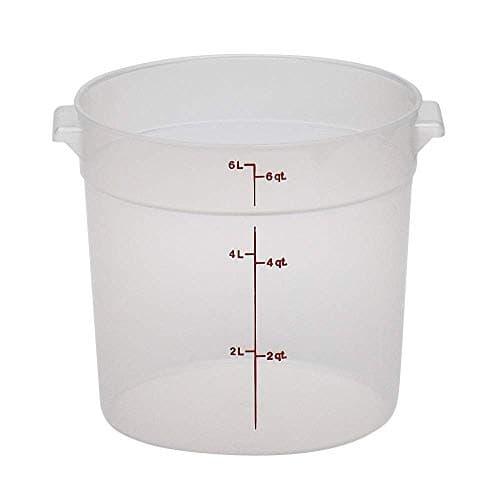 Cambro 6-Quart Round Container with Lid The restaurant-kitchen default, and the shape that makes bulk fermentation legible: straight round walls mean the dough climbs in a column you can actually measure against, rather than spreading. | Reading the rise | |
| 02 | 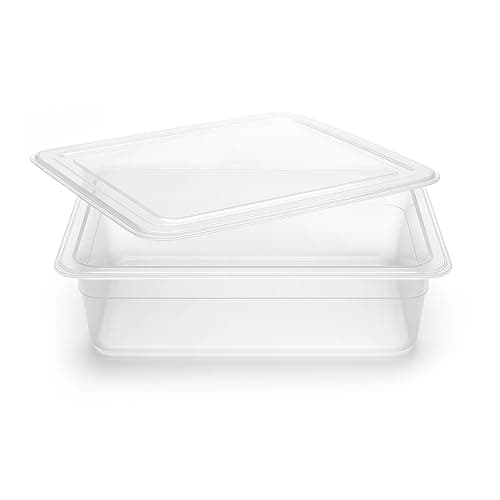 Brod & Taylor Proofing Container, 6 L Low and wide instead of tall and round, with volume markings molded in. | Stretch and folds, and fridge space | |
| 03 | 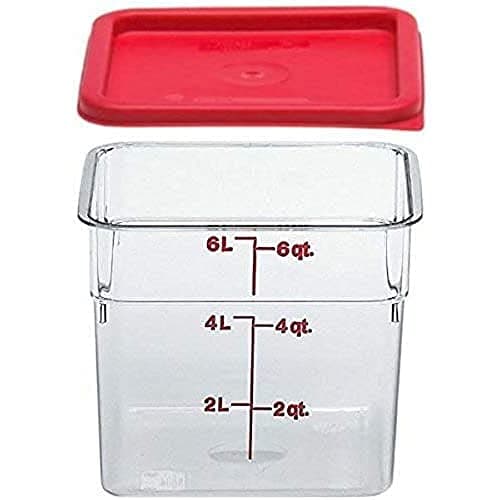 Cambro Camsquare 6-Quart Polycarbonate Container The clear polycarbonate version rather than the translucent polypropylene one. | Actually seeing the dough | $23.99 · View on Amazon
|
| 04 | 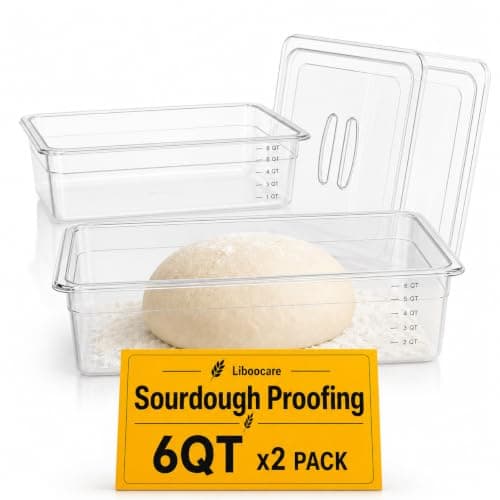 Liboocare Sourdough Proofing Containers, 6 qt, 2-Pack Two low-profile 6-quart boxes with volume markings, at roughly the price of one name-brand equivalent. | Two loaves at once | |
| 05 | 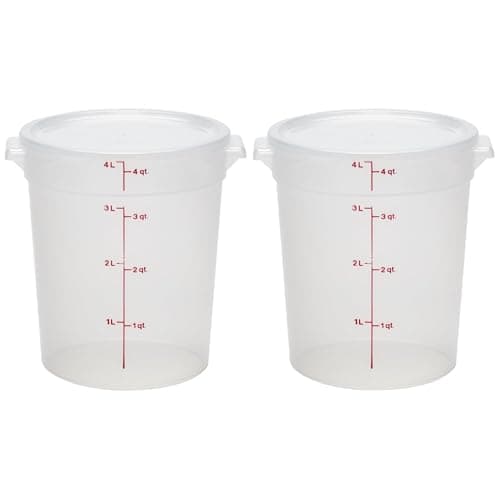 Cambro 4-Quart Round Containers with Lids, 2-Pack The 4-quart size, sold in pairs. | A single small loaf |
#ad · We earn a commission on Amazon purchases. Prices come from Amazon and change.
Bulk fermentation happens in whatever you put the dough in, and for most people that is the mixing bowl with a tea towel over it. That works. A dedicated container earns its place by answering one question the bowl cannot: how much has this actually risen?
A mixing bowl has sloping sides, so a 50 percent rise in volume looks like almost nothing near the bottom and a lot near the top. A straight-sided container turns volume into height, and height is something you can see, mark and compare between bakes. That is the entire argument, and it is a good one.
Tall and round, or low and wide
Every container here is one of two shapes, and they are optimized for opposite things.
| Tall and round | Low and wide | |
|---|---|---|
| Reading the rise | Excellent - volume becomes height | Poor - a big rise looks small |
| Stretch and folds | Awkward - reaching down a well | Easy - open access from above |
| Fridge storage | Takes a whole shelf height | Stacks flat |
| Dough shape going in | Gathers into a ball naturally | Spreads out |
| Cost | Lowest - it is a commercial part | Higher, usually |
Which one is right depends entirely on your method. If you do coil folds every thirty minutes during bulk, the low box is transformative and the tall bucket is a nuisance. If you mix, cover and wait, the tall bucket tells you exactly when to stop waiting and the low box does not.
How we judged these
- Shape, for the reasons above. Everything else is secondary to whether the container matches how you handle dough.
- Whether you can read the dough through it. Clear polycarbonate shows bubble structure against the wall. Translucent polypropylene shows you a vague shape. That difference matters more than it sounds.
- Volume markings. Printed graduations remove the guesswork and the tape. Not essential — a rubber band round the outside at the starting level does the same job free — but genuinely convenient.
- Capacity against a real loaf. A single 500 g loaf does not need six quarts. Six quarts is for double batches, and buying it for one loaf means watching dough fail to fill a bucket.
- What it costs against a bowl. The honest baseline is the bowl you own. A container has to earn its price and its cupboard space.
Why the cheap one is a restaurant part
The least expensive real proofing container here is a commercial kitchen food storage tub. That is not a compromise — it is the same product professional bakeries use, made in enormous volume, sold without a bread label and priced accordingly.
The trade is the material. The cheap ones are polypropylene: translucent, durable, cheap, and slightly cloudy. The clear ones are polycarbonate: properly transparent so you can read the crumb structure, but it scratches, and it clouds with age and dishwasher cycles. Polycarbonate also has a lower heat ceiling — one here is rated to 160°F, which rules out very hot water.
What size do you actually need?
Dough roughly doubles. A standard single loaf is around 800 to 900 g of total dough, which occupies something close to a liter before it rises and two after. Four quarts is comfortable for that with headroom to spare. Six quarts is a double batch, or a single batch with a lot of empty space above it.
Bakers consistently buy too big, because the six-quart size is the one every recommendation names. If you bake one loaf at a time, the four-quart is the honest size and the pair costs less than a single six.
The short version
Coil folds through bulk: buy low and wide, with volume markings. Mix and wait: buy tall, round, straight-sided, and buy the cheap commercial one. One loaf at a time: buy four quarts, not six. And before any of that, put a rubber band round the bowl you already own and see whether you use it.
Every pick, in order
The full write-ups
Pick 01 · Reading the rise
Cambro 6-Quart Round Container with Lid
Cambro
The restaurant-kitchen default, and the shape that makes bulk fermentation legible: straight round walls mean the dough climbs in a column you can actually measure against, rather than spreading. It costs less than most banneton liners.
Capacity
6 quarts
Shape
Round, straight-sided
Material
Polypropylene
Size
10 x 7 x 8 inches, lid included
Specs compiled from: Manufacturer product listing and product name
What is good
- Tall straight walls turn percentage rise into something you can see at a glance
- Commercial-kitchen part, so replacement lids and other sizes are easy to find
- Cheapest real proofing container here by a wide margin
What is not
- Translucent rather than clear, so reading the dough through it is less crisp than the polycarbonate version
- Tall and round is awkward for coil folds -- you are reaching down a well
- No volume markings printed on it; you gauge by eye or add tape
#ad Disclosure · Price as of October 17, 2026
Pick 02 · Stretch and folds, and fridge space
Brod & Taylor Proofing Container, 6 L
Brod & Taylor
Low and wide instead of tall and round, with volume markings molded in. The shape is the argument: a 4-inch-deep box lets you get a hand in for coil folds without fighting the walls, and two of them stack flat in a fridge where a bucket does not.
Capacity
6 L, up to 3000 g of dough per the manufacturer
Size
12.8 x 10.5 x 4 inches
Markings
Volume markings on translucent walls
Material
BPA-free polypropylene, dishwasher safe
Specs compiled from: Manufacturer product listing and product name
What is good
- Low profile makes stretch-and-folds and coil folds genuinely easier
- Printed volume markings remove the guesswork the Cambro leaves you
- Stacks flat in a fridge, with or without the lid
What is not
- Nearly twice the price of the Cambro for the same job
- Wide and shallow makes percentage rise harder to judge than a straight column
- Sized to nest in the maker's own folding proofer, which you may not own
#ad Disclosure · Price as of October 17, 2026
Pick 03 · Actually seeing the dough
Cambro Camsquare 6-Quart Polycarbonate Container
Cambro
The clear polycarbonate version rather than the translucent polypropylene one. You can read the crumb structure against the wall properly, which is the one thing the cheaper Cambro does not let you do. Square walls also waste less shelf space.
Capacity
6 quarts
Material
Polycarbonate, clear, NSF approved
Temperature
-40F to 160F, per the manufacturer
Size
8.75 x 8.75 x 7.25 inches, lid included
Specs compiled from: Manufacturer product listing and product name
What is good
- Genuinely clear, so bubble structure at the wall is readable
- Square footprint fits a fridge shelf better than a round bucket
- NSF-rated commercial part built for daily abuse
What is not
- Polycarbonate scratches and clouds over the years; polypropylene ages better
- 160F ceiling means no hot water and no dishwasher sanitizing cycle
- Costs what the Brod & Taylor does without the volume markings
Pick 04 · Two loaves at once
Liboocare Sourdough Proofing Containers, 6 qt, 2-Pack
Liboocare
Two low-profile 6-quart boxes with volume markings, at roughly the price of one name-brand equivalent. If you bulk two doughs in parallel, or want one in the fridge while another is on the counter, the second container is worth more than the brand on the first.
Capacity
6 qt each, 12 qt total
Size
12.8 x 10.4 x 3.9 inches each
Dough capacity
About 3000 g each, per the listing
Markings
Side volume markings; stackable
Specs compiled from: Manufacturer product listing and product name
What is good
- Two containers for less than most single branded boxes
- Same low, wide geometry that makes folds easy
- Stackable, which matters as soon as you own two
What is not
- Unbranded polypropylene with no track record on how the markings survive dishwashing
- Two boxes is more storage than most home kitchens want to give up
- Wide and shallow, so the same poor rise-reading as the other low-profile boxes
#ad Disclosure · Price as of October 17, 2026
Pick 05 · A single small loaf
Cambro 4-Quart Round Containers with Lids, 2-Pack
Cambro
The 4-quart size, sold in pairs. A single 500 g loaf does not need six quarts of headroom, and a smaller container makes a small dough look like it is doing something. This is the honest size for most home bakes.
Capacity
4 quarts each
Quantity
2 containers with lids
Material
BPA-free plastic
Size
8 x 8 x 9 inches
Specs compiled from: Manufacturer product listing and product name
What is good
- Right-sized for one standard loaf rather than a bakery batch
- Two for less than the price of one 6-quart branded box
- Same straight-walled shape that makes rise easy to judge
What is not
- Too small for a double batch, which is exactly when people want a big container
- Round and tall, so folds mean reaching into a well
- No volume markings
#ad Disclosure · Price as of October 17, 2026
How we picked
We have not tested any of this equipment. What we did instead: compiled the published specifications from each manufacturer’s own listing, checked them against the task a beginner is actually trying to do, read the care instructions, and named the thing we would skip. Where a pick is a product type rather than a brand, it is because the category is sold mostly unbranded and the type is the real decision.
Frequently asked
Questions
+Do I need a dough proofing container?
No — a bowl with a cover works. A straight-sided container earns its place by turning volume rise into visible height, which makes it much easier to judge when bulk fermentation is done. A rubber band round your existing bowl is the free version of the same idea.
+What size proofing container for one loaf?
Four quarts is comfortable for a standard single loaf of around 800 to 900 g of dough, with room for it to double. Six quarts is a double-batch size, and most people buy it and then watch their dough sit in the bottom of it.
+Round or rectangular proofing container?
Round and tall if you want to read the rise easily; low and rectangular if you do stretch-and-folds during bulk or need to stack in a fridge. It is a genuine trade-off, not one being better.
+Are Cambro containers good for sourdough?
Yes — they are the commercial food-storage tubs professional kitchens use, they are straight-sided, and they are the cheapest option here. The polypropylene versions are translucent rather than clear; the polycarbonate ones are properly clear but scratch and cloud over time.
+Should a proofing container be airtight?
It should be covered, not sealed tight. The job is holding humidity so the dough does not form a dry skin. Fermenting dough produces gas, so a lid that rests rather than clamps is the safer arrangement.
Read next