Hub 03 · Sourdough Baking Gear
Do you need a stand mixer for sourdough?
Sourdough is the one bread a mixer helps least with, and there is a measured reason why. If you want one regardless, only one of these is built for dough.
We earn a commission if you buy through our links, at no extra cost to you. We have not tested this equipment. Here is what we did instead.
Quick picks
Tap a row for the full write-up · Prices open on Amazon
| # | Product | Best for | Price |
|---|---|---|---|
| 01 | 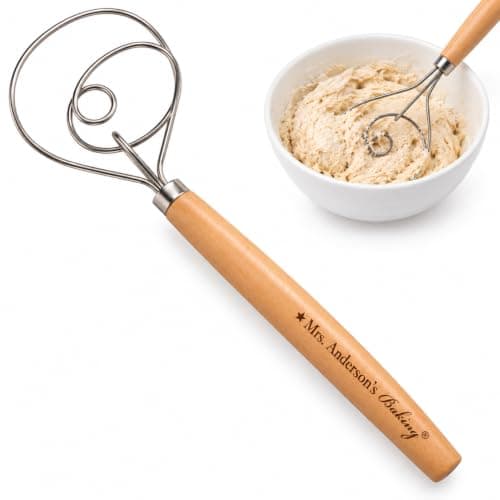 Mrs. Anderson's Baking Dough Whisk, Single-Loop, 12 Inch A single loop of 18/8 stainless on a sealed beechwood handle, which is the whole tool and the right version of it. | The one to buy if you buy one | |
| 02 | 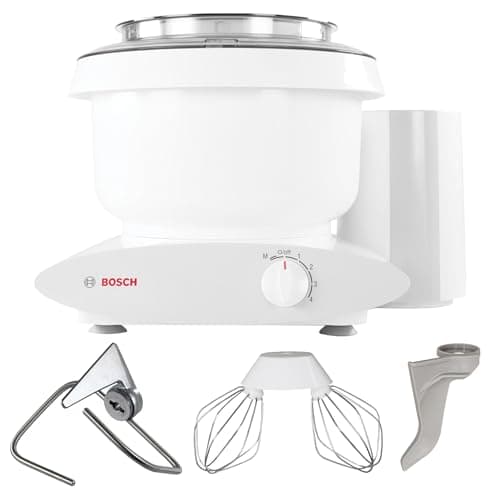 Bosch Universal Plus Stand Mixer The bread baker's choice, and the one machine here designed around dough rather than around cake batter. | Bread dough above all else | |
| 03 | 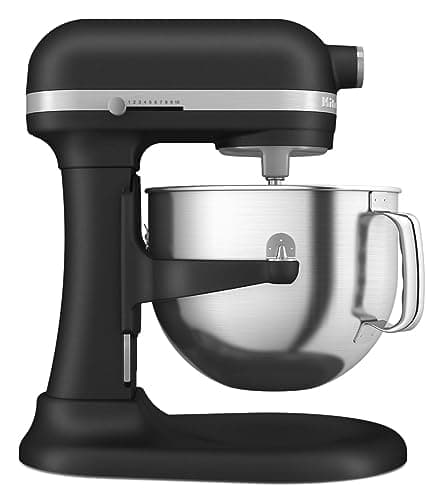 KitchenAid 7 Quart Bowl-Lift Stand Mixer (KSM70SKXX) The machine to buy if it has to do everything, not just bread. | One mixer for the whole kitchen | $599.00 · View on Amazon
|
| 04 | 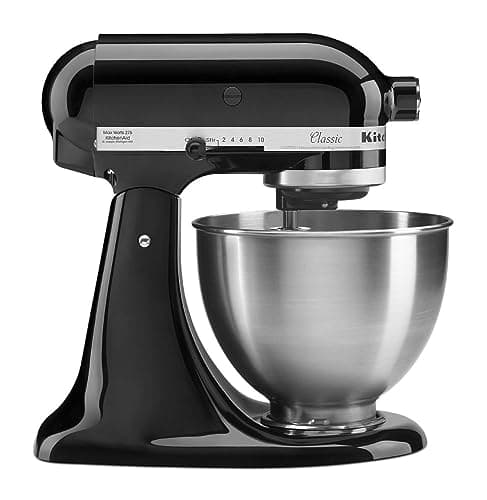 KitchenAid Classic Series 4.5 Quart Tilt-Head Stand Mixer (K45SS) Included because it is the mixer that is actually in most kitchens, and because the honest answer about it is a warning. | A mixer you already own | $322.99 · View on Amazon
|
#ad · We earn a commission on Amazon purchases. Prices come from Amazon and change.
No — and for sourdough specifically, a twelve-dollar Danish dough whisk is the better first purchase. Sourdough is built by time and folding rather than by kneading, so the machine is doing the least valuable part of the process. If you want a mixer anyway, and there are good reasons to, the Bosch Universal Plus is the one designed around dough; the KitchenAid 7-quart bowl-lift is the one to buy if it has to do everything else as well.
This is not a frugality argument. There is a measured, published reason a mixer is a mixed blessing for sourdough, and almost nobody selling you one mentions it.
The friction number
Mixing puts energy into dough and energy comes out as heat. Bakers call the rise in dough temperature during mixing the friction factor, and it is large enough that professional recipes subtract it from the water temperature before mixing.
King Arthur Baking measured both methods. Mixing and kneading by hand for eight minutes: a friction factor of 6 to 8F. The same dough in a 7-quart KitchenAid, on stir for three minutes then speed 2 for four minutes: 22 to 24F.
The target for wheat yeast breads, per the same source, is a dough temperature of 75 to 78F. So the machine is putting roughly 16F more heat into your dough than your hands would, and you have to plan for it — with colder water, or a colder flour, or by accepting that the bulk ferment will run faster and hotter than the recipe assumed. A warm dough ferments faster, and faster is not better: it is less flavor and less control.
None of that makes a mixer wrong. It makes it a variable you now have to manage, in a process whose entire difficulty is managing variables. That is the opposite of what people expect when they buy one to make sourdough easier. If you want to work with these numbers, our thermometer page covers measuring dough temperature, which is the prerequisite.
Using that number, with the arithmetic
The friction factor is not trivia; it is an input to a formula bakers use to hit a target dough temperature. King Arthur’s desired dough temperature calculation multiplies the target by the number of factors involved — three for a straight dough, four when a preferment is in the mix — then subtracts the room, the flour, the preferment and the friction factor to tell you what temperature your water should be.
Run it both ways for a 76F target in a 70F kitchen with 70F flour and a 70F starter, with a preferment so four factors apply:
- By hand (friction 7F): 76 x 4 = 304, minus 70 minus 70 minus 70 minus 7 = 87F water. Warm tap water.
- In the mixer (friction 23F): 304, minus 70 minus 70 minus 70 minus 23 = 71F water. Cool water.
A sixteen degree swing in what you pour, to land the same dough. That is the whole practical consequence, and it is why the mixer is a variable rather than a shortcut — and why, if you buy one, you need to be able to measure dough temperature. Our thermometer picks are the prerequisite, not an accessory.
Note also what King Arthur says about the figure itself: friction varies with the mixer, the speed, the duration and the quantity of dough in the bowl. Their 22 to 24F is a measurement of one machine on one schedule, not a constant. Yours will differ, and the only way to know is to measure.
Why sourdough specifically does not need one
Kneading develops gluten fast, by force. Sourdough develops it slowly, by time and hydration — the long autolyse and bulk fermentation do the structural work that kneading does in a yeasted sandwich loaf, and a handful of stretch-and-folds spread over a few hours finishes it.
That is why a sourdough recipe rarely says “knead for ten minutes.” There is very little kneading to mechanize. The machine genuinely saves labor on a stiff bagel dough, a brioche, or five loaves at once — and saves you almost nothing on a single 500g-flour boule that wants four folds and eight hours.
When a mixer genuinely earns its place
We are not against stand mixers; we are against buying one to solve a sourdough problem. There are four cases where the machine is clearly the right answer, and none of them is a single boule:
- Enriched doughs. Brioche, challah, cinnamon rolls, panettone — butter and egg doughs need long, hard mechanical mixing that is genuinely unpleasant by hand. This is the strongest case of the four.
- Volume. Four or five loaves at a time, or a weekly bake for a large household. Hand-mixing scales linearly and your arms do not.
- Stiff, low-hydration doughs. Bagels and some pasta doughs are genuinely hard work and benefit from torque rather than time.
- A physical limitation. Arthritis, a shoulder injury, limited grip strength. If hand-mixing is the barrier between you and bread, a machine is not an indulgence and the friction-heat arithmetic above is simply something to plan around.
What is missing from that list is “better sourdough.” A mixer will not produce a better single loaf than your hands and eight hours will.
What a mixer cannot do at all
Worth stating because the marketing implies otherwise. A stand mixer cannot shape a loaf, cannot judge a bulk ferment, cannot score a crust and cannot control a temperature. Those are four of the five things that decide whether a sourdough loaf is good. The fifth is dough development, and it is the only one a mixer touches — in a bread style that develops itself through time rather than through kneading.
So the machine is not competing with your hands for the important work. It is competing with a twelve-dollar whisk for the one job that is genuinely tedious, and adding heat while it does it. That is the entire case, and it is why this page opens with a whisk rather than with a machine.
How we picked
Criteria set before ranking, from the job:
- Does the geometry suit dough? A planetary head drives a tool around a stationary bowl; a bottom drive turns the bowl. Stiff dough behaves very differently in the two.
- Is the rated power actually different? It mostly is not, which turns out to be the most useful fact here.
- What does the manufacturer publish? Capacity and warranty claims that exist only on retailer pages are not specifications.
- Is there a cheaper tool that does the sourdough-specific job? For mixing a wet dough there is, and it is ranked first.
What replaces the kneading, concretely
It is easier to accept that you do not need a machine when you can see what does the work instead. Three things do, and none of them is effort:
Time. Flour and water left alone hydrate and begin forming gluten without any input at all — the autolyse. Twenty minutes to an hour of nothing does a measurable part of what a mixer would have done loudly.
Folds. Every forty-five minutes or so during the bulk ferment, wet one hand, lift one side of the dough, stretch it up and fold it over the middle, then turn the bowl a quarter and repeat. Four sets of four folds, about fifteen seconds each. That is roughly a minute of total work spread across several hours, and it builds the same alignment a mixer builds by force.
Fermentation itself. The gas the culture produces inflates and stretches the structure from the inside. A mixer cannot do this part at all, and it is a large share of what makes sourdough sourdough.
Which is the real reason this page answers no. The machine replaces the one component of dough development that sourdough needs least, charges several hundred dollars, and adds 16F of heat to a process whose difficulty is temperature control. A wide bowl and a wet hand are the actual tools.
The pick that is not a mixer
A Danish dough whisk is a loop of stiff wire on a handle. It mixes flour, water and starter into a shaggy mass in about thirty seconds without the paste-on-fingers problem of a spoon or a hand, and it is the tool that does the one genuinely tedious job in a sourdough recipe. It costs about a fortieth of a mixer, it adds no friction heat, and it goes in a drawer. That is why it is first here, and it has its own roundup.
If you are buying a mixer anyway
There are perfectly good reasons to. You bake more than sourdough; you have a shoulder injury; you make five loaves at a time; you want one machine for enriched doughs and meringue as well. In that case the decision is between two geometries, and one number makes it clearer than any review will.
The Bosch Universal Plus and the KitchenAid 7-quart are both rated at 500 watts. The difference between them is not power. It is that the Bosch drives from underneath so the bowl rotates and carries dough into the tool, while the KitchenAid orbits a tool around a fixed bowl. For stiff dough the first is the better mechanism; for a cake batter or a meringue the second is.
| Dough whisk | Bosch Universal Plus | KitchenAid 7 qt | |
|---|---|---|---|
| Rated power | n/a | 500 W, per Bosch | 500 W, per listings |
| Drive | Your arm | Bottom drive, bowl rotates | Planetary, bowl fixed |
| Speeds | One | 4 stages | 11, with Soft Start |
| Friction heat added | Negligible | Real; plan water temperature | 22-24F in King Arthur's test |
| Bowl | n/a | Plastic; 6.5 qt per retailer | 7 qt stainless |
| Published dough capacity | n/a | None from Bosch | None from KitchenAid |
| Good at cake batter | No | Adequate | Yes |
| Lives in a drawer | Yes | No | No |
The head-to-head between those two machines is worth its own page, and it is at Bosch Universal Plus vs KitchenAid.
What we would do
Buy the dough whisk. Bake twenty loaves with your hands and the folds. If at that point you want a mixer, you will know exactly which jobs you want it for — and if one of them is bread dough in volume, buy the Bosch and chill your water.
Every pick, in order
The full write-ups
Pick 01 · The one to buy if you buy one
Mrs. Anderson's Baking Dough Whisk, Single-Loop, 12 Inch
Mrs. Anderson's Baking
A single loop of 18/8 stainless on a sealed beechwood handle, which is the whole tool and the right version of it. The single loop is what you want for bread dough: it passes through a shaggy mass without packing full of it, and twelve inches is the length that suits an ordinary mixing bowl rather than a bucket.
Loop
Single loop
Length
12 inches; head 3.25 inches wide, per the listing
Wire
18/8 stainless steel
Handle
Sealed Eastern European beechwood; hand-wash only, per the manufacturer
Specs compiled from: Manufacturer product listing and product name
What is good
- Single loop is the right geometry for stiff bread dough, not just batter
- 18/8 is the same steel as 304 -- the grade worth having on something that lives wet
- Twelve inches clears a standard mixing bowl without the head fouling the side
What is not
- Hand-wash only, and dried dough in the loop is genuinely annoying to pick out
- Short for a deep bucket or a tall container of bulk dough
- The sealed handle is sealed wood, not sealed forever -- soaking it will eventually raise the grain
#ad Disclosure · Price as of October 17, 2026
Pick 02 · Bread dough above all else
Bosch Universal Plus Stand Mixer
Bosch
The bread baker's choice, and the one machine here designed around dough rather than around cake batter. The drive is underneath the bowl so the bowl itself turns, which is why it takes a stiff, high-hydration dough without the motor housing walking across the counter. Bosch's own product page publishes 500 W, four speed stages and the outside dimensions -- and nothing else. Bowl capacity, dough capacity, drive type and warranty are all absent from the manufacturer's specification.
Power
500 W, per Bosch
Speeds
4 switching stages, per Bosch
Dimensions
7 15/16 x 15 3/8 x 12 5/16 in (HxWxD), per Bosch
Bowl
Plastic, per Bosch; 6.5 qt per the retail listing
Warranty
Not published by Bosch on the product page
Specs compiled from: Manufacturer published specification sheet
What is good
- Bottom-drive geometry: the bowl rotates, so stiff dough is carried into the tool rather than climbing it
- The tallest practical dough capacity in a domestic machine at this price
- You can add flour or water mid-mix without stopping or tilting a head out of the way
- Light enough to lift into a cupboard, which a cast-metal bowl-lift mixer is not
What is not
- Bosch publishes no bowl capacity, no dough capacity, no warranty and no drive description on its own product page -- every number past 500 W comes from retailers
- A plastic bowl on a machine at this price, and it is the only bowl the base model comes with
- Four speed stages against eleven on the KitchenAid; it is a dough machine, not a general mixer
- The attachment ecosystem is far smaller and harder to buy than KitchenAid's
#ad Disclosure · Price as of October 17, 2026
Pick 03 · One mixer for the whole kitchen
KitchenAid 7 Quart Bowl-Lift Stand Mixer (KSM70SKXX)
KitchenAid
The machine to buy if it has to do everything, not just bread. Eleven speeds, all-metal gears, a bowl-lift frame and a 7-quart stainless bowl, at the same rated 500 watts as the Bosch -- which is the most useful fact on this page, because it means the difference between these two is geometry and not power. The planetary head is better at a cake and worse at a stiff dough than the Bosch, and the frame is heavy enough to stay put while it argues with one.
Power
500 W, per the listings
Bowl
7 qt stainless steel, bowl-lift
Speeds
11, with Soft Start
Gears
All metal
Included
Dough hook, flat beater, flex edge beater, wire whip, pouring shield
Specs compiled from: Manufacturer product listing and product name
What is good
- One machine for dough, batter, meringue and everything else -- the Bosch is narrower than this
- Bowl-lift frame and all-metal gears: the construction that survives repeated bread batches
- The largest attachment ecosystem of any mixer, and it is available everywhere
- Soft Start, which stops a dry flour cloud at the beginning of a mix
What is not
- Planetary action is the wrong geometry for a stiff dough -- the dough climbs the hook and the head rocks
- Heavy and tall; it lives on the counter permanently or it does not get used
- KitchenAid does not publish a flour or dough capacity figure; the 8.5 lb claim is a retailer's
- Still 500 W, so the price buys build and versatility, not more power than the Bosch
Pick 04 · A mixer you already own
KitchenAid Classic Series 4.5 Quart Tilt-Head Stand Mixer (K45SS)
KitchenAid
Included because it is the mixer that is actually in most kitchens, and because the honest answer about it is a warning. A 4.5-quart tilt-head Classic will mix a single sourdough loaf and it will not enjoy it: the head rocks, the dough climbs the hook, and the machine gets hot. It is a fine mixer for the cakes and cookies it was designed for. If you have one, use it for batter and mix your dough by hand -- do not buy a bigger mixer on its account before you have tried that.
Bowl
4.5 qt, tilt-head
Speeds
10
Construction
Metal body; 59 touch points, per KitchenAid
Power
Not published for this model by KitchenAid
Specs compiled from: Manufacturer product listing and product name
What is good
- The cheapest entry to the KitchenAid attachment ecosystem
- Entirely adequate for the cakes, cookies and batters most people bought it for
- Small enough to fit under a wall cabinet, which the 7-quart does not
- Metal construction rather than plastic at an entry price
What is not
- The wrong machine for sourdough: a tilt head and 4.5 quarts means one loaf, badly, with the head rocking
- KitchenAid publishes no wattage for this model, so you cannot compare it on power at all
- A tilt-head latch is the part that loosens first under dough load
- Buying this specifically for bread is the single commonest mixer mistake in this category
How we picked
We have not tested any of this equipment. What we did instead: compiled the published specifications from each manufacturer’s own listing, checked them against the task a beginner is actually trying to do, read the care instructions, and named the thing we would skip. Where a pick is a product type rather than a brand, it is because the category is sold mostly unbranded and the type is the real decision.
Frequently asked
Questions
+Can you make sourdough without a stand mixer?
+Does a stand mixer overheat sourdough dough?
+Is the Bosch or the KitchenAid better for bread?
+Will a 4.5-quart KitchenAid handle sourdough?
+What about a dough hook versus a spiral hook?
Sources
Where the facts on this page came from
Read next