Hub 03 · Sourdough Baking Gear
Best thermometer for sourdough
Two numbers decide a loaf: the temperature of the dough when you mix it, and the temperature of the crumb when you pull it. Everything else on a thermometer spec sheet is for cooking meat.
We earn a commission if you buy through our links, at no extra cost to you. We have not tested this equipment. Here is what we did instead.
Quick picks
Tap a row for the full write-up · Prices open on Amazon
| # | Product | Best for | Price |
|---|---|---|---|
| 01 | 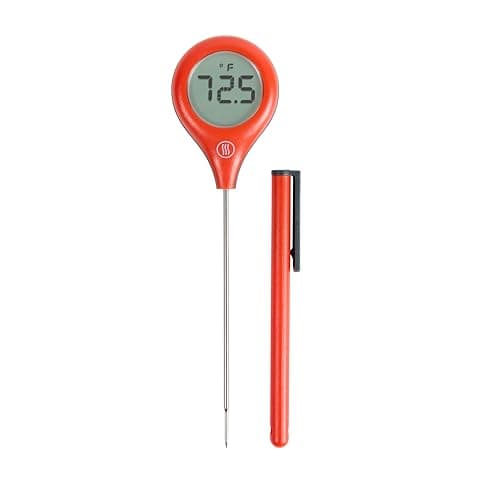 ThermoWorks ThermoPop 2 ThermoWorks accuracy and a NIST-traceable certificate for roughly a third of Thermapen money, which makes it the sensible answer for bread. | The one to buy | |
| 02 | 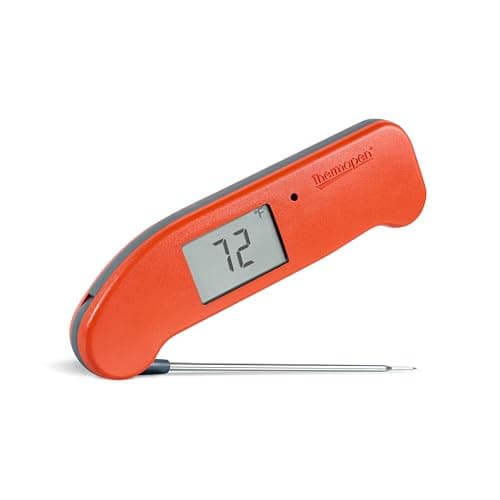 ThermoWorks Thermapen ONE A one-second reading, the tightest accuracy figure here, and a five-year warranty. | The fastest read | |
| 03 | 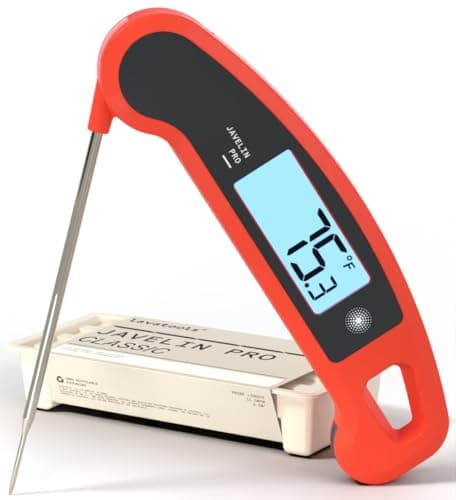 Lavatools Javelin PRO Classic The closest thing to a Thermapen that is not one: a 4.5 inch probe, a two-inch auto-rotating backlit display and a published accuracy figure that sits between the two ThermoWorks units. | Best alternative brand | |
| 04 | 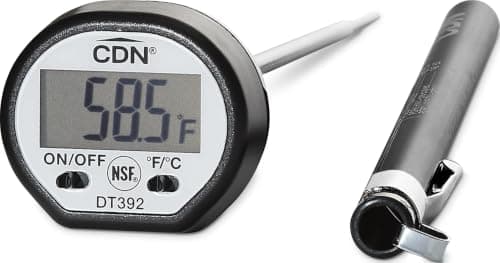 CDN DT392 ProAccurate Digital Thermometer A 4.68 inch stem with a 1.7mm tip for about the price of a bag of good flour. | Thin tip, lowest price | |
| 05 | 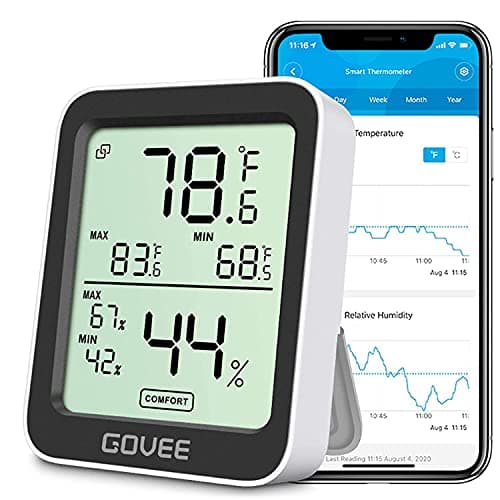 Govee Hygrometer Thermometer H5075 Not a probe, and that is the point. | Room temperature, logged |
#ad · We earn a commission on Amazon purchases. Prices come from Amazon and change.
A thermometer is the only tool in sourdough that answers a question you cannot answer by looking. The basket holds a shape you can see. The pot traps steam you can hear. A thermometer does arithmetic: it tells you how fast your dough is fermenting, and whether the middle of the loaf is cooked. Those are two separate numbers, taken at two separate moments, about a hundred and twenty degrees apart.
That matters for buying, because the specification you should care about is not the headline one. Almost every instant-read thermometer is sold on how fast it reads a steak and how high the scale goes. Bread needs neither. Bread needs a number you can trust at roughly 78F and again at roughly 200F, and a probe thin enough that getting the reading does not wreck the crumb.
The two temperatures are the whole brief
The first is dough temperature at the end of mixing. King Arthur puts the ideal range for wheat-based doughs at 75 to 78F and advises holding it from mixing right through bulk fermentation. This is the number that decides whether your four-hour bulk is four hours or seven, and it is the reason the same recipe behaves differently in July and January. It is also the reading where a two-degree instrument error genuinely compounds, because every later timing decision is built on it.
The second is internal temperature at the end of the bake, which tells you the starch has gelatinized and the crumb is set rather than gummy. This is the reading most people buy a thermometer for, and it is the one where the number everybody repeats is usually wrong.
What done actually is, because the internet rounds it up
The figure you will see everywhere is 205 to 210F. King Arthur’s own guidance is more specific and lower than that. Most loaves and rolls are done at 190F. A large, dense wholegrain round is fully baked at 190F too, although some bakers push it to 205 to 210F. Rye genuinely should go to 205 to 210F, because rye tends towards excessive moistness. Gluten-free yeast bread needs 205F to gelatinize its starches. Baguettes are judged on crust color instead of temperature. And at high altitude you reduce the target by about 5F.
So for an ordinary white or lightly wholemeal sourdough, the window is 190F to 205F, and where you land inside it is a texture preference rather than a safety line. That is a relief, because it means instrument error of a degree or two is not what stands between you and a good loaf. It also reorders the buying decision: the accuracy you are paying for matters most at the mixing bowl, not at the oven door.
Accuracy is a band, not a number
The specifications worth reading qualify accuracy by range, because no thermistor is equally good across six hundred degrees. ThermoWorks rates the ThermoPop 2 at plus or minus 1.0F from 14 to 208F, loosening to plus or minus 4.0F up at 392 to 572F. Look at where 208F sits: precisely at the top of the bread window. Thermapen ONE is tighter again at plus or minus 0.5F from -4 to 248F. Lavatools rates the Javelin PRO Classic at plus or minus 0.9F from -4 to 302F.
CDN quotes a single figure, plus or minus 1.7F, for its whole span. That is not automatically worse, but it is less information: one number across -50 to 392F is a different sort of claim from a tight number across a stated band. When two makers quote similar tolerances and only one says over what range, you are comparing a specification with an advertisement.
Probe thickness, the spec almost nobody publishes
CDN publishes a 1.7mm tip. Most manufacturers publish nothing at all about tip diameter, which is a shame, because it is the specification you will notice most often. It matters twice. It decides the size of the hole left in a crumb you were about to photograph, and it decides whether you can take the temperature of a shaped loaf or a jar of starter without leaving a crater in it.
If a listing does not name a tip diameter, treat that as unknown rather than as bad. It is the same situation as a steel grade that is not stated: the absence is information about the listing, not proof of a flaw in the tool.
Speed matters in exactly one situation
Reading speed is the headline number on every one of these boxes, and it is relevant to bread in one moment only: the few seconds the oven or the Dutch oven is open while you take the reading. One second instead of three is three seconds less heat loss, and if you are probing two or three spots it compounds.
For the reading that matters more, dough temperature in a bowl on the counter, speed is completely irrelevant. Nothing is cooling, nothing is escaping, and you can stand there for a minute. So be honest with yourself about what you are buying: a one-second read is a convenience you want because you also cook meat, not a requirement bread imposes on you.
The temperature a probe cannot give you
A probe samples. It does not record. Your dough spends four to twelve hours in a particular corner of a particular kitchen, and unless you are standing over it you are guessing at what that corner actually did overnight. This is the gap an ambient thermometer fills, and it is why the cheapest thing on this page is arguably the one that will change your bread most.
Twenty days of logged temperature and humidity, exported to a spreadsheet, turns a hunch about your proofing spot into a number. That is the same problem a proofing box solves by brute force and the same one people solve for free by finding a warm spot for a starter. Measure first; it is cheaper than buying a box you did not need.
The same number governs the starter
The ambient reading is not only a bread-day concern, because the jar on your counter is running the same thermodynamics every day of the week. King Arthur’s own figures for a temperature-controlled starter are worth reading as a set: around 72F doubles or triples the volume in about eight hours; 75F is the nudge a sluggish culture needs in cool months; 78F brings activity back up within eight to twelve hours; 65F keeps a starter happy and active on a single daily feed; and 45 to 50F deliberately slows it down far enough that you can leave it alone for a few days.
Every one of those numbers sits inside a thirteen-degree spread, and they produce completely different feeding schedules and completely different flavors. That is the argument for knowing your kitchen to the degree rather than as cool or warm. It is also, usually, the answer when a starter stops rising in November having behaved perfectly all summer, and it is what makes a sensible feeding and storing routine possible to plan instead of guess.
How to use one
- Take the dough temperature right after mixing. Push the probe into the middle of the mass, not against the side of the bowl. You are aiming for 75 to 78F. Write it down with the room temperature next to it.
- Work backwards next time. Desired dough temperature is simple arithmetic: multiply your target by three, or by four if you are using a pre-ferment, which a sourdough levain is. Then subtract room temperature, flour temperature, your friction factor and, with a pre-ferment, the levain temperature. What is left is the water temperature to use. King Arthur puts the friction factor at 22 to 24F for a stand mixer and 6 to 8F for eight minutes of hand mixing.
- Probe the bake at the center. Go in from underneath or through the side rather than straight down through the top, and the hole will not be the first thing you see on the finished loaf.
- Stop at the right number for your bread. 190F for an ordinary loaf, 205 to 210F for rye or a very dense wholegrain, about 5F lower if you bake at altitude.
- Check the instrument in ice water. A glass packed with crushed ice and topped with water sits at 32F. If the thermometer does not read 32F there, you now know its real offset, which is worth more than the number on the box. Some units let you recalibrate; the rest you simply correct in your head.
What it will not do
It will not tell you when bulk fermentation is finished. That is a judgment about volume, doming and the way the dough moves when you tilt the container, and no number substitutes for it — dough temperature tells you how fast you are traveling, not whether you have arrived. It will not rescue an underproofed loaf; a loaf can hit 205F in the middle and still be dense, because doneness and fermentation are different problems. It will not read your oven air temperature usefully, because an instant-read probe in hot air measures the probe, not the oven; that job needs an oven thermometer. And it will not make a sluggish starter rise, although it will tell you the real reason it is sluggish, which is almost always that the kitchen is colder than you think.
Buying advice, short version
Buy the ThermoPop 2. Its tight accuracy band covers both bread temperatures exactly, it ships with a traceable calibration certificate, and it costs roughly a third of a Thermapen. Buy the Thermapen ONE instead only if you also cook meat often enough to want the one-second read, because no loaf requires it. Buy the Javelin PRO Classic if you want the biggest display on the page and a magnet that keeps it on the oven door. Buy the CDN if money is tight or the thinnest tip is what you care about. And whichever probe you choose, consider spending ten dollars more on an ambient logger, because the number you are most wrong about is not the temperature of your loaf — it is the temperature of the room it rose in.
Every pick, in order
The full write-ups
Pick 01 · The one to buy
ThermoWorks ThermoPop 2
ThermoWorks
ThermoWorks accuracy and a NIST-traceable certificate for roughly a third of Thermapen money, which makes it the sensible answer for bread. A loaf is not a steak: you are reading a 78F dough and a 207F crumb, both of them comfortably inside the band this thing is specified tightest over, so the extra speed you are not paying for costs you nothing.
Accuracy
+/-1.0F from 14 to 208F, per the published spec
Range
-58 to 572F
Speed
Full reading in 2-3 seconds, 4.5 inch probe
Sealing
IP67
Battery
One CR2032, about 4,000 hours
Specs compiled from: Manufacturer published specification sheet
What is good
- The tight accuracy band covers dough temperature and crumb temperature exactly
- Ships with a NIST-traceable calibration certificate, which almost nothing at this price does
- Auto-rotating backlit display, so it reads right-side up whichever hand you hold it in
What is not
- Two to three seconds feels slow next to a Thermapen once you have used one
- The accuracy loosens to +/-4F at the top of the range, which matters for frying and not for bread
- A coin cell is a thing you have to keep in a drawer, unlike a AAA
#ad Disclosure · Price as of October 17, 2026
Pick 02 · The fastest read
ThermoWorks Thermapen ONE
ThermoWorks
A one-second reading, the tightest accuracy figure here, and a five-year warranty. It is the reference instrument and it is priced like one. For bread alone it is more thermometer than the job needs, which is an honest thing to say about a tool this good: buy it because you also cook meat, not because your loaf requires it.
Accuracy
+/-0.5F from -4 to 248F, per the published spec
Range
-58 to 572F
Speed
One second
Sealing
IP67
Battery
One AAA, about 2,000 hours without backlight
Specs compiled from: Manufacturer published specification sheet
What is good
- One second is quick enough that you can probe three spots in a loaf without losing oven heat
- Tightest published accuracy of anything on this page, across the whole band bread lives in
- Five-year warranty and a NIST-traceable certificate
What is not
- Costs more than a banneton, a lame and a scale put together
- Nothing about a one-second read rather than a three-second read changes a loaf
- The folding probe is a moving part, and moving parts are the thing that eventually fails
#ad Disclosure · Price as of October 17, 2026
Pick 03 · Best alternative brand
Lavatools Javelin PRO Classic
Lavatools
The closest thing to a Thermapen that is not one: a 4.5 inch probe, a two-inch auto-rotating backlit display and a published accuracy figure that sits between the two ThermoWorks units. The display is the largest here by some margin, which is the reason to pick it if you are reading a number at arm's length over a hot oven.
Accuracy
+/-0.9F from -4 to 302F, per the manufacturer
Range
-40 to 482F
Speed
Typically 2-3 seconds
Display
2 inch antifog backlit, auto-rotating
Sealing
IP65 splash resistant; NSF certified
Specs compiled from: Manufacturer published specification sheet
What is good
- Biggest display on this page, and it rotates to whichever way up you are holding it
- Published accuracy covers the whole dough-to-crumb band with room to spare
- Magnet in the body, so it lives on the side of the oven rather than in a drawer
What is not
- IP65 is splash resistant, not immersible -- do not put it under a running tap
- Three-year warranty against ThermoWorks' five
- No calibration certificate, so the accuracy claim is the manufacturer's word
#ad Disclosure · Price as of October 17, 2026
Pick 04 · Thin tip, lowest price
CDN DT392 ProAccurate Digital Thermometer
CDN
A 4.68 inch stem with a 1.7mm tip for about the price of a bag of good flour. The thin tip is the real argument for it: it leaves a far smaller hole in a crumb you are about to photograph, and the stem still reaches the middle of a tall boule. Note that several retailers list this model as a 5 inch stem with a 3mm tip and an accuracy of +/-2F; CDN's own product page says 4.68 inches, 1.7mm and +/-1.7F, and we have used CDN's figures.
Accuracy
+/-1.7F (1C), per CDN
Range
-50 to 392F
Probe
4.68 inch stem, 1.7mm thin tip
Body
Food-safe ABS with BioCote; NSF certified
Power
One LR44 button cell; five-year warranty
Specs compiled from: Manufacturer published specification sheet
What is good
- A 1.7mm tip is the thinnest here, so it leaves the smallest hole in a crumb or a starter
- Accuracy of +/-1.7F is far better than the price suggests, and better than retailers claim
- NSF certified, BioCote body and a five-year warranty at the lowest price on the page
What is not
- CDN publishes no response time for this model, so the one thing you cannot look up is how long you stand with the oven open
- The accuracy figure is a single number for the whole span, not tightened over a stated band like the ThermoWorks and Lavatools specs
- Not described as waterproof, unlike CDN's own DT450X
#ad Disclosure · Price as of October 17, 2026
Pick 05 · Room temperature, logged
Govee Hygrometer Thermometer H5075
Govee
Not a probe, and that is the point. This answers the question a probe cannot: what temperature is the corner of the kitchen where the dough is actually sitting, all night, while you are asleep. It logs twenty days and exports to CSV, which turns a guess about your proofing spot into a number you can read in the morning.
Accuracy
+/-0.5F temperature, +/-3% RH humidity, per the manufacturer
Sensor
Swiss-made sensor, per the manufacturer
Refresh
2 seconds
Logging
20 days on device; CSV export via the app
Power
Two AAA, about 6 months
Specs compiled from: Manufacturer published specification sheet
What is good
- Records overnight, so you learn what your bulk ferment actually sat at rather than guessing
- Humidity reading as well, which is the other half of why a starter behaves differently in winter
- Cheapest item on this page by a wide margin
What is not
- Measures air, not dough -- it is a companion to a probe, never a replacement
- Bluetooth only, so the logging needs a phone in range rather than wifi
- The app account is an app account, with everything that implies
#ad Disclosure · Price as of October 17, 2026
How we picked
We have not tested any of this equipment. What we did instead: compiled the published specifications from each manufacturer’s own listing, checked them against the task a beginner is actually trying to do, read the care instructions, and named the thing we would skip. Where a pick is a product type rather than a brand, it is because the category is sold mostly unbranded and the type is the real decision.
Frequently asked
Questions
+What temperature should sourdough be when it is done?
For an ordinary wheat sourdough, 190F at the center is baked, which is lower than the 205 to 210F figure usually repeated online. King Arthur reserves 205 to 210F for rye and for very dense wholegrain loaves, and notes that gluten-free yeast bread needs 205F to gelatinize its starches. Baguettes are judged on crust color rather than temperature. Reduce the target by about 5F if you bake at altitude.
+Do I really need a thermometer for sourdough?
No. People baked sourdough for thousands of years without one, and you can judge a finished loaf by color, weight and the sound it makes. What a thermometer buys you is the removal of two guesses: whether the crumb is set, and how fast your dough is actually fermenting. The second is the valuable one, and it is the one almost nobody buys a thermometer for.
+What temperature should sourdough dough be during bulk fermentation?
King Arthur puts the ideal range for wheat-based doughs at 75 to 78F from mixing through bulk fermentation. Warmer ferments faster and sours differently; colder simply takes longer. The practical value is not hitting 78F exactly but knowing what number you are at, so that a bulk that took seven hours instead of four stops being a mystery.
+What is desired dough temperature, and how do you calculate it?
It is the arithmetic for choosing your water temperature. Multiply your target dough temperature by three, or by four when you use a pre-ferment such as a sourdough levain. Subtract room temperature, flour temperature, the friction factor and, with a pre-ferment, the levain temperature. The remainder is your water temperature. King Arthur gives the friction factor as 22 to 24F for a stand mixer and 6 to 8F for eight minutes of hand mixing.
+Can I use a meat thermometer for bread?
Yes, and that is what every probe on this page is sold as. There is no separate category of bread thermometer; there is only whether the instrument is accurate across the range bread occupies, which is roughly 70F to 210F. Any instant-read probe specified tightly over that band will do the job, which is why the honest advice is to read the accuracy band rather than the marketing.
+Where should you insert the thermometer in a loaf?
At the center, going in from underneath or through the side rather than straight down through the crust, so the hole is not the first thing anyone sees. Avoid the very bottom, which sits against hot cast iron and reads high, and take a second reading a little away from the first if the number surprises you.
+How do you check whether a kitchen thermometer is accurate?
Pack a glass with crushed ice, top it with cold water, stir, and wait a moment. That slurry sits at 32F. Whatever your thermometer reads there is its offset, and knowing the offset is worth more than the tolerance printed on the box. Some models can be recalibrated to correct it; with the rest you just do the subtraction yourself.
+Will a thermometer tell me when bulk fermentation is done?
No, and this is the most common misunderstanding about buying one. Dough temperature tells you how fast fermentation is proceeding, not how far it has got. Whether bulk is finished is a judgment about how much the dough has grown, whether the surface has domed and how it behaves when you tilt the tub. A thermometer makes that judgment predictable from day to day; it does not replace it.
Sources
Where the facts on this page came from
- King Arthur Baking — using a thermometer with yeast bread (doneness temperatures by bread type)
- King Arthur Baking — desired dough temperature (75-78F range and the DDT formula)
- King Arthur Baking — temperature is the missing ingredient for a starter (72F, 75F, 78F, 65F, 45-50F behavior)
- ThermoWorks ThermoPop 2 published specification (accuracy band, range, IP67, battery)
- Lavatools — Javelin PRO Classic specifications (accuracy, probe, IP65, warranty)
- CDN — DT392 ProAccurate product page (accuracy, 4.68in stem, 1.7mm tip)
- Govee — H5075 hygrometer thermometer specifications (accuracy, logging, CSV export)
Read next