Hub 03 · Sourdough Baking Gear
Best oven thermometer for bread
The number on the front of your oven is a thermostat setting, not a measurement of where your loaf is sitting. These are the five ways to find out the truth, and what each one cannot tell you.
We earn a commission if you buy through our links, at no extra cost to you. We have not tested this equipment. Here is what we did instead.
Quick picks
Tap a row for the full write-up · Prices open on Amazon
| # | Product | Best for | Price |
|---|---|---|---|
| 01 | 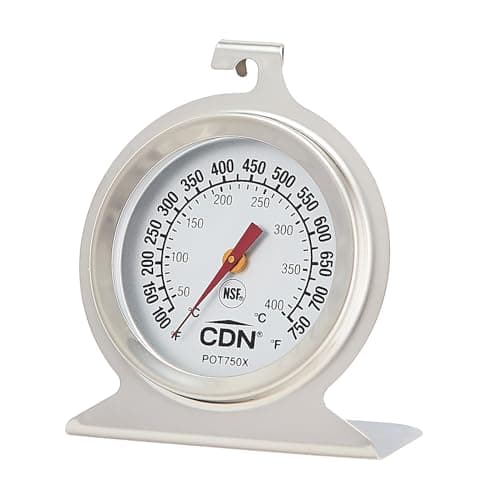 CDN POT750X High Heat Oven Thermometer The only dial here that is not nearly maxed out by a bread bake. | Highest range, for bread | |
| 02 | 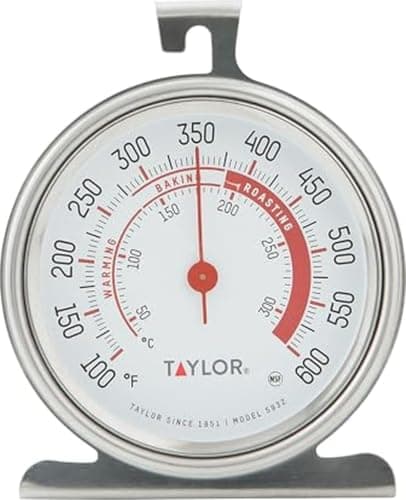 Taylor Analog Oven Thermometer, 3 Inch Dial Ten dollars, a three-inch face and NSF listing. | Cheapest big dial | $7.99 · View on Amazon
|
| 03 | 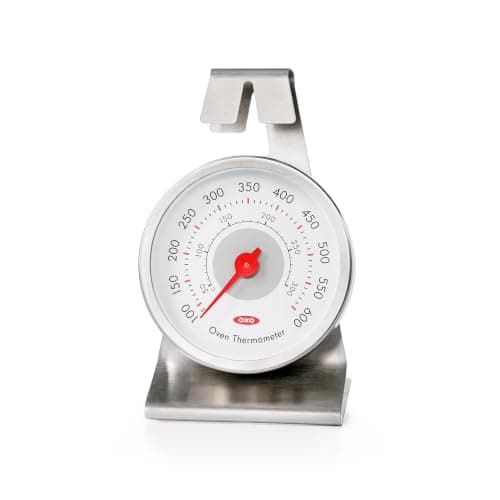 OXO Good Grips Oven Thermometer Twice the price of the Taylor and the money goes somewhere specific: the mounting. | Stays on the rack | |
| 04 | 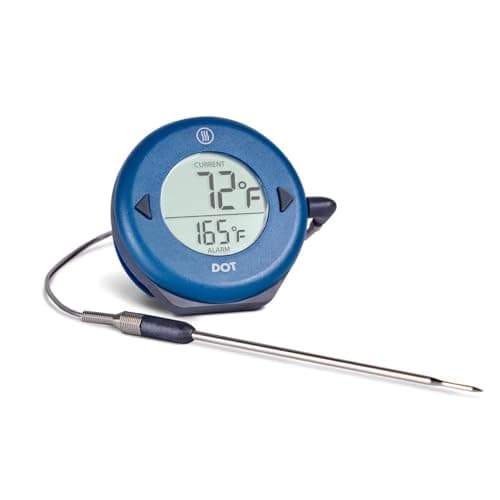 ThermoWorks DOT Alarm Thermometer The only option here that answers the real complaint about oven thermometers: you have to open the oven to read one. | Reading without opening | |
| 05 | 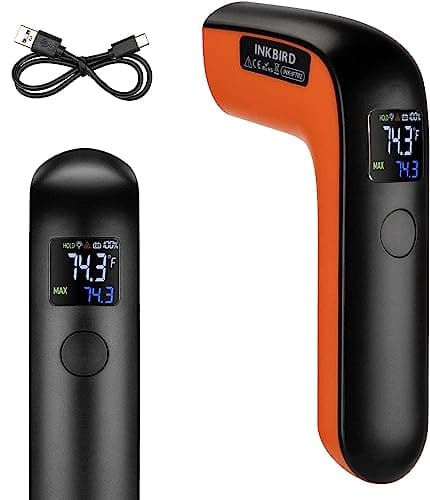 Inkbird INK-IFT02 Rechargeable Infrared Thermometer Not an oven thermometer at all, and that is why it is here. | Stone surface, not air | $24.69 · View on Amazon
|
#ad · We earn a commission on Amazon purchases. Prices come from Amazon and change.
The number on the front of your oven is not a measurement. It is the temperature you asked for, and the little light or the beep tells you the thermostat near the element has reached it — not that the air where your loaf will sit has. King Arthur put the gap plainly: their oven announces it is ready after fifteen minutes and takes a good thirty to actually reach 350F.
For most cooking that gap is survivable. For bread it is the difference between oven spring and a pale, dense loaf, because the first ten minutes decide how much the dough expands before the crust sets. So this page is about the four things an independent thermometer can tell you that your oven will not: what the air temperature actually is, when the oven has genuinely finished preheating, where its hot spots are, and — separately, and this is the one people miss — whether the stone or steel you are baking on is hot yet.
Range is the first specification, and most of them are too low
Sourdough preheats hot. A covered bake typically starts somewhere between 450 and 500F, and if you ever chase pizza heat you are higher again. Now look at what these units actually cover: the Taylor and the OXO both stop at 600F, and the ThermoWorks probe stops at 572F.
A 600F ceiling is not a failure — it covers a bread bake. But it puts a 500F reading near the top of the scale, where dial markings crowd together and where you have no headroom at all for a hotter preheat. The CDN reads to 750F, which is the reason it is first on this page: a bread bake sits in the middle of its scale rather than at the end of it. If you only ever bake at 450F, any of these will do. If you are the sort of person who wants to try a 550F stone, the range is the whole decision.
Nobody except ThermoWorks publishes an accuracy figure
This is the uncomfortable part of the category. You are buying a thermometer to find out how wrong your oven is, and four of these five makers do not publish how wrong the thermometer might be. CDN gives the range and no tolerance. Taylor and OXO the same. You are trusting a dial to audit a dial.
ThermoWorks is the exception and the figures are instructive: the DOT is rated to plus or minus 1.8F from -4 to 248F, then plus or minus 3.6F to 392F, then plus or minus 5.4F from 392 to 572F. That loosest band is exactly where a bread bake lives. The most transparent maker here is telling you that even good electronics get vaguer at bread temperatures — which is worth knowing before you treat any reading as gospel, and a good reason to care more about consistency than about the absolute number.
Dial inside, or display outside
A dial thermometer has one real flaw and it is not accuracy: you have to read it. Through a glass door with the oven light on, past whatever is in the way, often crouched down. The practical consequence is that people buy one, use it twice and then leave it in the oven unread for a year. That is why the dial size and the mounting matter more than they sound like they should — a three-inch face you can read from standing beats a two-inch face you cannot, and a clip that actually grips the rack beats one that drops the thermometer onto your loaf.
The alternative is a probe on a cable with the display outside, which is what the ThermoWorks DOT is. You get to watch the temperature climb without opening the door, which also means you stop doing the thing that makes the problem worse: every time you open the oven to check, you dump the heat you were measuring. The cost is four times the money, a cable routed past the door seal, and that loosest accuracy band landing on bread temperatures.
Your oven is not one temperature, and a stone only half fixes it
A single reading tells you less than you think, because an oven is not uniform. King Arthur describe ovens as hottest around the periphery — the sides, the bottom and the top — with the air getting hotter the closer you are to the metal walls. Which spot you hang the thermometer in is therefore part of the measurement, and the honest answer is to hang it where the loaf goes rather than wherever is convenient.
You can map the hot spots for nothing. King Arthur’s method is a tray of bread slices across the rack, baked until the middle ones are light golden, then read like a contact sheet: wherever the toast is darkest is where your oven runs hot. That costs a loaf of sliced bread and tells you more about your particular oven than any thermometer will.
A baking stone is the usual suggested fix, and King Arthur’s own testing is refreshingly unexcited about it: a stone made a difference 66 percent of the time, reduced the intensity of hot spots rather than removing them, and worked best when preheated for a full sixty minutes rather than just through the oven’s own preheat. That sixty-minute figure is the most useful number on this page, and it leads directly to the thing a dial cannot measure. If you are weighing the surface itself, we compare the two materials in baking steel vs baking stone.
The air is not what browns the bottom of your loaf
This is the point the whole category tends to miss. The air in your oven reaches temperature relatively quickly. A thick ceramic stone or a slab of steel does not — it keeps absorbing heat long after the air has arrived, which is why that sixty-minute preheat exists and why a loaf landing on an under-heated stone comes out with a pale, soft bottom. An oven thermometer hanging in the air will tell you none of that. It is the same physics that governs a cast-iron Dutch oven, where the metal is the thing that has to be hot.
An infrared gun reads a surface instead, in about half a second, from roughly a foot away. It is the right tool for the question and it comes with one hard limitation worth understanding before you buy: emissivity. Infrared thermometers assume how reflective the target is, and the Inkbird’s assumption is fixed at 0.95, which is about right for ceramic and fired clay. Inkbird’s own manual states that non-ferrous metals, reflective objects and transparent objects read inaccurately — and a clean baking steel is a shiny metal surface. So an IR gun is excellent for a stone, unreliable on a bare steel, and no use at all for air.
The loading moment is the one you cannot measure
There is a reading no thermometer on this page will give you, and it is the one that matters most: the temperature at the instant the loaf goes in. Opening the door dumps the hot air almost immediately — air has very little heat capacity, which is exactly why it comes back up quickly too. What does not drop, and what re-radiates into the dough while the air recovers, is everything solid in there: the walls, the racks, the stone, the cast iron.
This reframes what you are actually shopping for. A dial reading of 500F taken before you open the door tells you the air was ready. It tells you nothing about whether the mass in the oven is carrying enough stored heat to get through the loading moment, which is the entire reason bakers obsess over preheating a vessel or a slab rather than an oven.
King Arthur’s stone testing is consistent with that: with a stone in place and preheated a full hour, bottoms browned less aggressively and front-to-back variation decreased, and their practical advice is to leave the stone in the oven as a permanent fixture and to group bakes together so the long preheat is worth doing. Thermal mass, in other words, is the fix for most of what an oven thermometer will reveal to you — the thermometer just tells you whether it is working.
What to do with the reading once you have it
- Hang it where the loaf goes, not at the back or against a wall. You are measuring your baking position, not the oven in general.
- Ignore the preheat beep and time it instead. Watch how long the oven actually takes to reach the set temperature, once, and then use that time forever. If it says fifteen minutes and takes thirty, your preheat is thirty.
- Write down the offset, do not chase it. If the oven reads 50F high at 450F, set it to 400F and move on. Consistency is worth more than accuracy here: a known-wrong oven you can work with beats an unknown one.
- Preheat the stone far longer than the oven. A full hour, per King Arthur’s testing, if you bake on a stone or a steel.
- Map the hot spots once with the toast test, then rotate your loaf or shift your rack position to suit what you found.
What an oven thermometer will not do
It will not tell you whether your bread is baked — that is the internal temperature of the crumb, which needs a probe, and the figures are on our instant-read thermometer page. It will not make your oven even; it only tells you where the unevenness is. It will not respond instantly, because a bimetallic dial lags behind the air it is sitting in and shows you where the temperature was a moment ago. And it will not survive being treated as a fit-and-forget device: dials drift, none of these can be recalibrated, and a cheap one is worth replacing every couple of years rather than trusting indefinitely.
Buying advice, short version
Buy the CDN. It reads to 750F so a bread bake sits mid-scale, it has a glass lens instead of plastic, and it costs about the same as the ones that stop at 600F. Buy the Taylor instead if you want the largest dial for the least money and you will never go above 500F. Buy the OXO if cheap thermometers keep falling off your rack, because that is specifically what the extra money buys. Buy the ThermoWorks DOT if the thing that actually stops you checking is having to open the door, and accept the looser accuracy band at bread temperatures. And add the infrared gun to any of them if you bake on a stone — not instead of them, and not if you bake on a bare steel, where its fixed emissivity will lie to you.
Every pick, in order
The full write-ups
Pick 01 · Highest range, for bread
CDN POT750X High Heat Oven Thermometer
CDN
The only dial here that is not nearly maxed out by a bread bake. Most oven thermometers stop at 600F, which is uncomfortably close to the 450 to 500F a sourdough loaf preheats to and past it entirely if you chase pizza heat. This one reads to 750F, has a laboratory glass lens rather than plastic, and carries a five-year warranty at under fifteen dollars.
Range
100 to 750F (50 to 400C)
Dial
2 in; laboratory glass lens
Housing
304 stainless steel
Mounting
Two-way: stand or hang
Certification
NSF certified; five-year warranty
Specs compiled from: Manufacturer published specification sheet
What is good
- 750F ceiling means a 500F bread preheat sits mid-scale instead of at the end of the dial
- A glass lens will not haze or craze the way a plastic window does over a year of 500F bakes
- NSF certified with a five-year warranty, which is unusual at this price
What is not
- CDN publishes no accuracy tolerance for it, so you know the range and not the error
- A 2 inch dial is small to read through a closed oven door, which is when you most want to read it
- A wider range on the same size dial means the degree markings are closer together
- Like every dial here, it lags: it shows where the air was a moment ago, not where it is
#ad Disclosure · Price as of October 17, 2026
Pick 02 · Cheapest big dial
Taylor Analog Oven Thermometer, 3 Inch Dial
Taylor
Ten dollars, a three-inch face and NSF listing. The large dial is the entire argument: the single most common reason people stop using an oven thermometer is that they cannot read it through the glass without opening the door, and a three-inch face is the cheapest fix for that. Range stops at 600F, which covers bread and not much beyond it.
Range
100 to 600F, per the product listing
Dial
3 in
Body
Stainless steel
Mounting
Hanging or standing
Certification
NSF listed
Specs compiled from: Manufacturer published specification sheet
What is good
- The biggest dial on this page for the lowest price, which is what actually gets it read
- Hangs from a rack or stands on it, so it works in any oven layout
- Cheap enough to own two and check one against the other, which is a real way to catch a bad unit
What is not
- 600F ceiling: fine for bread, not for a 550F pizza preheat with headroom
- No published accuracy tolerance, so the number on the dial is a claim with no stated error
- Plastic lens rather than glass, which hazes with repeated high-heat cycles
- Bimetallic dials drift over time and there is no way to recalibrate this one
Pick 03 · Stays on the rack
OXO Good Grips Oven Thermometer
OXO
Twice the price of the Taylor and the money goes somewhere specific: the mounting. An integrated hanging clip and a wide angled base are designed to hold on thick or thin rack wires and to stand without tipping, which addresses the genuinely irritating failure mode of cheap oven thermometers -- the thing falls off the rack and lands on your loaf.
Range
100 to 600F (about 50 to 300C)
Mounting
Integrated hanging clip and angled base; hangs or stands
Display
Large numbers, Fahrenheit and Celsius
Care
Hand wash; do not submerge
Specs compiled from: Manufacturer published specification sheet
What is good
- The mounting is the point, and it is the thing that fails on cheap units
- Large dual-scale numbers, so it is readable at a glance through the door
- Stands or hangs, so it suits an oven where the racks are already crowded
What is not
- Twice the Taylor's price for the same 600F ceiling and a similar size face
- OXO publishes no accuracy tolerance either, so you are paying for build, not proven precision
- Hand wash only, and a thermometer that lives at 500F does get greasy
- Still a dial inside the oven, so reading it still means squinting through glass
#ad Disclosure · Price as of October 17, 2026
Pick 04 · Reading without opening
ThermoWorks DOT Alarm Thermometer
ThermoWorks
The only option here that answers the real complaint about oven thermometers: you have to open the oven to read one. The DOT puts a probe inside on a 47-inch cable rated to 700F and the display outside, so you can watch the temperature without losing heat. Read the accuracy bands before you buy, though, because they loosen exactly where bread lives.
Range
-58 to 572F (-50 to 300C)
Accuracy
+/-1.8F from -4 to 248F; +/-3.6F from 248 to 392F; +/-5.4F from 392 to 572F
Probe
4.5 in, 0.13 in dia tapering to 0.08 in; max 572F
Cable
47 in, rated to 700F
Power
2 x AAA, about 5,000 hours; 70 dB alarm
Specs compiled from: Manufacturer published specification sheet
What is good
- Display stays outside the oven, so you read the temperature without opening the door and dropping it
- The only unit on this page with published accuracy figures at all, by range
- An alarm means you can leave it to tell you when the oven has genuinely arrived
What is not
- Accuracy loosens to +/-5.4F between 392 and 572F, which is precisely the band a bread bake occupies
- The probe tops out at 572F, so a 550F pizza preheat is almost at its ceiling and above it you are out of range
- Four times the price of a good dial, and it is an alarm thermometer adapted to this job rather than built for it
- The cable has to come out past the door seal, which is fine but is one more thing to route
#ad Disclosure · Price as of October 17, 2026
Pick 05 · Stone surface, not air
Inkbird INK-IFT02 Rechargeable Infrared Thermometer
Inkbird
Not an oven thermometer at all, and that is why it is here. The air temperature is not what browns the bottom of your loaf -- the surface of the stone or steel is, and it reaches temperature far later than the air does. This reads a surface in half a second from about fourteen inches away. One hard limitation: its emissivity is fixed, so it reads ceramic honestly and shiny metal badly.
Range
-58 to 1022F (-50 to 550C)
Accuracy
+/-2% above 100C; +/-2C below 100C
Emissivity
Fixed at 0.95, NOT adjustable
Optics
12:1 distance-to-spot; about 14 in measuring distance
Power
Built-in 250 mAh Li-ion, USB-C; 0.5 s response
Specs compiled from: Manufacturer published specification sheet
What is good
- Tells you when the stone is actually hot, which the air temperature does not
- Reads to 1022F, so pizza-steel and broiler territory are well inside range
- Rechargeable over USB-C rather than another coin cell to keep in a drawer
What is not
- Emissivity is fixed at 0.95, and Inkbird's manual states non-ferrous metals, reflective and transparent objects read inaccurately -- a shiny baking steel is exactly that
- It measures surfaces only; it cannot tell you the air temperature your crust is setting in
- The 12:1 optics average everything in the spot, so point it at the middle of the stone and not at an edge
- It is a second tool, not a replacement for a dial or a probe
How we picked
We have not tested any of this equipment. What we did instead: compiled the published specifications from each manufacturer’s own listing, checked them against the task a beginner is actually trying to do, read the care instructions, and named the thing we would skip. Where a pick is a product type rather than a brand, it is because the category is sold mostly unbranded and the type is the real decision.
Frequently asked
Questions
+Do I need an oven thermometer for sourdough?
It is the cheapest useful diagnostic you can buy for bread. Domestic ovens routinely run well off their dials and signal that they are preheated before they are — King Arthur describe an oven that claims to be ready in fifteen minutes and takes thirty. Since the first ten minutes of a bake decide how much oven spring you get, knowing the real number matters more for bread than for most cooking.
+Why does my oven say it is preheated when it is not?
Because the sensor it is reading sits near the heating element, not where your loaf goes, and it reaches the set temperature long before the whole cavity and everything in it does. The signal is honest about the thermostat and misleading about the oven. Time how long yours really takes once, and use that figure from then on.
+What temperature range do I need for bread?
Sourdough usually preheats between 450 and 500F, so a thermometer reading to 600F covers it. The reason to prefer a higher ceiling is headroom and readability: at 500F a 600F dial is near the end of its scale, while a 750F dial puts the same reading mid-face where the markings are easier to resolve.
+Is a dial or a digital oven thermometer better?
A dial is cheaper and lives in the oven; a digital probe on a cable puts the display outside so you can read it without opening the door, which is the main reason dials go unread. The trade is price and range: the ThermoWorks DOT probe tops out at 572F and its accuracy loosens to plus or minus 5.4F above 392F, which is where bread bakes.
+Where should I put an oven thermometer?
Where the loaf will sit. Ovens are hottest around the periphery, nearest the metal walls, so a thermometer at the back or against a side reads a different oven from the middle of the rack. If you always bake in one position, measure that position.
+How do I find my oven's hot spots?
King Arthur’s method costs a loaf of sliced bread: cover the rack in slices, bake at your usual temperature until the middle ones are light golden, then look at the pattern. The darkest slices mark the hot spots. It tells you more about your own oven than any single thermometer reading can.
+Will a baking stone fix uneven oven heat?
Partly. King Arthur’s testing found a stone made a difference 66 percent of the time, reducing the intensity of hot spots rather than eliminating them, and working best when it was preheated for a full hour rather than only through the oven’s own preheat cycle. Treat it as mitigation, not a cure.
+Can I use an infrared thermometer to check my oven?
For surfaces, yes, and that is genuinely useful — it tells you whether your stone is hot, which air temperature does not. It cannot measure air at all. And watch emissivity: the Inkbird’s is fixed at 0.95, which suits ceramic, while its manual states that reflective and non-ferrous metal surfaces read inaccurately. A shiny baking steel is one of those.
+My oven runs 50 degrees off. Do I need it repaired?
Almost certainly not. A domestic oven being 25 or 50F out is ordinary, and once you know the offset you simply set the dial to compensate. What matters for bread is that the error is consistent, so you can work around it. Write the number down and bake.
Sources
Where the facts on this page came from
- King Arthur Baking — identifying oven hot spots (the preheat signal lies; ovens are hottest at the periphery; the bread-slice test)
- King Arthur Baking — baking trials: will a baking stone fix my oven's hot spots? (helped 66% of the time; preheat the stone 60 minutes)
- CDN — POT750X high heat oven thermometer specifications (100-750F, 2 in dial, laboratory glass lens, NSF, five-year warranty)
- ThermoWorks DOT published specifications (range, the three accuracy bands, 4.5 in probe to 572F, 47 in cable to 700F)
- OXO Good Grips oven thermometer published specifications (100-600F, hanging clip and angled base)
- Inkbird — INK-IFT02 specifications (range, fixed 0.95 emissivity, 12:1 optics, and the manual's note that reflective and non-ferrous metals read inaccurately)
Read next