Hub 03 · Sourdough Baking Gear
Bosch Universal Plus vs KitchenAid
Same rated wattage, opposite mechanisms. One turns the bowl and one orbits a tool around it, and that single difference decides which is better at bread.
We earn a commission if you buy through our links, at no extra cost to you. We have not tested this equipment. Here is what we did instead.

For bread dough, the Bosch Universal Plus. For a kitchen that needs one mixer to do everything, the KitchenAid 7-quart bowl-lift. Both are rated at 500 watts, so anyone telling you one is more powerful is reading retailer copy rather than a specification. The real difference is where the motor drives from, and it decides everything else.
Before either: read whether you need a stand mixer for sourdough at all. The honest answer is no, and that page has the friction-heat numbers. This page is for people who have decided to buy one.
Bottom drive versus planetary
A planetary mixer — the KitchenAid, and almost every mixer most people have seen — holds the bowl still and moves a tool around it on an orbit while the tool also spins. It covers the bowl thoroughly and it is excellent at aerating: cake batter, meringue, buttercream.
A bottom drive — the Bosch — puts the shaft up through the base of the bowl, and the bowl itself rotates. The dough is carried past the tool rather than the tool being pushed through the dough.
With a stiff, low-hydration dough the difference is physical and easy to predict. On a planetary machine, dough climbs the hook, collects at the top, and stops being mixed; the head takes the load as a side-to-side force, which is why bowl-lift frames are heavy and why tilt-heads rock. On a bottom drive, the load is a rotation about the vertical axis, which is a much easier thing for a machine to resist.
What each manufacturer actually publishes
This is where the comparison gets interesting, and where most of what is written about these machines falls apart.
Bosch publishes almost nothing. Its own product page for the Universal Plus gives the 500 W rating, four switching stages, the exterior dimensions and the fact that the bowl is plastic. It does not publish the bowl capacity, the dough capacity, the drive type, or the warranty. The 6.5 quarts everyone quotes comes from retail listings. So does “14 pounds of dough.”
KitchenAid publishes more, but not the number you want. Eleven speeds, a 7-quart stainless bowl, all-metal gears, Soft Start, 500 watts across the listings. There is no published flour or dough capacity; the “over 8.5 pounds of bread per batch” figure is a retailer’s.
Side by side
| Bosch Universal Plus | KitchenAid 7 qt bowl-lift | |
|---|---|---|
| Rated power | 500 W, per Bosch | 500 W, per listings |
| Drive | Bottom; the bowl rotates | Planetary; the bowl is fixed |
| Speeds | 4 switching stages | 11, plus Soft Start |
| Bowl | Plastic, per Bosch | Stainless steel, 7 qt |
| Bowl capacity published by maker | No | Yes, 7 qt |
| Dough capacity published by maker | No | No |
| Warranty published on product page | No | Not in the listings we checked |
| Add ingredients mid-mix | Yes, nothing is in the way | Yes, with the shield off |
| Best at stiff dough | Yes, by geometry | Workable; dough climbs the hook |
| Best at batter and meringue | Adequate | Yes |
| Attachment ecosystem | Small | The largest of any mixer |
| Weight to lift into a cupboard | Manageable | No; it stays out |
What each is like to own
Specifications decide very little about whether an appliance gets used. These two differ most in the parts no spec sheet covers.
The Bosch is light and it goes away. That sounds minor and it is not. A mixer in a cupboard gets used when you plan to bake; a mixer on the counter gets used on impulse. The Bosch can live either way. The 7-quart KitchenAid cannot: it is a cast-metal bowl-lift machine and it stays where you put it, which means it has to earn permanent counter space and a clear height under your wall cabinets.
The bowls are a real difference in daily use. Bosch’s is plastic, which is lighter and quieter and will scratch and stain and eventually look tired. KitchenAid’s is stainless with a handle, which is heavier, louder against the beater, and will look the same in ten years. Plastic also means you cannot chill the bowl usefully, which matters precisely because of the friction-heat problem.
Adding ingredients mid-mix. The bottom-drive layout leaves the top of the bowl completely open, so flour and water go in while it runs. A planetary head has a motor housing and usually a pouring shield in the way. For a dough you are adjusting by feel, that is a genuine workflow advantage to the Bosch.
The attachment question
This is where KitchenAid wins decisively, and it is worth being clear that it has little to do with bread.
KitchenAid’s power hub is effectively an industry standard. Grain mills, pasta rollers, meat grinders, spiralizers, ice cream bowls — both from KitchenAid and from a large third-party market — all fit it, and they are available everywhere. That ecosystem is a real part of what you are buying, and our grain mill page runs into it directly: a mill attachment is a cheap route into fresh-milled flour if you already own the machine.
Bosch’s accessories exist, cover the same ground, and are harder to find and narrower in selection. If the mixer is a bread machine, that does not matter at all. If you imagined it as the hub of a kitchen, it matters a lot.
If you already own a KitchenAid
Then the question is not which of these to buy, it is whether to buy anything. Our answer is usually no.
A bowl-lift KitchenAid handles sourdough adequately; it is the 4.5-quart tilt-head Classic that struggles, and the fix for that is to mix by hand rather than to replace a working appliance. A dough whisk and four stretch-and-folds cost about twelve dollars and produce a better loaf than any machine on this page. Buying a second mixer to improve sourdough specifically is close to the worst value in this category.
A third-party spiral dough hook is the cheap middle path. It keeps dough lower in the bowl than a C-hook and works it more evenly, it costs a fraction of a mixer, and it fits the bowl-lift machines. It does not change the friction arithmetic, but it does address the dough-climbing complaint that sends people shopping.
So which one
Buy the Bosch if
Bread is most of what you make
Bottom drive is the right mechanism for stiff dough, it takes the biggest batches at this price, and it is light enough to put away. Accept a plastic bowl, four speeds and a manufacturer that publishes very little.
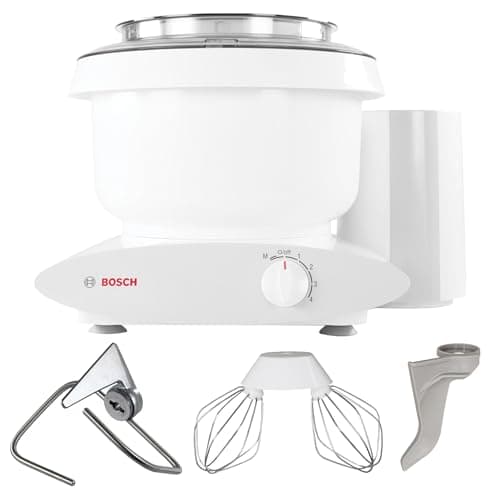
Bosch Universal Plus Stand Mixer
#ad Disclosure · Price as of October 17, 2026
Buy the KitchenAid if
It has to do everything
Eleven speeds, a stainless bowl, all-metal gears and the attachment ecosystem. It handles bread dough well enough in a bowl-lift frame, and it is far better at everything that is not bread.
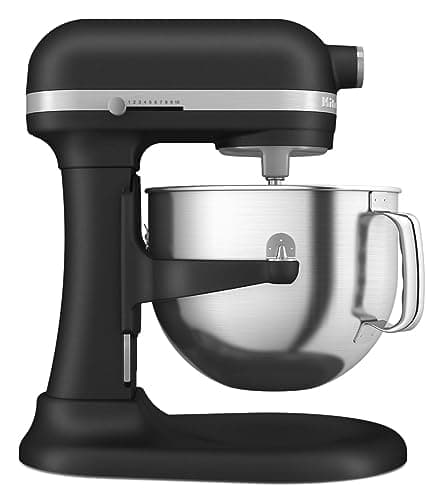
KitchenAid 7 Quart Bowl-Lift Stand Mixer (KSM70SKXX)
What you will want to buy alongside
Neither machine is quite complete out of the box for bread, and the extras are not the same.
With the Bosch: the stainless bowl, if you want to be able to chill it. Given that the whole friction-heat problem is about starting dough cool, a bowl you can put in the refrigerator for ten minutes is more useful here than it sounds, and the plastic bowl the base model ships with cannot do it.
With the KitchenAid: a spiral dough hook. The C-shaped hook that comes in the box is the design dough climbs; a spiral keeps it lower in the bowl and works it more evenly. Third-party spiral hooks for bowl-lift machines are cheap and widely sold, and it is the single best upgrade for bread on a planetary mixer.
With either: a thermometer, for the reason this comparison keeps returning to. You cannot manage a friction factor you cannot measure, and our thermometer picks are the cheapest part of either setup.
Noise, cleaning and the things you do fifty times a year
Cleaning. The bottom-drive design has a coupling in the base of the bowl, which is one more place dough collects and one more thing to clean around. A planetary bowl is a plain vessel with nothing in the bottom, and it is genuinely easier to wash. Advantage KitchenAid, and it is a daily rather than an occasional advantage.
Noise. Neither manufacturer publishes a figure, so we will not invent one. The structural difference is that a plastic bowl on a light body transmits and resonates differently from a stainless bowl in a cast frame, and a heavy machine resists a load instead of moving under it. Expect a different character of noise rather than a clear winner.
Counter height. Measure before you buy the KitchenAid. Bosch publishes its own dimensions at 7 15/16 inches high — low enough to sit under any wall cabinet. A 7-quart bowl-lift KitchenAid is around 16 1/2 inches with the bowl in place and needs clearance above that to raise the handle. This catches people out after delivery.
What they cost over ten years
We cannot give you a repair-rate comparison, because neither manufacturer publishes reliability data and we have not run these machines for a decade. Two things are checkable, though, and both are worth weighing.
KitchenAid’s parts and service network is the larger by a wide margin. Bowls, beaters, hooks, gaskets and gearbox parts for bowl-lift machines are stocked by third parties as well as by KitchenAid, and independent repair for them is a real trade. That is a genuine long-term asset in an appliance you intend to keep.
Bosch does not publish a warranty on its own product page for the Universal Plus, which is the single most surprising gap we found while researching either machine. Check what the seller offers in writing before you buy, because the manufacturer’s own listing will not tell you.
Resale cuts the same way. KitchenAid mixers hold value and sell quickly secondhand because the ecosystem guarantees demand. The Bosch has a smaller, more specialist market — serious bread bakers, who know exactly what it is — which means slower but not necessarily cheaper.
The third option nobody mentions
The Ankarsrum Original is the machine that usually comes up next in this conversation, and we have deliberately left it out of the picks. We checked, and it currently has no buyable Amazon offer — the listing exists but no live price. We do not feature products we cannot send you to, so it is a note rather than a pick. If you want one, it is sold direct and through specialist retailers.
Frequently asked
Questions
+Is the Bosch Universal Plus more powerful than a KitchenAid?
+How much dough can each one handle?
+Why is the Bosch bowl plastic?
+Which is better for whole wheat and rye?
+What about the Ankarsrum?
Sources
Where the facts on this page came from
Read next