Hub 03 · Sourdough Baking Gear
Best cooling rack for bread
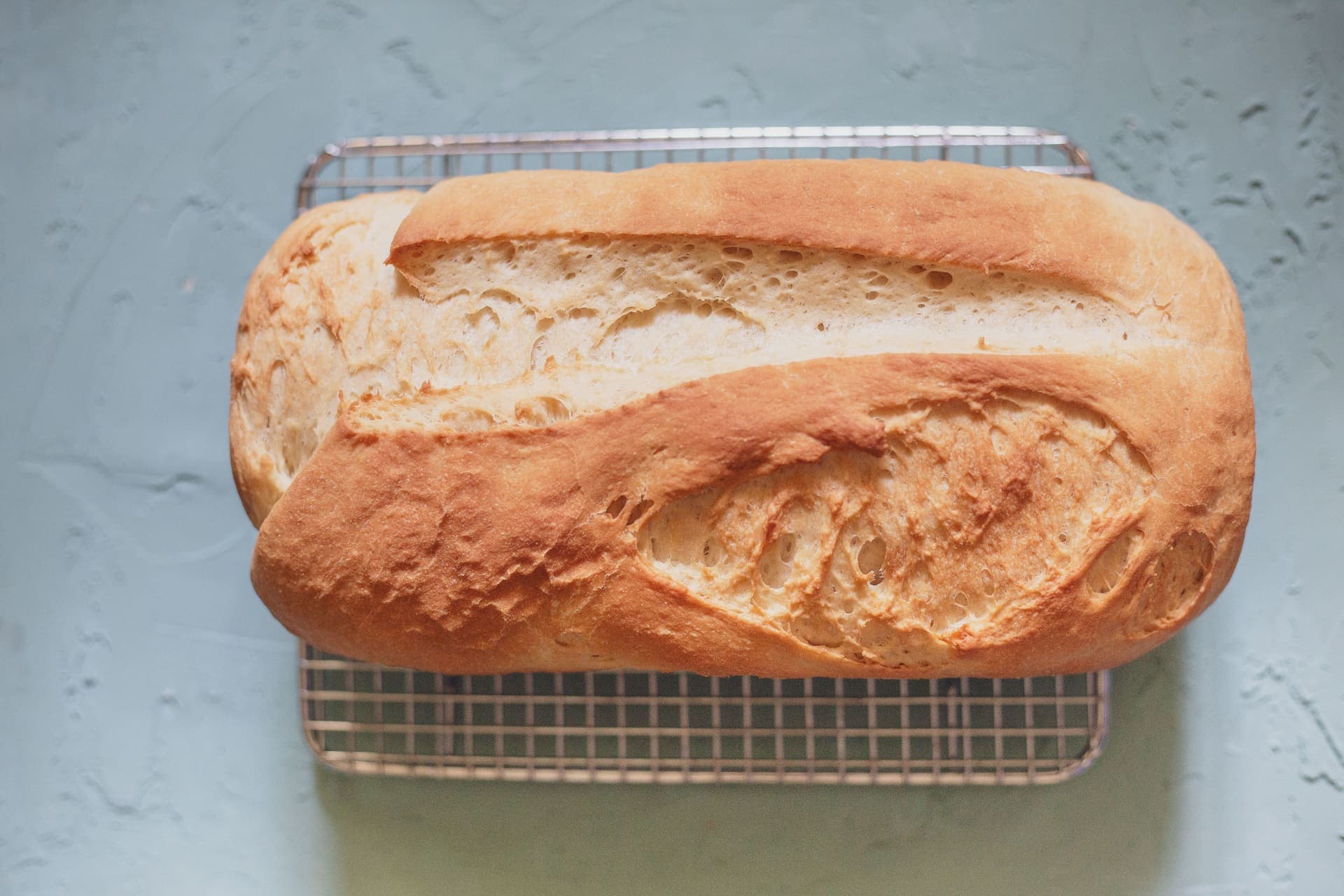
The rack is the cheap part. The specification that actually decides whether your crumb is gummy is the internal temperature of the loaf when the knife goes in.
We earn a commission if you buy through our links, at no extra cost to you. We have not tested this equipment. Here is what we did instead.
Quick picks
Tap a row for the full write-up · Prices open on Amazon
| # | Product | Best for | Price |
|---|---|---|---|
| 01 | 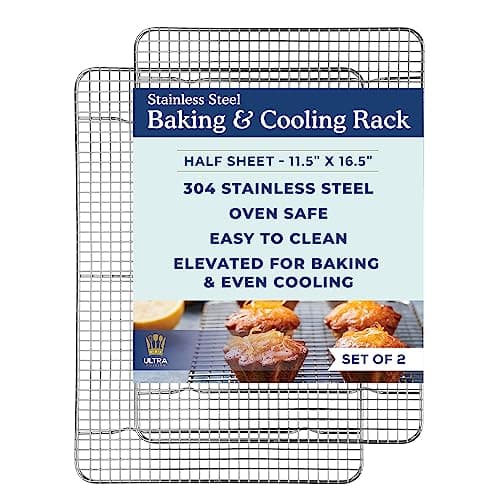 Ultra Cuisine Stainless Cooling Rack, 11.5 x 16.5 in, Set of 2 Bare stainless, tight wire, oven-safe, dishwasher-safe, sized to drop into a half sheet pan, and two of them. | The one to buy | |
| 02 | 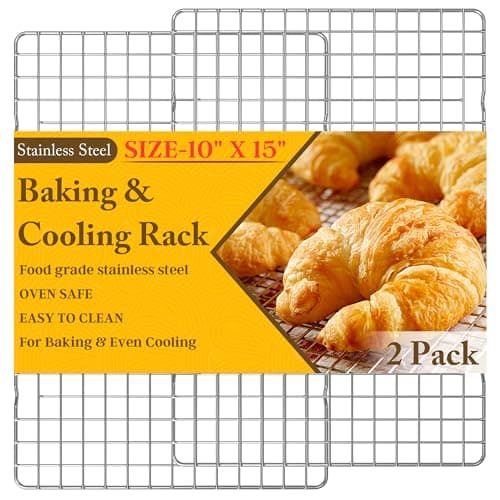 Qukaka Stainless Cooling Racks, 10 x 15 in, 2-Pack Two stainless racks for less than a loaf's worth of flour. | Cheapest that works | |
| 03 | 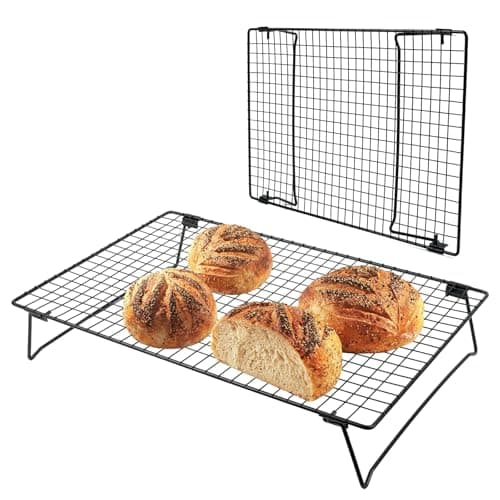 Sourdough Cooling Rack, 17 x 11 x 3 in Elevated The one genuine design difference in this category: three inches of leg instead of the usual half inch to one inch. | Maximum clearance | |
| 04 | 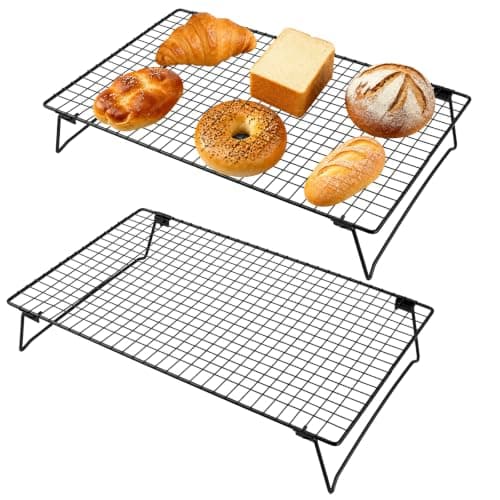 Sourdough Bread Cooling Rack, 17 x 11 x 3 in, 2-Pack The same tall-legged design as the pick above, in a pair, for a few dollars more than the single. | Two tall racks | $19.99 · View on Amazon
|
| 05 | 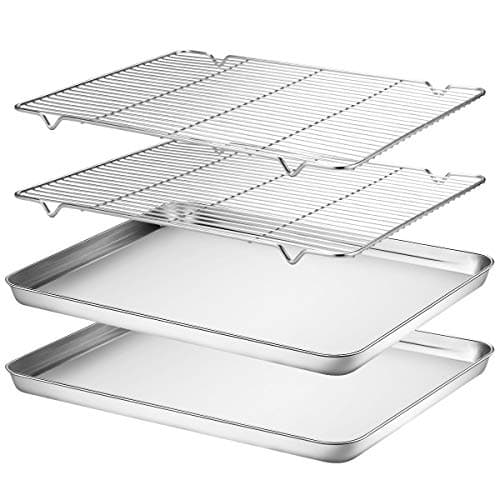 Wildone Baking Sheet and Rack Set, 2 Sheets + 2 Racks Two racks and the two half-size sheet pans they drop into. | If you need the pan too | $23.99 · View on Amazon
|
#ad · We earn a commission on Amazon purchases. Prices come from Amazon and change.
Buy the Ultra Cuisine stainless pair if you want the decision over with, and a seven-dollar two-pack if you do not. This is a white-label category where the brand on the grid means very little and three properties mean everything: how far the loaf sits off the counter, whether the wire is bare steel or coated, and whether you need one rack or two.
But the rack is not the interesting part of this page, and it is not what ruins most loaves. The loaf should reach about 95 to 100F internally before you cut it, and on a large loaf that takes hours. Slice before that and the crumb is gummy no matter what it is resting on. The rack is simply the cheapest way to let the loaf get there without steaming its own base.
What a cooling rack is actually for
A loaf out of the oven is full of water, and that water is leaving. It leaves as vapor through the crust, in every direction including downward.
Put the loaf on a board or a counter and the vapor heading down has nowhere to go. It condenses against the base, and the bottom crust you spent the whole bake building goes soft and leathery. Busby’s Bakery describes the mechanism as air flowing around the loaf carrying water vapor away from the crust, and their conclusion is that “allowing sourdough bread to cool on a rack is the best way to cool bread at home.”
That is the whole function. A cooling rack is a device for holding bread in moving air. It is not a performance product, and nothing about the expensive ones cools bread better than the cheap ones — which is why this page spends more time on timing than on racks.
The number that matters more than the rack: 95 to 100F
Here is the part almost no cooling-rack page tells you. The reason to wait is not etiquette or patience, it is that the crumb is still physically setting while the loaf cools.
During the bake, starch gelatinizes and amylose leaches out of the granules. As the loaf cools, that amylose recrystallizes — retrogradation — and that is what turns the interior from a soft wet mass into something that holds a slice. A baking-technology account of staling puts the timing precisely: “amylose retrogradation occurs relatively quickly during cooling and contributes immediately to crumb firmness,” while amylopectin retrogradation is a much slower process that “governs long-term staling and firming over days of storage.”
So the fast, useful half of the process happens while the loaf cools on your rack, and the slow half is what makes it stale later in the week. Cut into the loaf before the fast half has finished and you are slicing a structure that has not formed yet. The crumb compresses under the blade, smears, and reads as gummy or underbaked — and people blame the bake, or the hydration, or the starter.
Busby’s gives the target as a temperature rather than a clock: “sourdough bread should cool until it reaches 35-38C (95-100F) before slicing, which can take between 2 and 6 hours.”
How long, by what you baked
Times from the same source. They are longer than most people expect, and they scale with mass and with how much water the flour holds onto:
| What you baked | Cool for about |
|---|---|
| Small rolls | 30 minutes |
| Small white loaf, 1 lb | 2 hours |
| Large white loaf, 1.5 lb | 3 hours |
| Small wholegrain loaf, 1 lb | 3 hours |
| Large wholegrain loaf, 1.5 lb | 4 hours |
| Small rye loaf, 25% rye or more | 4 hours |
| Large rye loaf, 25% rye or more | 6 hours |
Rye is the outlier because, as the same source notes, “rye flour retains more moisture, so it’s going to need more time to cool down.” A rye loaf cut at two hours will always read as dense and damp.
There is a ceiling as well as a floor: “for most sourdough bread, cooling for over eight hours will dry it out too much.” So this is a window, not a one-way instruction to wait as long as possible.
How we picked
Criteria first, from the job, before any ranking. In a category sold mostly unbranded, these are the only four things that differ:
- Clearance under the loaf. The whole point is air moving beneath the base. Most racks give roughly half an inch to an inch of leg; a few give three. This is the specification we would actually pay for, and the one most listings do not publish.
- Bare stainless or coated. A coated grid can chip, and a coating of unstated composition is not something we would put a 450F pan on. Bare stainless is oven-safe and has nothing to flake.
- Wire spacing. A heavy, wet, high-hydration boule will sag between widely-spaced wires and take the grid pattern. A tight grid holds it.
- Count and size. One rack cools one loaf properly. Two loaves on one rack, touching, is worse than one loaf on a plate — see the spacing point below.
What we deliberately did not rank on: non-stick claims, color, or whether the listing says the word “sourdough.” One of the picks below is branded a sourdough cooling rack and the design is not sourdough-specific in any way. Its three-inch legs are worth buying; its name is not.
Size and fit, which is the only sizing decision
Racks come in two broad footprints and it is worth knowing which you want before you order, because the smaller one is not a smaller version of the larger one — it is a different fit.
Roughly 10 x 15 in takes one boule comfortably and fits a quarter sheet pan. Roughly 11.5 x 16.5 in is sized to drop into a standard half sheet pan, which is what makes a rack useful in the oven as a roasting rack as well. If you want one object for both jobs, buy the half-sheet size and buy it in bare stainless.
Length matters separately from area. A batard is long and narrow, and a 17 in rack takes one along its length where a 15 in rack means the ends overhang. Overhanging ends are not a disaster — air still moves around them — but a loaf that overhangs at both ends is also a loaf you cannot pick up cleanly. If you mostly bake long loaves, measure before you buy. Our couche page covers the proofing side of the same shape problem.
Where to cool it, and what about the turned-off oven
On the counter, uncovered, in ordinary room air. That is genuinely all the placement thought required, and two popular alternatives are worse:
Leaving it in the switched-off oven with the door ajar is a slow cool in warm, humid air — the loaf is sitting in the moisture it is trying to shed. Some bakers do this deliberately for a drier, harder crust, and it does work for that, but it is the opposite of what you want if a soft base is your complaint.
A cupboard, a bread box or a closed microwave is worse still: an enclosed volume with no air exchange, which is the towel problem with walls. Save the box for after it is cool, which is a storage decision rather than a cooling one.
Space the loaves, or the rack does nothing
This is the commonest way a perfectly good rack gets defeated. Two loaves pushed together on one rack, or a towel thrown over the top to keep them warm, and you have rebuilt the problem you bought the rack to solve. Busby’s is explicit: “putting loaves too close together or covering them with a towel stops the moisture migrating out of the crust,” with about three inches between loaves as the guide.
Which is the real argument for owning two racks rather than one large one, and the reason two of the five picks below are pairs.
What the rack does not fix
Cooling is the last step, so it gets blamed for problems made earlier. A rack and four hours will not fix:
- An actually underbaked loaf. If the center was never up to temperature, cooling sets a gummy crumb rather than curing it. That is a bake problem and our thermometer page covers the 190F figure for an ordinary loaf.
- A soggy bottom from the bake itself. If the base was pale and damp coming out of the pot, the rack is not the issue — heat into the base is, which is what the steel versus stone question is about.
- Staling. That is the slow amylopectin half of retrogradation and it happens over days regardless. It is a storage question, and how to store sourdough bread is where it belongs — including the reason the refrigerator is the worst place for a loaf.
What we would buy
The Ultra Cuisine pair, if you want to stop thinking about it: bare stainless, tight grid, oven-safe, half-sheet sized, two of them. It is the most expensive thing here and it is still inexpensive.
The seven-dollar Qukaka pair, if the above feels absurd for a wire grid. It holds a loaf off a counter, which is the entire job. You give up a published steel grade and a half-sheet fit.
The tall 17 x 11 x 3 in rack, if you have read the clearance argument above and found it convincing — which we do. Three inches of leg against half an inch is the only meaningful design difference in this category. Buy the single if you bake one loaf, the pair if you bake two; they are the same object.
Then pair whichever you buy with a thermometer and the patience to wait for 95F, because that is the half of this page that actually changes the bread. The knife you slice it with matters far less than the hour you slice it at.
Every pick, in order
The full write-ups
Pick 01 · The one to buy
Ultra Cuisine Stainless Cooling Rack, 11.5 x 16.5 in, Set of 2
Ultra Cuisine
Bare stainless, tight wire, oven-safe, dishwasher-safe, sized to drop into a half sheet pan, and two of them. That is every property that matters in this category in one box, and the only thing you are paying extra for over the cheap pairs is the grade of the steel and the density of the grid. A tight wire matters more than it sounds: a wet 900g boule sitting on a widely-spaced grid sags between the wires and marks.
Size
11.5 x 16.5 in; fits a half sheet pan
Material
100% stainless steel, per the listing
Oven safe
Yes, per the listing
Count
2
Grid
Heavy-duty tight wire, per the listing
Specs compiled from: Manufacturer product listing and product name
What is good
- Bare stainless rather than a coated grid, so there is no finish to flake into the crust
- Oven-safe, which makes it a roasting rack the rest of the week rather than a single-purpose object
- Tight wire spacing: a heavy wet loaf sits on it rather than sagging through it
- Two racks, which is what a double bake actually needs
What is not
- The most expensive option here, in a category where a seven-dollar pair does the core job
- The listing publishes no leg height, and clearance under the loaf is the specification that matters most
- No published wire gauge or grid pitch, so 'tight wire' is a claim rather than a figure
- Half-sheet sizing is wasted if you bake one loaf at a time on a small counter
#ad Disclosure · Price as of November 2, 2026
Pick 02 · Cheapest that works
Qukaka Stainless Cooling Racks, 10 x 15 in, 2-Pack
Qukaka
Two stainless racks for less than a loaf's worth of flour. The physics of cooling bread does not care what a rack cost: it needs to hold the loaf off the counter so water vapor can leave the base, and this does that. Buy this if you want the job done and nothing else, and accept that an unbranded pair at this price publishes nothing about its steel.
Size
10 x 15 in
Material
Stainless steel wire, per the listing
Oven safe
Yes, per the listing
Count
2
Specs compiled from: Manufacturer product listing and product name
What is good
- Does the one thing a cooling rack has to do, at the lowest price here
- Two of them, so a double bake is covered
- Listed as oven and dishwasher safe
- Small enough to store upright in a cupboard gap
What is not
- Unbranded: no published steel grade, wire gauge, leg height or load rating
- 10 x 15 in does not fit a half sheet pan, so it will not double as a roasting rack in one
- Wider grid spacing than the premium racks, which a very wet loaf can mark on
- At this price the welds and feet are where the cost was taken out
#ad Disclosure · Price as of November 2, 2026
Pick 03 · Maximum clearance
Sourdough Cooling Rack, 17 x 11 x 3 in Elevated
WGDJEMAX
The one genuine design difference in this category: three inches of leg instead of the usual half inch to one inch. More clearance means more air moving under the base, which is where a cooling loaf has the hardest time getting rid of its water vapor. Treat the word 'sourdough' on the listing as marketing -- it is a cooling rack -- but the extra height is real and it is the spec we would actually pay for.
Size
17 x 11 x 3 in, per the listing
Clearance
3 in legs -- the tallest here
Finish
Black coated, per the listing
Count
1
Specs compiled from: Manufacturer product listing and product name
What is good
- Three inches of clearance, against roughly half an inch to an inch on an ordinary rack
- Long enough at 17 in to take a batard rather than only a round
- Elevated legs also make it easy to get a hand or a towel underneath to move a hot loaf
- The only pick here whose headline specification is the one that matters
What is not
- Black coated rather than bare stainless, and a coated grid is the kind that eventually chips
- The listing does not state whether the coating is oven-safe, so we would not roast on it
- 'Sourdough cooling rack' is branding: nothing about the design is sourdough-specific
- One rack, and no published steel grade or load rating
#ad Disclosure · Price as of November 2, 2026
Pick 04 · Two tall racks
Sourdough Bread Cooling Rack, 17 x 11 x 3 in, 2-Pack
OGNWFUNK
The same tall-legged design as the pick above, in a pair, for a few dollars more than the single. If you have decided that clearance is the specification worth buying and you bake more than one loaf, this is simply the better arithmetic. We have ranked it below the single only because most people baking one loaf a weekend do not need two racks taking up the cupboard.
Size
17 x 11 x 3 in each, per the listing
Clearance
3 in legs
Count
2
Extra
Hanging design, per the listing
Specs compiled from: Manufacturer product listing and product name
What is good
- Two tall racks for close to the price of one, which is the cheapest route to 3 in clearance per loaf
- Lets you space loaves properly instead of crowding two onto one rack
- Same 17 in length, so it takes a batard
- Hangable, which is the only sensible way to store a rack this tall
What is not
- Same coated finish and the same silence about whether it is oven-safe
- Two racks is storage you may not want for a single-loaf habit
- No published steel grade, wire gauge or load rating, as with every rack on this page
- The 'sourdough' label is doing marketing work here too
Pick 05 · If you need the pan too
Wildone Baking Sheet and Rack Set, 2 Sheets + 2 Racks
Wildone
Two racks and the two half-size sheet pans they drop into. Worth it only if you do not already own sheet pans, in which case the pair-and-pan combination costs about what the racks alone cost elsewhere. The pan is not part of cooling a loaf -- a rack in a pan traps the vapor you are trying to let out -- but it is what makes the rack useful for roasting and for catching drips the rest of the week.
Contents
2 baking sheets + 2 cooling racks
Size
16 x 12 x 1 in, per the listing
Material
Stainless steel, per the listing
Fit
Racks sized to the sheets
Specs compiled from: Manufacturer product listing and product name
What is good
- Racks and matched pans together, which is cheaper than buying both separately
- Stainless rather than coated, per the listing
- The nested rack-in-pan combination is genuinely useful for roasting and for bacon
- Sized to a standard half sheet, so other racks will fit the pans later
What is not
- For cooling bread the pan is dead weight, and cooling a loaf on a rack INSIDE the pan defeats the point
- You are buying four objects when the job needs one
- No published leg height on the racks
- Sheet pans at this price warp at high oven temperatures over time
How we picked
We have not tested any of this equipment. What we did instead: compiled the published specifications from each manufacturer’s own listing, checked them against the task a beginner is actually trying to do, read the care instructions, and named the thing we would skip. Where a pick is a product type rather than a brand, it is because the category is sold mostly unbranded and the type is the real decision.
Frequently asked
Questions
+How long should sourdough cool before slicing?
+Why is my crumb gummy when I cut the loaf warm?
+Do I actually need a cooling rack?
+Can I cool bread on the rack inside a sheet pan?
+Should I cover the loaf with a towel while it cools?
+Is a coated rack a problem?
+Does a cooling rack keep the crust crisp?
Sources
Where the facts on this page came from
Read next