Hub 03 · Sourdough Baking Gear
Best bread sling for a Dutch oven
The spec that matters is the one buried at the bottom of the listing: the temperature rating. A lot of these are rated below the heat you bake at.
We earn a commission if you buy through our links, at no extra cost to you. We have not tested this equipment. Here is what we did instead.
Quick picks
Tap a row for the full write-up · Prices open on Amazon
| # | Product | Best for | Price |
|---|---|---|---|
| 01 | 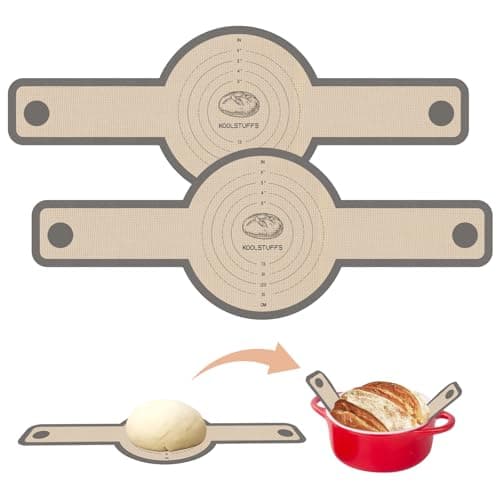 Koolstuffs Silicone Bread Sling, 2-Pack Rated to 500F, which is the number that matters and the number most of this category misses. | The one that matches oven temperature | |
| 02 | 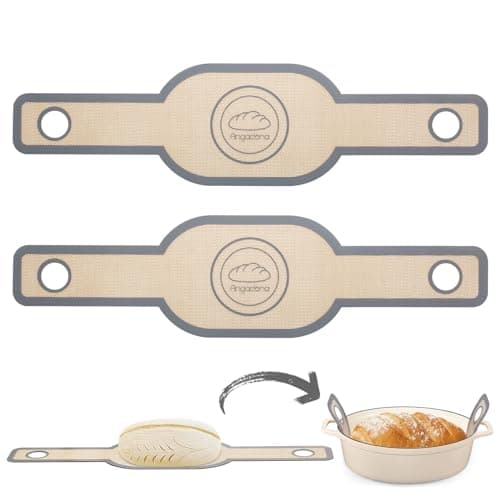 Angadona Oval Silicone Bread Sling, 2-Pack An oval sling rather than a round one, which is the right shape if you shape batards instead of boules. | Batards and long loaves | |
| 03 | 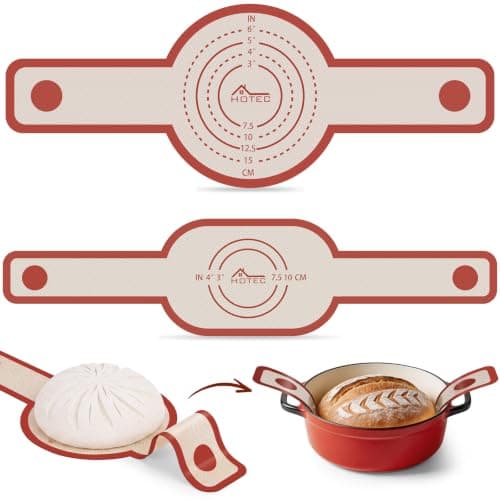 HOTEC Silicone Bread Sling, 0.7 mm, 2-Pack Rated to 500F like the Koolstuffs, but at 0.7 mm with a reinforced fiberglass core it is the substantial one here. | The thickest silicone at the right temperature | $5.98 · View on Amazon
|
| 04 | 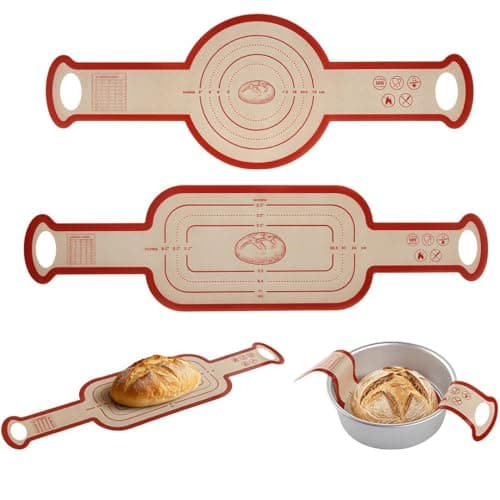 Kallisya Silicone Bread Sling, Oval and Round Pair One oval and one round in the same pack, which covers both loaf shapes without buying twice. | Baking both shapes |
#ad · We earn a commission on Amazon purchases. Prices come from Amazon and change.
A bread sling is a silicone mat with two long handles. You shape the loaf on it, lift it by the handles into a screaming-hot Dutch oven, and lift the baked loaf back out the same way. It replaces the parchment-and-prayer maneuver, and it replaces the burned forearm that maneuver occasionally produces.
It is a genuinely useful ten-dollar tool. It also has one specification problem that almost nobody writing about it mentions, and it is the reason this page leads with a number rather than a pick.
The temperature problem
Sourdough in a Dutch oven is usually baked with the pot preheated to somewhere between 450°F and 500°F. Most silicone bread slings are rated by their manufacturers to 480°F.
Those two numbers overlap badly. If you preheat to 500°F — which a great many sourdough recipes specify — a 480°F sling is being used above its stated limit on every single bake. Not catastrophically: silicone does not burst into flame at 481°F. But the manufacturer has told you where they stand behind the product, and you would be operating past it routinely.
| Stated rating | Bake at 450F | Bake at 500F |
|---|---|---|
| 500F | Within spec | At the stated limit - makers advise against prolonged use there |
| 480F | Within spec | Above the stated limit on every bake |
| Not stated | Unknown | Unknown - and on this product that is the spec you most want |
Two honest ways out. Buy a sling whose rating covers your bake temperature, or drop your preheat to 450°F, which makes a perfectly good loaf and brings every sling here inside spec. What we would not do is ignore the number.
How we judged these
- Stated temperature rating, first. For the reasons above. A listing that does not publish one is a listing withholding the most relevant fact about the product.
- Shape against your loaf. Round for a boule, oval for a batard. A round sling under a long loaf bunches at the ends and the dough slumps into the folds.
- Diameter against your pot. Too wide and it rides up the walls and creases into the crust. Too narrow and the dough spreads off the edge onto bare iron.
- Handle length. The whole point is lifting into a deep, 500°F pot without touching it. Short handles put your knuckles level with the rim.
- How many you get. These are cheap and they go in the dishwasher, but a second one means you can shape the next loaf while the first is still in the oven.
Sling or parchment?
Parchment paper does the same job for pennies and is what most bakers used before slings existed. It is genuinely better in two ways: it is thinner, so the base of the loaf sits closer to the hot iron and browns harder, and it wicks a little moisture rather than trapping it.
The sling wins on handles, on not running out, and on not having to cut a new square every bake. It loses slightly on bottom crust — a layer of silicone between dough and cast iron is an insulator, and you will notice a marginally paler, softer base. If bottom crust is the thing you are chasing, parchment or bare iron beats any sling.
If you are still deciding whether you need the pot at all, that argument is on do you need a Dutch oven for sourdough, and the size question is worth settling before you buy a sling to fit it.
Getting the diameter right
Measure the inside diameter of your Dutch oven at the base, not at the rim — most pots taper. A sling an inch narrower than the base diameter sits flat with a little margin, which is what you want. A sling wider than the base will curl up the walls and press a crease into the side of the loaf.
A common 5 to 6 quart round Dutch oven has a base somewhere around 9 inches, which is why 8.3-inch slings are the most common size sold. If you do not know your pot’s dimensions, measure across the inside of the base with a ruler before ordering -- it takes ten seconds and saves a return.
Care, briefly
Every sling here is dishwasher safe, some top-rack only. The failure mode over time is not tearing but staining and a faint smell that silicone picks up from repeated high-heat use — harmless, but it is why people replace them every couple of years rather than keeping one forever. Do not cut on them, and do not use one under the broiler.
The short version
Check what temperature you actually bake at. If it is 500°F, buy the sling rated to 500°F or drop your oven to 450°F. Match round to boules and oval to batards, buy roughly an inch narrower than your pot’s base, and get the two-pack — they cost almost nothing and one is always in the wash.
Every pick, in order
The full write-ups
Pick 01 · The one that matches oven temperature
Koolstuffs Silicone Bread Sling, 2-Pack
Koolstuffs
Rated to 500F, which is the number that matters and the number most of this category misses. A sourdough Dutch oven is usually preheated to 450-500F, so a sling rated to 480F is being asked to work past its own stated limit every bake. This one is not.
Temperature
-40F to 500F, per the manufacturer (avoid prolonged use at 500F)
Size
22.04 inches long including handles, 8.26 inches wide
Quantity
2 slings
Care
Dishwasher safe once cooled, per the manufacturer
Specs compiled from: Manufacturer product listing and product name
What is good
- The highest stated temperature rating here, and the only one that clears a 500F preheat
- Long handles give a real grip when lowering dough into a hot pot
- Two in the pack, so one is always clean
What is not
- The manufacturer still says to avoid prolonged use at the top of the range
- 8.26 inches is a round-loaf width; a long batard will overhang
- Silicone between dough and cast iron slightly softens the bottom crust compared to bare metal
#ad Disclosure · Price as of October 17, 2026
Pick 02 · Batards and long loaves
Angadona Oval Silicone Bread Sling, 2-Pack
Angadona
An oval sling rather than a round one, which is the right shape if you shape batards instead of boules. At 23.2 inches it is the longest here, so the handles clear the rim of a deep oval Dutch oven with room to grip.
Shape
Oval
Temperature
Up to 480F, per the manufacturer
Size
23.2 inches long, 8.3 inches wide
Care
Dishwasher safe, top rack only, per the manufacturer
Specs compiled from: Manufacturer product listing and product name
What is good
- Oval footprint suits a batard, which round slings bunch up under
- Longest handles in this group, which matters most on a deep pot
- Two per pack
What is not
- 480F rating is below a typical sourdough preheat -- see the temperature section
- Top-rack-only dishwashing is a real restriction if you run a crowded machine
- Oval is the wrong shape for a round boule, so it is not the universal pick
#ad Disclosure · Price as of October 17, 2026
Pick 03 · The thickest silicone at the right temperature
HOTEC Silicone Bread Sling, 0.7 mm, 2-Pack
HOTEC
Rated to 500F like the Koolstuffs, but at 0.7 mm with a reinforced fiberglass core it is the substantial one here. A thicker sling sags less when you lift a heavy loaf, which is the moment a thin one folds and drops the dough against the side of the pot.
Temperature
-40F to 500F, per the manufacturer
Thickness
0.7 mm with a reinforced fiberglass core, per the listing
Size
22 inches long including handles, 8.27 inches wide
Care
Dishwasher safe, per the manufacturer
Specs compiled from: Manufacturer product listing and product name
What is good
- Clears a 500F preheat, unlike most of this category
- Thicker gauge sags far less under a heavy loaf than a thin sling
- Long handles and a 2-pack at a commodity price
What is not
- A thicker sling insulates the base slightly more, so the bottom crust browns a little less
- Round only -- a batard will overhang the 8.27-inch width
- The fiberglass core is a listing claim we cannot inspect
Pick 04 · Baking both shapes
Kallisya Silicone Bread Sling, Oval and Round Pair
Kallisya
One oval and one round in the same pack, which covers both loaf shapes without buying twice. The handles are shorter than the long-handled specialists here, so it is the pick for a shallower pot rather than a tall one.
Shapes
One oval, one round
Size
16.5 inches long, 11.6 inches wide
Material
Food-grade BPA-free silicone, per the listing
Quantity
2 slings
Specs compiled from: Manufacturer product listing and product name
What is good
- The only pack here that covers a boule and a batard out of one purchase
- Wider sheet than the narrow slings, so a spread-out loaf still sits on silicone
- Doubles as a work mat when it is not in the pot
What is not
- Shortest handles in this group -- less clearance on a deep Dutch oven
- The listing does not state a temperature rating, which for this product is the spec you most want
- Wider sheet can crumple against the wall of a narrow pot
#ad Disclosure · Price as of October 17, 2026
How we picked
We have not tested any of this equipment. What we did instead: compiled the published specifications from each manufacturer’s own listing, checked them against the task a beginner is actually trying to do, read the care instructions, and named the thing we would skip. Where a pick is a product type rather than a brand, it is because the category is sold mostly unbranded and the type is the real decision.
Frequently asked
Questions
+Are silicone bread slings safe at sourdough baking temperatures?
It depends on the sling. Manufacturers commonly state 480°F, and many sourdough recipes preheat to 500°F, which puts the sling above its stated limit. Either buy one rated to 500°F or bake at 450°F, where every sling on this page is within spec.
+Is a bread sling better than parchment paper?
It is more convenient and reusable; parchment gives a slightly better bottom crust because it is thinner and does not insulate. If crust is your priority, parchment or bare iron wins. If handling a hot pot safely is your priority, the sling wins.
+What size bread sling do I need?
Roughly an inch narrower than the inside base diameter of your Dutch oven, measured at the base rather than the rim. For a common 5 to 6 quart round pot that usually means about 8.3 inches.
+Do bread slings affect the crust?
Slightly, on the bottom. Silicone between the dough and the cast iron is an insulating layer, so the base browns a little less than it would on bare iron or thin parchment. The sides and top are unaffected.
+Round or oval bread sling?
Match the loaf. Round for a boule, oval for a batard. A round sling under a long loaf bunches at the ends, and the dough settles into the folds and bakes with creases in it.
Read next