Hub 03 · Sourdough Baking Gear
Challenger Bread Pan review
It is the most specialized piece of sourdough equipment most people ever consider buying. Here is what the shape actually buys you, and what it costs.
We earn a commission if you buy through our links, at no extra cost to you. We have not tested this equipment. Here is what we did instead.
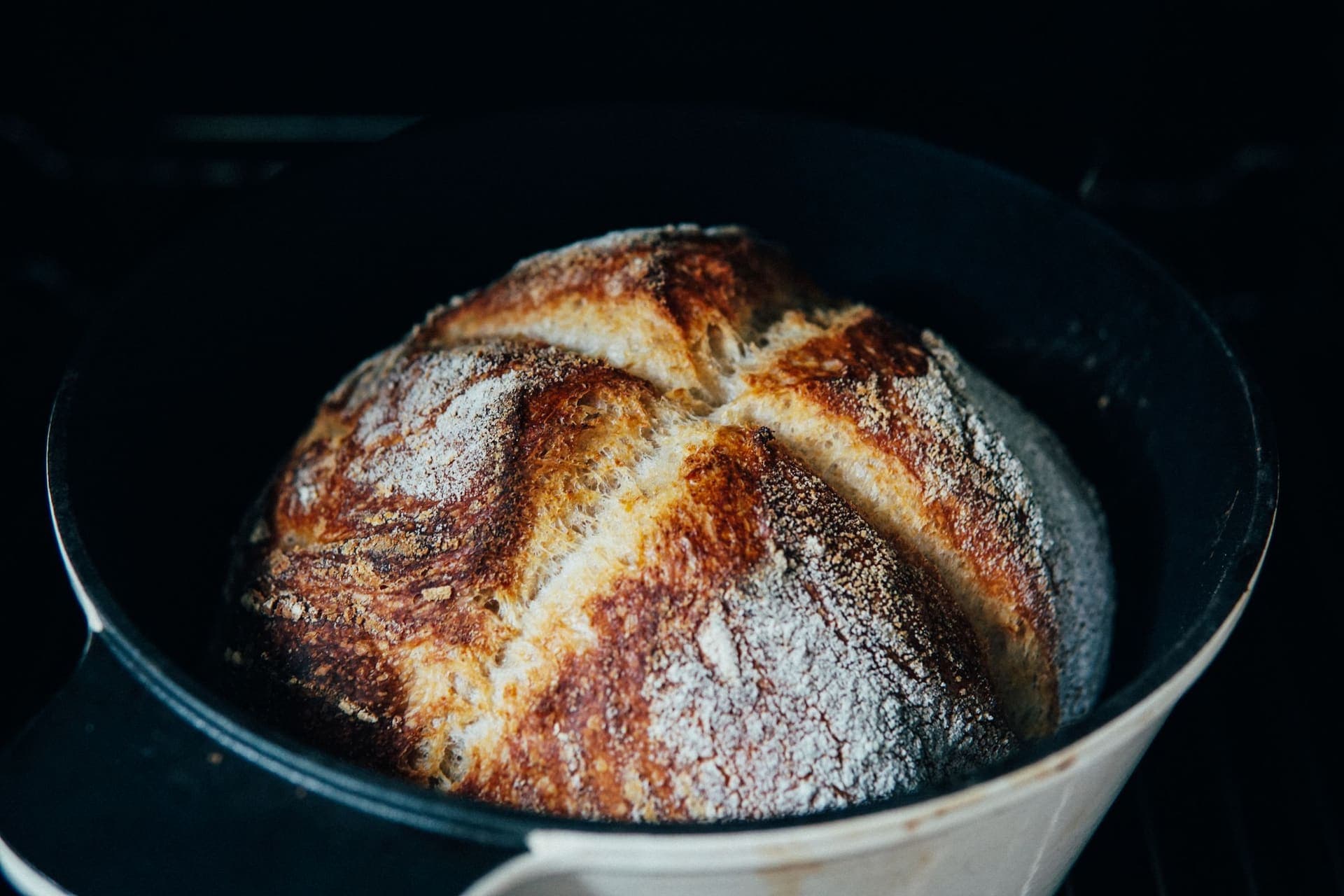
The Challenger Bread Pan is cast iron, made in the USA, and costs roughly what seven budget Dutch ovens cost. It exists because the people who designed it decided that the standard Dutch oven — a deep pot with a shallow lid — is the wrong shape for bread, and built the inverse.
That is the whole product, and it is worth taking seriously before dismissing it on price. The question is not whether it is good. It is whether the specific problem it solves is a problem you have.
What the shape actually does
A Dutch oven is a deep well. To load it you lower a proofed, slack loaf down past hot walls, usually blind, usually with your forearms inside a 500°F cavity. Then you score it — down in the well, at an angle, quickly, before it starts to set.
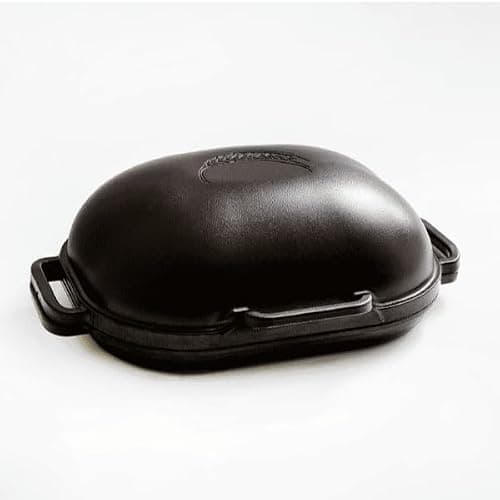
The Challenger inverts that. The base is a shallow tray with handles and the lid is the deep part. You turn the loaf out onto a flat, open, waist-height surface, score it in the open with a clear view and both hands free, and then lower the deep lid over the top. Nothing goes down a well and nothing goes near a hot wall.
If you have ever burned a wrist loading a Dutch oven, or produced a wandering score because you could not see what you were doing, that is the pitch. It is a real ergonomic difference, not a marketing one.
What it does not do
It does not bake a better loaf than a good Dutch oven. Both are preheated cast iron that trap the loaf’s own steam, and that mechanism is what produces oven spring and crust. Same material, same physics, same result.
Anyone claiming a meaningfully better crumb from this pan is describing something we cannot verify and would not repeat. What it buys is handling, not baking.
Against a Dutch oven, honestly
| Challenger pan | Dutch oven | |
|---|---|---|
| Loading a slack loaf | Onto an open flat base | Down into a deep hot well |
| Scoring | In the open, both hands free | In the well, at an angle |
| Burn risk | Low - nothing enters a cavity | Real, and the usual complaint |
| Loaf shapes | Round and oval, including batards | Round; oval pots exist but are less common |
| Crust and spring | Trapped steam in cast iron | Trapped steam in cast iron - the same |
| Other uses | Bread, essentially | Stews, braises, frying, everything |
| Price | Several times a budget pot | From about forty dollars |
The last two rows are the case against. A Dutch oven is a general-purpose pot that also bakes bread; this bakes bread. If you own one cast iron vessel and it has to cook dinner as well, this is the wrong one.
Buy it if
You bake weekly and dread the loading step
Frequent bakers who have burned themselves, who bake batards as well as boules, or who have limited wrist strength and mobility get a genuine, repeated benefit from the open-base design. That adds up over years.
Challenger Bread Pan
#ad Disclosure · Price as of October 17, 2026
Skip it if
You bake occasionally, or own one pot
An enameled Dutch oven at a fraction of the price bakes the same loaf and also makes stew. For most people that is simply the better purchase, and the money is better spent on flour.
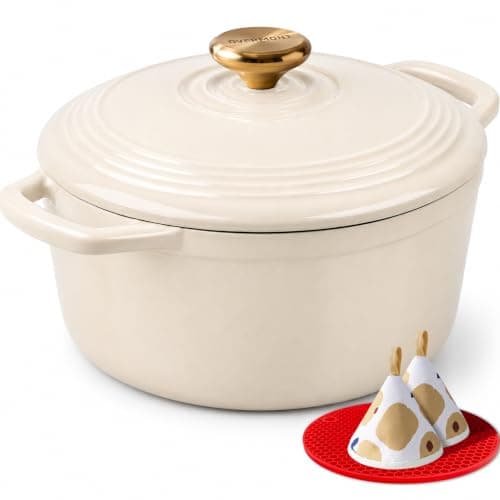
Overmont 5.5-Quart Enameled Cast Iron Dutch Oven
What you are actually buying
Two pieces of bare cast iron: a shallow base with handles on both sides, and a deep domed lid that inverts over it. The manufacturer lists it as pre-seasoned and made in the USA. There is no enamel, no coating and no mechanism — which is why there is nothing on it that can fail, and also why it needs the same care any bare cast iron pan needs.
Pre-seasoned does not mean finished. Bare cast iron builds its non-stick surface over time through use and oil, and a new pan is at the start of that process rather than the end. Expect the first few loaves to want parchment or a sling underneath, and expect the surface to darken and improve over a year.
Preheating, and the part people get wrong
Both pieces have to be preheated, not just the lid. The base is where the loaf lands, and a cold base is the single most common reason a loaf out of any cast iron vessel has a pale, soft bottom. That means the whole thing sits in the oven through the preheat and comes out hot, which is the moment the handles and a pair of serious oven gloves start to matter.
It also means the preheat is not quick. Cast iron of this mass takes a long time to come to temperature and there is no shortcut — a thermometer reading the oven air tells you nothing about the metal. This is the same physics that governs a Dutch oven, and neither product escapes it.
Care, honestly
Bare cast iron rusts. It gets wiped rather than washed, dried immediately, and given a thin film of oil now and then. Nothing acidic sits in it. Nothing soaks. If that routine sounds like a chore you will resent, an enameled Dutch oven has none of it, and that is a legitimate reason to choose one instead.
The upside of bare iron is that there is no enamel to chip, and chipped enamel is how most enameled pots eventually die. A bare cast iron vessel that is kept dry and oiled is genuinely a lifetime object, and can be stripped and reseasoned if it is ever neglected. Enamel cannot be repaired.
Cost, spread over the loaves
The price only makes sense as a cost per bake. At roughly seven times the price of a budget enameled pot, a weekly baker reaches parity with the cheap pot at about the point the cheap pot would need replacing — if it ever did. Cast iron of either kind tends not to wear out.
So this is not a purchase that pays for itself. It is a purchase that buys a better experience of a task you do often, in the same way a good knife does. If you bake fifty loaves a year for ten years, you are paying a few cents a loaf for an easier, safer loading step. If you bake six loaves a year, you are paying several dollars a loaf for the same thing.
The weight question
It is cast iron and it is not light. The trade against a Dutch oven is interesting though: a Dutch oven asks you to maneuver a deep, hot, heavy pot and get your hands inside it, while this asks you to lift a heavy flat base and a heavy lid separately. Two moderate lifts instead of one awkward one.
For someone with limited grip or wrist strength, that split can be the deciding factor in either direction. It is worth thinking about honestly rather than assuming heavier is simply worse.
Who it is genuinely for
- Weekly bakers. An ergonomic improvement you experience once a month is a luxury. Once a week for a decade is a different calculation.
- People who bake batards. The oval base takes long loaves that a round pot cannot, without buying a second vessel.
- People who have been burned. Literally. If loading a Dutch oven makes you anxious, that anxiety is worth solving.
- People whose scoring keeps failing. Scoring in the open with a clear view fixes a class of problem that technique alone struggles with in a deep pot.
Our verdict
It is a well-made, single-purpose tool that solves a real and specific problem: getting a slack loaf into a hot vessel and scoring it without fighting a deep well. It does not bake a better loaf than cast iron already bakes, and it does nothing else in your kitchen.
For a weekly baker who has met the problem, that is a fair trade. For everyone else — and that is most people — a budget Dutch oven bakes the same bread and leaves enough money for a year of good flour.
Frequently asked
Questions
+Is the Challenger Bread Pan worth it?
For a weekly baker who finds loading and scoring in a deep Dutch oven awkward or risky, yes — the shallow base and deep lid genuinely fix that. For an occasional baker, no: it bakes the same loaf as cast iron you can buy for a fraction of the price.
+Does the Challenger Bread Pan bake better bread than a Dutch oven?
No. Both are preheated cast iron that trap the loaf’s own steam, which is the mechanism behind oven spring and crust. The difference is how you load and score, not how it bakes.
+Can you bake batards in a Challenger Bread Pan?
Yes — the oval base takes long loaves, which is one of the clearer practical advantages over a standard round Dutch oven. Oval Dutch ovens exist but are less common and often more expensive.
+What else can you cook in a Challenger Bread Pan?
Very little, honestly. It is cast iron so it is oven-safe and durable, but the shape is built for bread. A Dutch oven at a fraction of the price also makes stews, braises and everything else, which is the main argument against this one.
+Is the Challenger pan good for beginners?
It is not a bad pan for a beginner, but it is a bad first purchase. Bake twenty loaves in a cheap pot first. If loading is still the part you dislike, you will know this solves it; if it is not, you have saved a lot of money.
Read next