Hub 03 · Sourdough Baking Gear
Best bread slicing guide
The first question is not which guide, it is whether your loaf is the shape these things are designed to hold. Most of them are built for a tin.
We earn a commission if you buy through our links, at no extra cost to you. We have not tested this equipment. Here is what we did instead.
Quick picks
Tap a row for the full write-up · Prices open on Amazon
| # | Product | Best for | Price |
|---|---|---|---|
| 01 | 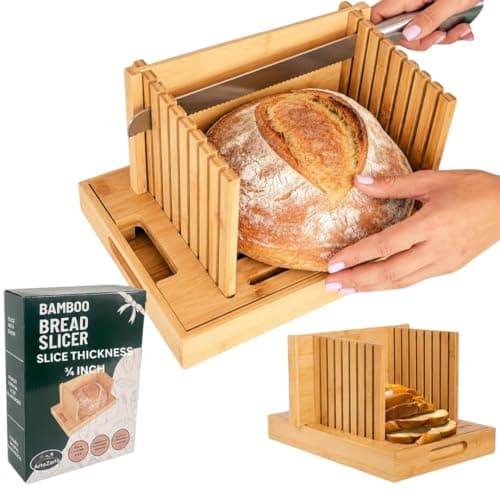 ArtoZariA Bamboo Bread Slicer for Sourdough Rounds One of the few guides sold explicitly for round loaves as well as sandwich tins and baguettes, which matters because a boule is the shape most slicing guides cannot hold. | Round sourdough loaves | $19.95 · View on Amazon
|
| 02 | 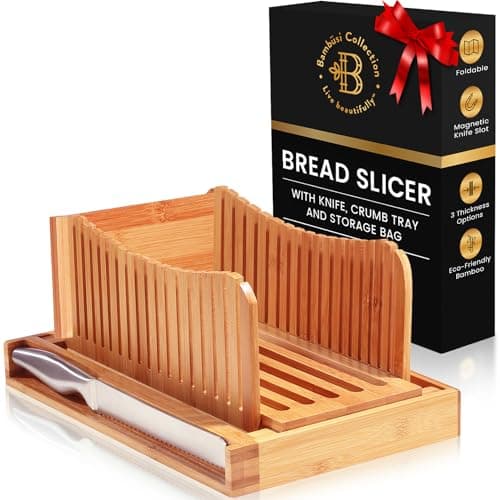 Bambusi Bamboo Bread Slicer with Knife Three thickness slots and a serrated knife in the box, which is the reason to pick it: most guides assume you already own a long knife. | Not owning a long bread knife yet | |
| 03 | 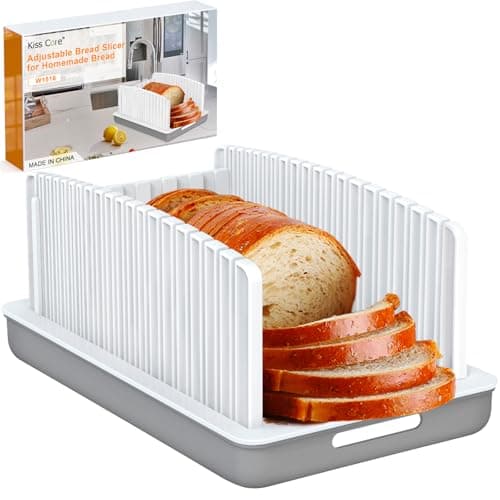 Kiss Core Adjustable Width and Thickness Bread Slicer Adjustable in width for the loaf and in thickness through three spacer positions, in molded plastic rather than bamboo. | Controlling the slice thickness | $19.49 · View on Amazon
|
| 04 | ZQZXD Foldable Adjustable Bread Slicer Adjustable in both length and width, in the same plastic as the Kiss Core, at the bottom of the price range. | Spending the least | |
| 05 | 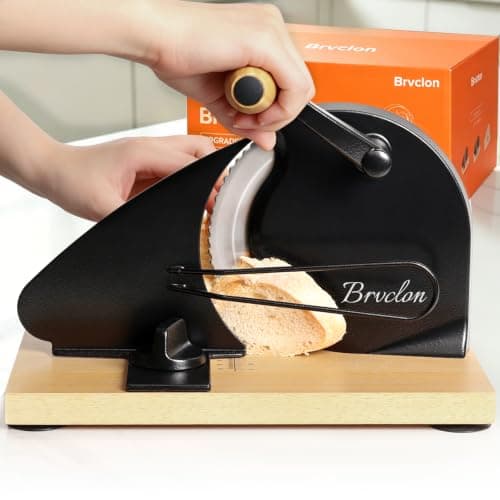 Brvclon Manual Hand-Crank Bread Slicer A crank-driven slicer on a solid wood base rather than a slotted frame, with adjustable thickness and a suction cup to hold it down. | Slicing a whole loaf, every week |
#ad · We earn a commission on Amazon purchases. Prices come from Amazon and change.
A bread slicing guide is a slotted frame that stands the loaf up and holds your knife square. Slide the blade down a slot and you get a slice of a fixed thickness, perpendicular to the board, every time — which is what a steady hand and a long knife produce on a good day and not on a rushed one.
We have said elsewhere, on the bread knife page, that a guide is a purchase to skip for most people. That is still our view. This page is for the people it genuinely suits, and for the one specification that decides whether any of them will work for you at all.
The shape problem, first
Almost every bread slicing guide on the market was designed around a rectangular sandwich loaf. The slots are spaced for a tin, the side walls are set for a tin, and the whole frame assumes the loaf is taller than it is wide.
A sourdough boule is the opposite: wide, round, and often nine inches across. Stand it in a guide built for a tin and either it does not fit between the walls at all, or it fits and the first two slots cut through nothing but air because the loaf curves away from them.
So before comparing anything else, check whether the listing says it takes round loaves. A minority do, and they say so plainly because it is their selling point. If you bake batards or tin loaves this is a non-issue — but then you are also the person a guide suits best. A square loaf from a Pullman pan is the easiest bread there is to slice evenly, and it is the shape these guides were designed around.
How we judged these
- Whether it takes a round loaf. For a sourdough baker this is the first filter and it eliminates most of the category.
- What thickness it actually cuts. The slots fix this, and the published figures across this page range from under a third of an inch to three quarters. That is the difference between toast and a doorstop, and it is not adjustable beyond the slots the maker gave you.
- Whether it folds. These are bulky objects that get used for five minutes a week. One that folds to two inches lives in a cupboard; one that does not lives on your counter forever.
- Whether a knife is included, and how long it is. A guide does nothing without a blade long enough to cross the loaf. An included knife sounds generous until you read the blade length.
- Material and cleaning. Bamboo looks better and is hand-wash only. Plastic looks worse, does not crack or splinter, and goes in the dishwasher. Both are defensible; pick the one you will actually maintain.
Slice thickness is the spec nobody compares
It is the number that changes your bread most and the one buried deepest in the listings. Published thicknesses on this page:
| Guide | Stated thickness | What that is for |
|---|---|---|
| Round-loaf bamboo guide | 3/4 inch, single setting | Thick sourdough slices; too thick for toast |
| Bamboo guide with knife | 0.25 / 0.38 / 0.5 inch | Thin toast up to a sandwich slice |
| Adjustable plastic guide | 0.315 / 0.433 / 0.55 inch | The finest control here |
| Budget plastic guide | Not published | Unknown - the one spec you want, missing |
| Hand-crank slicer | Adjustable on a scale | Anything, repeatably |
Note that the guide built for round sourdough cuts the thickest slice and offers no alternative, while the ones with the finest settings are the tin-loaf designs. That is not a coincidence: a wide, open sourdough crumb falls apart in a quarter-inch slice, so the round-loaf guides are cut for the bread they expect. It does mean that if you want thin slices from a boule, no guide here gives you that.
You still need a long knife
A guide squares the cut; it does not do the cutting. The blade still has to cross the loaf in one stroke, and our bread knife guide argues for ten inches as the sensible minimum on a sourdough loaf.
This is worth saying because one guide here ships with a knife whose blade is eight inches, and another simply tells you to bring a 10 to 12 inch blade. The honest reading is that the guide telling you to bring your own is the one being straight with you about what the job needs.
Who a guide is actually for
- People who slice a whole loaf at once for the freezer. This is the strongest case by a distance. Uniform slices freeze flat, toast evenly and come apart cleanly, and doing twelve cuts by eye is where hand-slicing drifts. The storage page covers why freezing is the right call past a couple of days.
- People who need the slices to be the same. Sandwiches for lunchboxes, anything portioned, anything sold at a bake sale.
- People for whom a long knife and a round loaf is a genuinely awkward combination. Limited grip, reduced wrist mobility, or an unsteady hand. A frame that holds the loaf and the blade is a real accessibility improvement, and it is the use case these products are least often marketed for.
- People teaching someone else to slice bread. The guide removes the two things that go wrong first, which are angle and pressure.
Slotted guide or hand-crank slicer
A slotted guide is a passive frame with nothing to go wrong. A hand-crank slicer is a small machine that carries the blade on a mechanism, so the thickness is adjustable on a scale rather than fixed by slots, and your technique stops mattering entirely.
The crank costs about three times as much, weighs five pounds, and stands eight inches tall — which in practice means it lives on the counter. If you slice one loaf a week, that is a poor trade. If you slice several, or you are buying for the accessibility reason above, the mechanism is doing something a frame cannot.
Storage is the part people regret
Every guide here is larger than it looks in the listing photograph: roughly the footprint of a chopping board, but three to eight inches tall when assembled. The ones that fold to around two inches genuinely disappear into a cupboard. The ones that do not become a permanent countertop resident in exchange for five minutes of use a week.
Check the folded dimensions before the assembled ones. It is the number that determines whether you keep using it in six months, and it is the reason most of these end up in a garage.
The short version
Bake round loaves? Buy the one that says it takes round loaves, and accept a thick slice. Bake tins and batards, and want thin slices? The adjustable plastic guide gives the finest control and cleans the most easily. Slicing whole loaves every week, or slicing is physically awkward? The crank is the only one here that genuinely removes the technique. And if you only slice as you eat, keep your money and buy a longer knife.
Every pick, in order
The full write-ups
Pick 01 · Round sourdough loaves
ArtoZariA Bamboo Bread Slicer for Sourdough Rounds
ArtoZariA
One of the few guides sold explicitly for round loaves as well as sandwich tins and baguettes, which matters because a boule is the shape most slicing guides cannot hold. It cuts at a single thick setting and folds down to two inches, and the listing is straight with you that you supply the knife.
Loaf shapes
Round, loaf and baguette, per the manufacturer
Slice thickness
3/4 inch
Size
12 x 8.5 inches, 7 inches tall set up, 2 inches folded
Knife
Not included; the maker recommends a 10-12 inch blade
Specs compiled from: Manufacturer product listing and product name
What is good
- Built for round loaves, which most of this category quietly is not
- Folds to two inches, so it stores upright in a cupboard rather than owning a shelf
- Anti-slip strips on the base, and a crumb tray that doubles as a serving board
What is not
- One thickness only -- 3/4 inch is a hearty slice and you cannot go thinner
- No knife in the box, and it needs a long one to work at all
- Bamboo is hand-wash only and will mark over time
Pick 02 · Not owning a long bread knife yet
Bambusi Bamboo Bread Slicer with Knife
Bambusi
Three thickness slots and a serrated knife in the box, which is the reason to pick it: most guides assume you already own a long knife. Read the blade length before you decide, though, because the included knife is shorter than what this job really wants.
Slice thickness
Three slots at 0.25, 0.38 and 0.5 inches
Included knife
13-inch knife with an 8-inch serrated blade, magnetic storage
Size
12.5 x 9.5 x 2.5 inches
Material
Solid bamboo, hand wash only, non-slip silicone feet
Specs compiled from: Manufacturer product listing and product name
What is good
- Three genuine thickness settings, from thin toast to a thick sourdough slice
- Knife included and stored magnetically on the frame, so it is never in the wrong drawer
- Folds flat and comes with a separate flat cutting board
What is not
- The included blade is 8 inches -- our own knife guide argues for ten inches or more on a sourdough loaf
- Designed around tins and artisan loaves; a wide boule is a squeeze
- Hand wash only
#ad Disclosure · Price as of October 17, 2026
Pick 03 · Controlling the slice thickness
Kiss Core Adjustable Width and Thickness Bread Slicer
Kiss Core
Adjustable in width for the loaf and in thickness through three spacer positions, in molded plastic rather than bamboo. Plastic is the unglamorous choice here and the practical one: it does not crack, it does not splinter, and it goes in the dishwasher.
Slice thickness
Three positions at 0.55, 0.433 and 0.315 inches
Width
Adjustable to the loaf
Size
13 x 8 x 1.97 inches, 1.8 lb
Material
PP plastic; disassembles and stacks flat
Specs compiled from: Manufacturer product listing and product name
What is good
- The finest thickness control here, and the thinnest available setting
- Plastic will not crack or raise splinters the way bamboo eventually does
- Breaks down and stores flat inside its own crumb tray
What is not
- Plastic next to a wooden board is a downgrade in the way it looks, if that matters to you
- Its thickest setting is thinner than the round-loaf guide's only setting
- Adjustable parts are more things to lose in a drawer
Pick 04 · Spending the least
ZQZXD Foldable Adjustable Bread Slicer
ZQZXD
Adjustable in both length and width, in the same plastic as the Kiss Core, at the bottom of the price range. The listing does not state its slot thicknesses, which is the one number you most want, so treat it as a cheap way to find out whether you use a guide at all.
Adjustment
Adjustable in length and width
Slice thickness
Not stated on the listing
Material
PP plastic; foldable, dishwasher safe
Tray
Crumb-catching tray with four non-slip pads
Specs compiled from: Manufacturer product listing and product name
What is good
- Cheapest real guide here by a clear margin
- Adjusts on two axes, so odd loaf shapes are less of a problem
- Dishwasher safe, which the bamboo guides are not
What is not
- No published slice thickness, which is the specification that decides whether you like it
- Unbranded plastic with no track record on how the adjusters wear
- Sold for bagels and sandwiches as much as loaves -- it is a generalist
Pick 05 · Slicing a whole loaf, every week
Brvclon Manual Hand-Crank Bread Slicer
Brvclon
A crank-driven slicer on a solid wood base rather than a slotted frame, with adjustable thickness and a suction cup to hold it down. It is three times the price of a guide and considerably more machine, and it earns that only if you are slicing whole loaves for the freezer on a schedule.
Type
Hand-crank manual slicer, not a slotted guide
Thickness
Adjustable, with a scale line
Base
Solid wood with a suction cup and a metal guide
Size
13.8 x 11.3 x 7.5 inches, 5.3 lb
Specs compiled from: Manufacturer product listing and product name
What is good
- Repeatable thickness across a whole loaf without holding a knife steady
- The suction cup means it is not sliding around while you work
- The only option here that does not depend on your knife technique at all
What is not
- Three times the price of a slotted guide
- Five pounds and eight inches tall -- this lives on a counter, not in a cupboard
- A machine with moving parts, in a category where the alternative has none
#ad Disclosure · Price as of October 17, 2026
How we picked
We have not tested any of this equipment. What we did instead: compiled the published specifications from each manufacturer’s own listing, checked them against the task a beginner is actually trying to do, read the care instructions, and named the thing we would skip. Where a pick is a product type rather than a brand, it is because the category is sold mostly unbranded and the type is the real decision.
Frequently asked
Questions
+Do bread slicing guides work for round sourdough loaves?
Only the ones designed for them. Most guides are built around a rectangular sandwich tin, and a wide boule either will not fit between the side walls or curves away from the first slots. Check the listing for round-loaf capability before anything else.
+How thick do bread slicing guides cut?
It depends entirely on the slots, and the range across this page runs from about 0.3 inch to 0.75 inch. It is fixed by the guide rather than adjustable, so check the published thickness before buying — it is the specification that most changes the bread you end up with.
+Do I still need a bread knife with a slicing guide?
Yes. The guide squares the cut but the blade does the cutting, and it still has to cross the loaf in one stroke. Ten inches is the sensible minimum for sourdough. Where a guide includes a knife, check the blade length rather than the overall length.
+Is a bread slicing guide worth it?
For most people, no — a long knife and a cool loaf do the same job. It is worth it if you slice a whole loaf at once for the freezer, if the slices need to be uniform, or if holding a long knife against a round loaf is physically awkward for you.
+Bamboo or plastic bread slicer?
Bamboo looks better on a counter and is hand-wash only; plastic will not crack or splinter and is usually dishwasher safe. Neither cuts better than the other — the slots do that. Choose on how you will clean it.
+What is the difference between a slicing guide and a bread slicer?
A slicing guide is a passive slotted frame that holds your own knife square. A hand-crank bread slicer carries the blade on a mechanism with adjustable thickness, costs several times more, and is heavy enough to live permanently on a counter.
Read next