Hub 03 · Sourdough Baking Gear
Le Creuset vs Staub
At 5.5 quarts these cost within ten dollars of each other, so price is not the decision. Interior color, lid design and weight are.
We earn a commission if you buy through our links, at no extra cost to you. We have not tested this equipment. Here is what we did instead.
These are the two pots people agonize over, and at 5.5 quarts they currently sit within about ten dollars of each other. That is useful, because it strips price out of the comparison and leaves only the things that are actually different.
One thing first, so it is not buried: for baking bread specifically, neither is better. Both are enameled cast iron of similar mass with a lid that seats. The loaf cannot tell them apart. If your question is whether to spend this much at all, that is a different question and it has its own page. This page assumes you have decided to buy one of the two.
Choose Le Creuset if
You want to see what you are cooking
The cream interior shows you the color of a fond, a caramel or a browning onion. For everything that is not bread, that visibility is genuinely useful, and it is the most practical difference between these two pots.
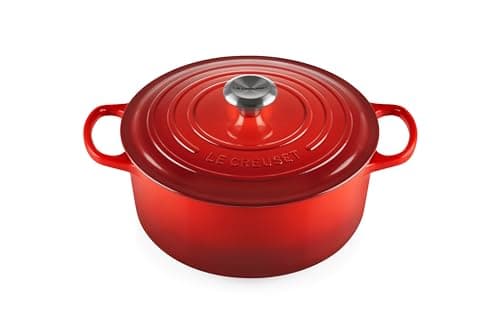
Le Creuset Signature Round Dutch Oven
Choose Staub if
You would rather not see the stains
Black matte enamel hides the discoloration that cream develops over years. You give up the ability to read browning by eye, and you gain a pot that looks the same after five years as it did new.
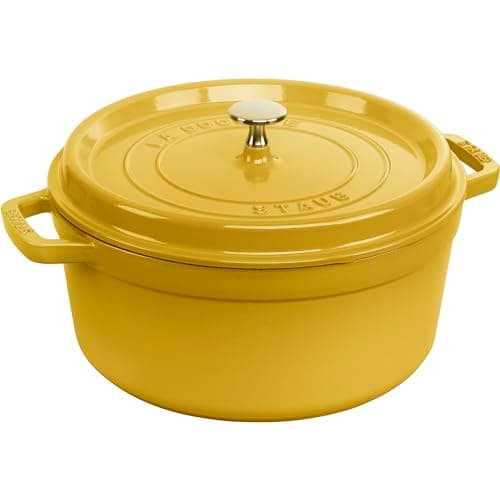
Staub Cast Iron Round Cocotte, 5.5 qt
#ad Disclosure · Price as of October 17, 2026
The differences that are real
| Le Creuset | Staub | |
|---|---|---|
| Interior enamel | Light cream | Black matte |
| Lid underside | Smooth | Raised spikes |
| Weight, 5.5 qt | About 11.3 lb | About 12.1 lb |
| Reading browning | Easy - you can see the color | Hard - the interior is dark |
| Showing stains | Cream discolors with use | Hides it |
| Color range | Very wide | Wide |
| For bread | No difference | No difference |
The interior is the whole decision
Everything else on that table is a detail. The enamel color is the thing you will notice every time you use the pot for the next twenty years.
A cream interior lets you judge color. When you are building a fond for a braise, or watching onions go from golden to burnt, you can see exactly where you are. That is a real cooking advantage and it is why a lot of people who cook as well as bake choose it.
A cream interior also stains. It develops a tea-colored patina from high-heat use over years, which is cosmetic and bothers people to wildly different degrees. Black matte enamel simply does not show it. If the idea of a pot that looks used would nag at you, that is a legitimate reason to go dark — and if you mostly bake bread, you are not reading browning through the pot anyway, because the lid is on.
The lid spikes, honestly
Staub lids have raised spikes on the underside. The manufacturer's explanation is that condensation collects on them and drips back onto the food rather than running to the edge.
For a braise, that is a plausible mechanism and plenty of cooks believe in it. For bread it is close to irrelevant: what matters during the covered phase is that the loaf's own steam stays trapped in the chamber, and both lids do that because both are heavy cast iron that sits flat. A drip pattern does not change a crust.
Weight, and where it actually bites
The Staub is roughly three quarters of a pound heavier at the same capacity. That sounds trivial and mostly is — until you are lifting a 500°F pot out of an oven at arm's length with a loaf in it.
If you have any doubt about wrist strength, the lighter pot is the better pot, and that consideration should outrank enamel color. It is also worth remembering that both of these are heavier than they look and that a sling or parchment makes getting the loaf out considerably less fraught than getting the pot out.
Knobs and handles
Check the knob rating on whichever you buy, in whichever year you buy it. Both brands have shipped phenolic and metal knobs across different lines and eras, and the maximum oven temperature of the pot is sometimes the maximum temperature of the knob rather than the iron.
This matters for sourdough more than for cooking, because a 500°F preheat is hotter than a lot of kitchen equipment expects. If the listing gives a temperature limit, that is the number to respect, and a metal knob is the way to sidestep the question entirely.
Our answer
Cook as much as you bake, and want to read what is happening in the pot? Le Creuset. Care more about a pot that still looks new in a decade, or bake more than you cook? Staub. Worried about the weight? Le Creuset, and it is not close enough to argue about.
And if reading this has made you wonder whether either is worth it, that page gives the honest answer for bread, which is no.
Frequently asked
Questions
+Is Le Creuset or Staub better for sourdough?
Neither. Both are enameled cast iron of similar mass with a heavy lid that seats, and a loaf cannot tell them apart. Choose on interior enamel color, weight and which you would rather look at for twenty years.
+What is the main difference between Le Creuset and Staub?
The interior enamel. Le Creuset is light cream, which lets you judge browning but stains over years; Staub is black matte, which hides discoloration but makes it hard to read color. Staub lids also carry raised spikes on the underside.
+Do Staub lid spikes make better bread?
There is no reason to think so. During the covered phase what matters is that the loaf’s own steam stays trapped, and both lids are heavy cast iron that sits flat. The spikes are a braising feature, not a baking one.
+Which is heavier, Le Creuset or Staub?
Staub, by roughly three quarters of a pound at 5.5 quarts. That is a small difference on paper and a real one when you are lifting a screaming-hot pot out of an oven, so it should outrank color if you have any doubt about grip.
+Can you use Le Creuset or Staub at 500F for bread?
Check the knob rating on the specific pot you are buying rather than assuming. Both brands have shipped different knobs across lines and years, and the pot’s stated maximum is sometimes the knob’s limit rather than the iron’s. A metal knob avoids the question.
Read next