Hub 03 · Sourdough Baking Gear
How to season a cast iron Dutch oven
If you bake sourdough in bare iron you are already seasoning it every week without meaning to. Here is why, what the oven is actually doing, and the three things worth knowing.
We earn a commission if you buy through our links, at no extra cost to you. We have not tested this equipment. Here is what we did instead.
Quick picks
Tap a row for the full write-up · Prices open on Amazon
| # | Product | Best for | Price |
|---|---|---|---|
| 01 | 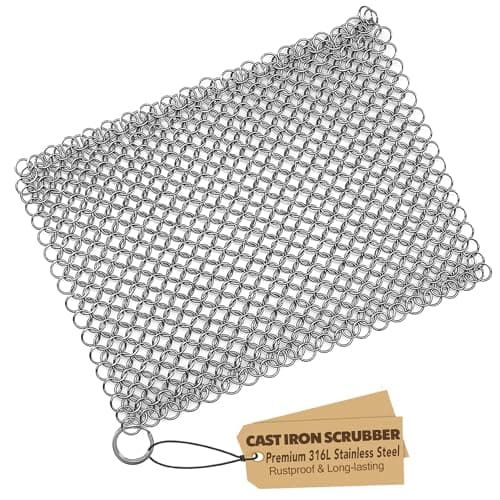 TOPULORS Cast Iron Chainmail Scrubber, 8 x 6 in Chainmail is the one item on this page that genuinely does something your kitchen cannot already do: it shifts baked-on residue from a pitted iron surface without taking the seasoning with it, which is exactly what a scouring pad fails at. | The one to buy | $6.39 · View on Amazon
|
| 02 | 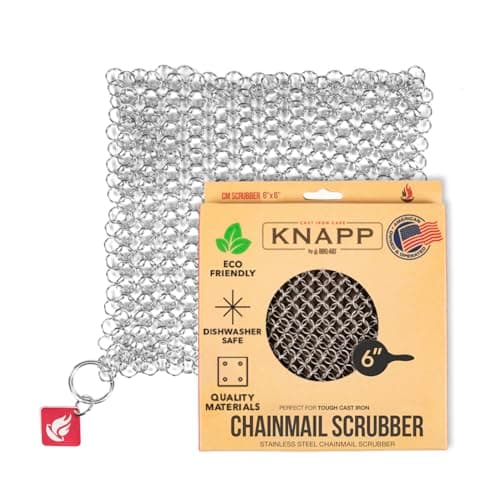 Knapp Made CM Scrubber, Small Ring, 6 x 6 in The version enthusiasts buy, and the reason is the one specification the cheap chainmails do not publish: this is the small-ring design, sold explicitly for pre-seasoned pans. | Gentler on seasoning | $19.99 · View on Amazon
|
| 03 | 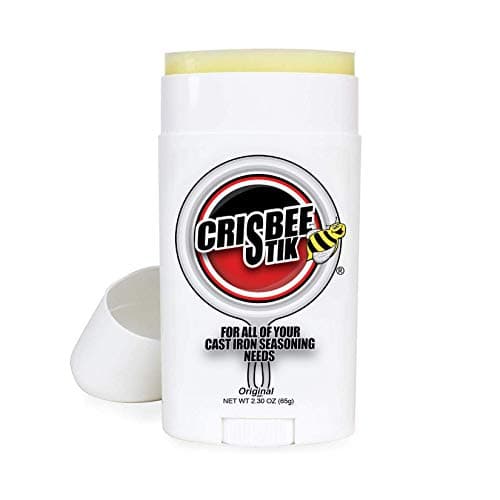 Crisbee Stik Cast Iron Seasoning A solid seasoning stick rather than a bottle, and the convenience is the entire argument: you rub it on a warm pot and nothing pools, runs or gets poured too generously. | Not dripping oil everywhere | |
| 04 | 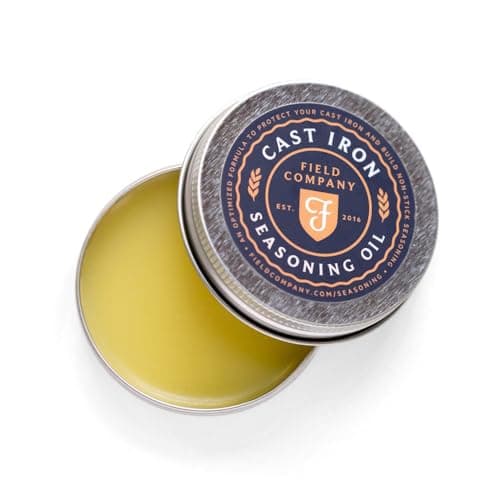 Field Company Cast Iron Seasoning Oil The pick for anyone who wants the composition on the label: organic grapeseed and sunflower with beeswax, from a cast iron maker rather than a care-products brand. | Knowing what is in it |
#ad · We earn a commission on Amazon purchases. Prices come from Amazon and change.
If you bake sourdough in a bare cast-iron pot, you are already seasoning it. America’s Test Kitchen recommends a 500F oven as the practical way to polymerize oil onto iron. A sourdough preheat is 500F. Every loaf you bake runs the pot through the same cycle a deliberate seasoning session would — provided there is a trace of oil on the metal when it goes in.
That single coincidence is most of what a sourdough baker needs to know about cast iron care, and it is why this page is short on ritual and shorter on products. Buy a chainmail scrubber. Use dish soap. Dry it. That is the routine.
What seasoning actually is
Not oil soaked into metal. Iron is not porous in that sense, and nothing is being absorbed.
Seasoning is polymerized fat. America’s Test Kitchen: “when fat is heated at a certain temperature for a particular length of time, it polymerizes,” and for cooking oils that means “the linking together of hundreds of molecules.” What you end up with is “a coating of polymerized triglyceride molecules that is many molecules thick” — “a plastic-like layer of large polymers” that is “physically trapped within the pitted surface of a cast-iron pan and partly bonded to the metal itself.”
Two consequences follow from that description and they are the useful part:
- It is a plastic layer, not a grease film. Which is why soap does not dissolve it, and why a scouring pad can physically scrape it off even though detergent cannot.
- It lives in the pitting. The rough casting is the point. A glass-smooth surface has nowhere for the layer to anchor, which is part of why vintage mirror-finish pans are harder to season than a rough modern Lodge.
Temperature is the variable, and more is not better
ATK is specific: “the degree of polymerization is directly related to the temperature to which the oil is heated.” So heat is what builds seasoning, not time or quantity of oil.
But there is a ceiling, and it is the part most seasoning advice omits: “heating the pan too hot can actually cause the coating to break down, or depolymerize.” Seasoning is not monotonic — you can cook it off.
ATK’s practical recommendation is a 500F oven, as the easiest way to get the pan just past the oil’s smoke point without overheating it. Which lands exactly on a sourdough preheat, and which also means: if you preheat well above 500F chasing oven spring, you may be degrading the seasoning rather than building it. Our Dutch oven roundup already notes that enameled pots carry a stated temperature ceiling; this is the bare-iron equivalent and almost nobody mentions it.
Which oil, and the flaxseed argument
ATK gives the governing principle: “the more unsaturated the oil, the more readily it will oxidize and polymerize,” and names canola, sunflower, soybean and corn as highly unsaturated. Any of those works. So does the grapeseed-and-sunflower blend in one of the picks below.
Flaxseed oil is the contested one and it is worth being straight about. It is a genuine drying oil — around 57% alpha-linolenic acid against roughly 10% for canola — and ATK notes it “forms a particularly durable seasoning layer.” The widely-cited home method built on it bakes the pan well above flaxseed’s smoke point, which is low.
Against that: a great many users report flaxseed seasoning flaking off in sheets, and just as many report years of trouble-free use. We could not find a controlled comparison of flaxseed against other oils for flaking. It is a genuine dispute resting on anecdote on both sides, so we are not going to declare a winner. If you want the least risk, use a cheap neutral oil you already own and let your bakes do the work.
Rust, and why it is not a disaster
Surface rust on bare iron looks terminal and is not. Lodge’s instruction is to scrub the rust off with steel wool and re-season, and their prevention advice is two steps: “dry promptly after each use, and finish with a light layer of cooking oil.”
Note that steel wool is the right tool here and the wrong tool everywhere else on this page. Rust removal is the one job where you genuinely want to take the surface back; routine cleaning is the job where a scouring pad does damage, and that is what chainmail is for.
What is not recoverable is enamel. As our French oven comparison says, a cracked enamel base spreads and cannot be repaired, and a chipped rim is where rust starts on an enameled pot. Bare iron is the forgiving material; enamel is the one with a failure mode.
How we picked
Criteria set before ranking, and one of them did most of the work:
- Does it beat something you already own? Chainmail does — nothing in a normal kitchen shifts baked-on residue without taking seasoning with it. The seasoning products do not: they beat a bottle of cooking oil on tidiness, not on chemistry. So chainmail ranks first and second.
- Does it publish what matters? For chainmail that is ring size, which decides how aggressive it is. Only one pick here names it.
- Does it state its composition? One seasoning pick does and one does not, and that is the difference between them.
- Is it relevant to an enameled pot? Mostly no, and we have said so on every card rather than letting readers find out.
Pre-seasoned does not mean finished
Almost every bare iron pot now arrives pre-seasoned, and that wording does a lot of work. Lodge define seasoning simply as “the term we use to describe the oil baked onto the cast iron pan.” Factory seasoning is exactly that and no more: one industrial pass, enough to stop the pot rusting in a warehouse and on a shelf.
It is a starting layer, not a finished surface. Each subsequent bake at bread temperature adds to it, which is why a pot that has made fifty loaves behaves better than the same pot out of the box, and why nothing you can buy accelerates that faster than simply using it. If a new pot seems to grab at dough, it is not faulty — it is new.
This is also the honest answer to a question our bread sling page raises from the other direction: a sling solves sticking on day one, where seasoning solves it over months. They are not competing purchases.
Bread is the easiest thing you can bake in it
Worth knowing if you worry about the pot, because sourdough is an unusually gentle tenant. Lodge’s one real food caution is that “large amounts of very acidic or alkaline foods can break down the seasoning when cooked for extended periods of time.”
A long tomato braise is that. A lemony stew is that. A loaf of bread is flour, water, salt and a culture — mildly acidic at most, in the oven for well under an hour, and in contact with the pot only where the base touches. It is close to the least demanding thing you could put in cast iron.
So a pot used mainly for sourdough has an easy life, gets a 500F polymerizing cycle every time, and should need very little from you beyond drying. The people who have genuine seasoning trouble are usually cooking acidic food in it, not baking.
The whole routine, after a bake
- Let it cool before it meets water. Thermal shock is the one genuine way to ruin a hot pot, and it matters more for enamel than for bare iron.
- Wash it. Mild dish soap, hot water, and chainmail for anything stuck on. Lodge are explicit that this is fine.
- Dry it promptly and completely. This is the step that actually prevents rust, and the one people skip. Back on a warm hob for a minute is the reliable version.
- A light wipe of oil, on bare iron only. Lodge’s own wording: a light layer of cooking oil. Light is the operative word — too much oil is how you get a sticky pot rather than a seasoned one.
- Then bake bread in it. Which, at 500F, is the seasoning cycle.
For an enameled pot, stop after step three. There is nothing to oil and nothing to season.
What we would buy
A cheap chainmail scrubber, and nothing else. It is the only item here that does something your kitchen cannot, it costs less than a bag of flour, and combined with dish soap it covers the entire routine for a pot you bake in weekly.
The small-ring Knapp Made instead if you own bare iron you care about and want the gentler mesh, which is the one chainmail difference that is actually specified rather than implied.
A seasoning stick or oil only if you want the tidy format. They work. So does the bottle of grapeseed oil you already have, and your 500F preheat does not know the difference.
Every pick, in order
The full write-ups
Pick 01 · The one to buy
TOPULORS Cast Iron Chainmail Scrubber, 8 x 6 in
TOPULORS
Chainmail is the one item on this page that genuinely does something your kitchen cannot already do: it shifts baked-on residue from a pitted iron surface without taking the seasoning with it, which is exactly what a scouring pad fails at. This is the cheap version in 316L stainless and it does the job. Buy this, use dish soap, and you have covered almost everything a sourdough Dutch oven needs.
Size
8 x 6 in
Material
316L stainless steel, per the listing
Ring size
Not published
Dishwasher
Per the listing, yes
Specs compiled from: Manufacturer product listing and product name
What is good
- Removes stuck-on residue without stripping seasoning, which a scouring pad cannot manage
- The cheapest thing on this page by a wide margin and the most useful
- 316L stainless rather than unspecified steel, so it is not going to rust itself
- Nothing to wear out or run out of
What is not
- Does not publish its ring size, and ring size is what decides how aggressive a chainmail is
- Unbranded, so there is no track record on whether the rings hold
- Awkward to hold compared with the versions that have a silicone grip
- A chainmail is overkill for an enameled pot, which is most of what this site recommends
Pick 02 · Gentler on seasoning
Knapp Made CM Scrubber, Small Ring, 6 x 6 in
CM Scrubber
The version enthusiasts buy, and the reason is the one specification the cheap chainmails do not publish: this is the small-ring design, sold explicitly for pre-seasoned pans. Smaller rings mean more contact points and less point pressure, which is the difference between scrubbing residue off and scrubbing seasoning off. Three times the price of the budget pick for a difference that matters only if you own bare iron.
Size
6 x 6 in
Ring
Small ring, stated for pre-seasoned pans
Material
Stainless steel mesh
Listed for
Pans, Dutch ovens, grills
Specs compiled from: Manufacturer product listing and product name
What is good
- Publishes the thing that matters -- small rings, specified as safe for pre-seasoned surfaces
- The established name in this category, with a long track record
- Smaller sheet is easier to hold and to work around a pot's curve
- Gentler on a seasoning layer you have spent bakes building
What is not
- Three times the price of a chainmail that does the same basic job
- Smaller sheet covers less area per pass
- Still pointless on an enameled pot, which needs no seasoning to protect
- No published ring dimension -- 'small ring' is a product name, not a measurement
Pick 03 · Not dripping oil everywhere
Crisbee Stik Cast Iron Seasoning
Crisbee
A solid seasoning stick rather than a bottle, and the convenience is the entire argument: you rub it on a warm pot and nothing pools, runs or gets poured too generously. What it is not is magic. Seasoning is polymerized oil, and a trace of the cooking oil already in your kitchen polymerizes at the temperature you preheat a Dutch oven to anyway. Buy this because it is tidy and lasts, not because the pot needs a proprietary blend.
Format
Solid stick
Composition
Oil and beeswax blend, per the listing
Made
USA, per the listing
Exact formula
Not published
Specs compiled from: Manufacturer product listing and product name
What is good
- A stick cannot pool or run, which is the practical failure of seasoning from a bottle
- A very small amount covers a pot, so one stick lasts a long time
- Tidy enough that you will actually do it after a bake rather than meaning to
- Long-standing favorite in the cast iron community, so plenty of user guidance exists
What is not
- Does nothing a neutral cooking oil you already own cannot do -- you are buying the format, not better chemistry
- Does not publish its exact formula, so you cannot compare it with an oil on composition
- Beeswax content makes it unsuitable if you want a strictly vegan kitchen
- Irrelevant to an enameled pot, which is the majority of what we recommend
#ad Disclosure · Price as of November 3, 2026
Pick 04 · Knowing what is in it
Field Company Cast Iron Seasoning Oil
Field Company
The pick for anyone who wants the composition on the label: organic grapeseed and sunflower with beeswax, from a cast iron maker rather than a care-products brand. Grapeseed and sunflower are both highly unsaturated, which per America's Test Kitchen is what makes an oil polymerize readily -- so the blend is at least pointed at the right chemistry. It is a bottle, so it will run if you are generous with it.
Composition
Organic grapeseed, sunflower and beeswax, per the listing
Format
Liquid, bottled
From
Field Company, a cast iron manufacturer
Smoke point
Not published
Specs compiled from: Manufacturer product listing and product name
What is good
- States what is actually in it, which the stick does not
- Grapeseed and sunflower are highly unsaturated, the property that drives polymerization
- Made by a company that manufactures the pans, not only the polish
- Liquid is easier to spread into a pot's corners than a stick is
What is not
- A bottle pours too easily, and too much oil is the commonest seasoning mistake
- No published smoke point, which is the figure you would want for an oven cycle
- Costs more than the equivalent volume of plain grapeseed oil from a supermarket
- Like every product here, it is optional: this is a format and sourcing choice, not a performance one
#ad Disclosure · Price as of November 3, 2026
How we picked
We have not tested any of this equipment. What we did instead: compiled the published specifications from each manufacturer’s own listing, checked them against the task a beginner is actually trying to do, read the care instructions, and named the thing we would skip. Where a pick is a product type rather than a brand, it is because the category is sold mostly unbranded and the type is the real decision.
Frequently asked
Questions
+Can you use soap on a cast iron Dutch oven?
+What temperature do you season cast iron at?
+What is seasoning, physically?
+Is flaxseed oil the best oil for seasoning?
+How do you fix a rusty Dutch oven?
+Do I need to season an enameled Dutch oven?
+Can I use metal utensils in cast iron?
Sources
Where the facts on this page came from
- Lodge Cast Iron — cast iron myths: mild dish soap is fine, re-season if too much comes off, any utensil including metal, acidic food caution, rust removal with steel wool, dry promptly and finish with a light layer of oil
- America's Test Kitchen — the science of seasoning: polymerization, the layer as polymerized triglycerides trapped in the pitted surface, degree of polymerization tied to temperature, depolymerization when too hot, a 500F oven, and unsaturation as the property that drives polymerization
Read next