Hub 03 · Sourdough Baking Gear
Emile Henry bread cloche review
It is the one baking vessel you load cold, at arm's length, with no preheated iron involved. The catch is a published temperature ceiling with no headroom at all.
We earn a commission if you buy through our links, at no extra cost to you. We have not tested this equipment. Here is what we did instead.
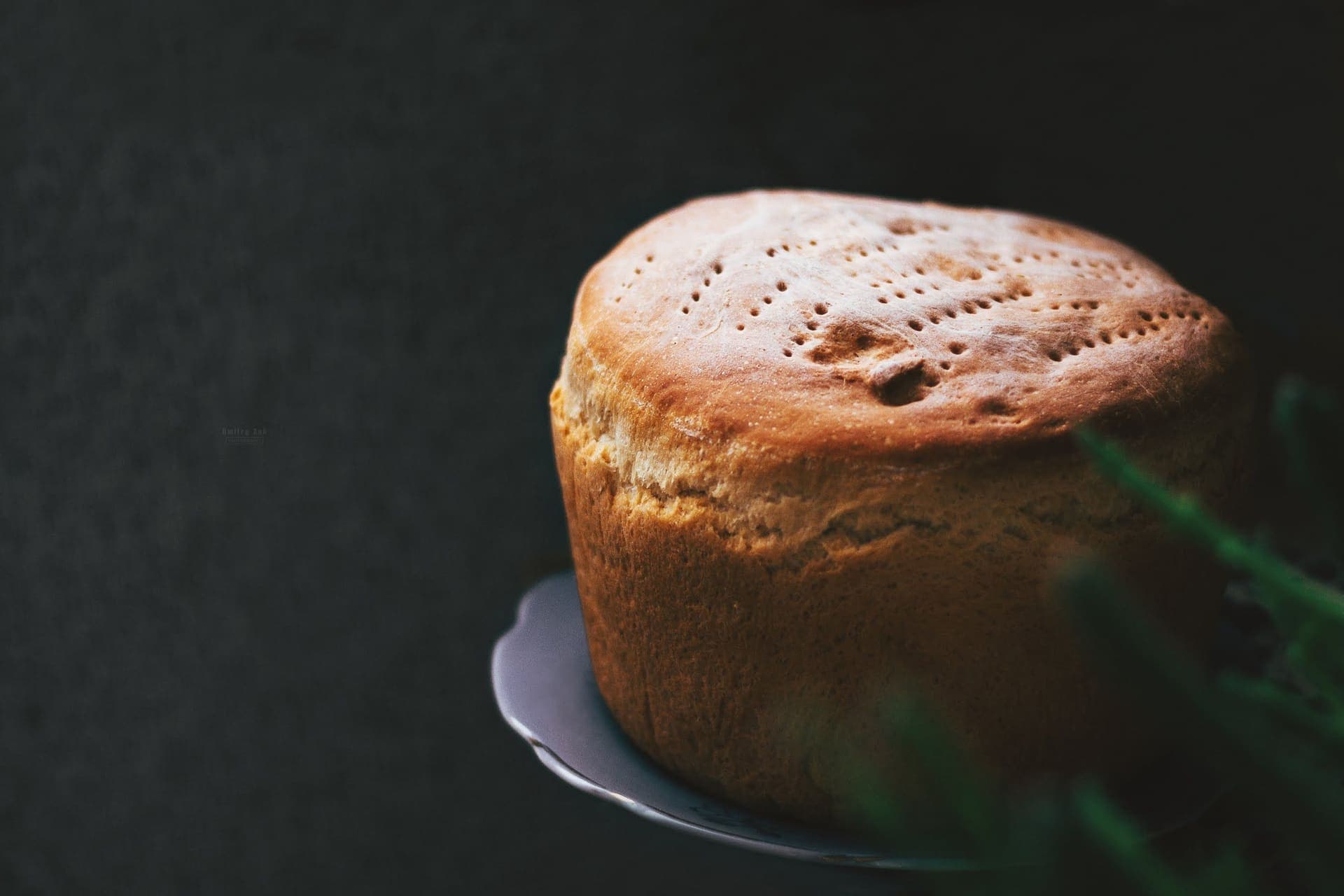
Buy it if the part of sourdough you dread is lowering a proofed loaf into a screaming-hot cast-iron pot. The Emile Henry cloche is loaded cold — dough goes onto a floured room-temperature base, the dome goes over it, and the whole thing goes into the oven. There is no preheated vessel and no moment where your knuckles are inside one.
Do not buy it if your recipe preheats above 500F. Emile Henry publishes a ceiling of 500F (250C) for this ceramic, and a great many sourdough recipes call for exactly 500F. That is a ceiling with no headroom, which is the single most important fact about this product and the one least likely to appear in a review.
What Emile Henry actually publishes
Unusually for this category, there is a real specification to report. From the manufacturer:
- Maximum temperature 500F / 250C, for the HR Ceramic body
- Capacity: a 3.5 to 4 cup flour recipe — stated as a recipe size rather than a volume
- Material: glazed HR Ceramic, made from refractory Burgundy clay
- Weight: 6.5 lb
- Warranty: 10 years, covering production faults in normal domestic use
- Made in Marcigny, France. Dishwasher safe. Rated freezer to oven.
A ten-year warranty and a published temperature ceiling put this ahead of almost everything else we cover on documentation alone. What Emile Henry does not publish is the vessel’s dimensions — only the recipe size it suits.
The cold-loading advantage is the real product
Our Dutch oven roundup makes the case that the lid is the specification nobody talks about, because loading a wet, fully-proofed loaf into a preheated 500F pot is the most nerve-wracking moment of a home bake. A deep pot with a domed lid means lowering your hands into a hot well.
A cloche removes that moment completely rather than mitigating it. The base is shallow, flat and cold. You place the loaf on it the way you would place it on a baking sheet, score it on a surface at waist height with both hands free, and put the dome on. Nothing is hot until it is in the oven.
That is also why the Challenger pan exists and costs what it does: it inverts a Dutch oven so the base is shallow and the lid is the tall part. The cloche gets to the same ergonomics by being ceramic and not needing to be preheated at all.
What you give up
The temperature ceiling. 500F is the published maximum, and plenty of sourdough recipes preheat to 500F before dropping to 450F. You are operating at the limit rather than inside it, with a brittle material. We would bake at 450F in this and accept slightly less initial oven spring.
Thermal mass, deliberately. A preheated cast-iron pot slams heat into the base of the loaf in the first minute, which drives oven spring. A cold ceramic base cannot do that: it has to warm up with the loaf. The trade is real — you are exchanging some bottom-crust aggression for a process that will not burn you.
Fragility. It is ceramic, 6.5 pounds of it, and the warranty covers production faults rather than the knock that chips it or the thermal shock that cracks it. A Lodge Dutch oven is effectively unbreakable by comparison.
Size. A 3.5 to 4 cup flour recipe is a modest loaf — roughly 500g of flour, not the big bake a 5-quart pot takes.
How you actually bake in it
The method is different enough from Dutch oven baking to be worth spelling out, because most sourdough recipes assume a preheated pot and will mislead you.
- Preheat the oven, not the cloche. The vessel stays out and stays cold.
- Flour the base and turn the proofed loaf straight onto it, seam side down, at counter height.
- Score it where it sits. This is the quiet advantage: both hands free, the loaf at waist height, nothing hot nearby. Compare that with scoring a loaf already sitting in a 500F pot. Our scoring guide applies unchanged, and is easier to follow here.
- Dome on, into the oven. We would set 450F rather than 500F, for the ceiling reason above.
- Lid off for the last third to brown, exactly as with a Dutch oven. The steam phase is over once the loaf has set.
Because the vessel starts cold, the total bake runs a little longer than the same loaf in a preheated pot. Bake to color and to an internal temperature rather than to the clock.
Care, and how one of these dies
Emile Henry says dishwasher safe and rates the ceramic freezer-to-oven, so the routine is genuinely easy: no seasoning, no oiling, no rust, and the glaze means it will not take on flavors from a previous bake. Against bare cast iron that is a real reduction in maintenance.
The realistic end of its life is mechanical rather than chemical. A ceramic baker dies from a knock against a tap, a chip on a hard counter, or thermal shock from something cold meeting something hot. The 10-year warranty covers production faults in normal domestic use — it does not cover any of those. Treat it as a good plate rather than as a pan, keep it away from the sink edge, and do not run cold water into it while it is hot.
Who should not buy this
- Anyone who bakes above 500F. The ceiling is the ceiling. If your recipe and your oven are happiest at 500F, buy iron.
- Anyone who already owns a heavy lidded pot and is not bothered by loading it. You would be paying for ergonomics you do not need.
- Anyone who wants one vessel for bread and dinner. A Dutch oven braises; this bakes bread. That is the whole list.
- Anyone baking large loaves. A 3.5 to 4 cup flour recipe is the published capacity and there is no larger version of this shape.
Against the Dutch oven it replaces
| Emile Henry cloche | Lodge double Dutch oven | |
|---|---|---|
| Preheated | No, loaded cold | Yes, empty, to 500F |
| Loading risk | None; the base is cold | The reason bread slings exist |
| Published max temperature | 500F, per Emile Henry | No ceiling to worry about |
| Published warranty | 10 years, domestic | Lifetime on the iron |
| Material | Glazed ceramic | Bare cast iron |
| Seasoning needed | No, glazed | Yes |
| Breakable | Yes | Effectively no |
| Loaf size | 3.5-4 cups of flour | A standard 500g-flour loaf and up |
| Other uses | Bread, and bread | Braising, frying, everything |
| Price bracket | Premium | Budget |
Classic or Modern
Buy the classic if
You want the documented one
The published 500F ceiling, 10-year warranty, 6.5 lb weight and capacity all belong to this model. The round dome suits a boule.
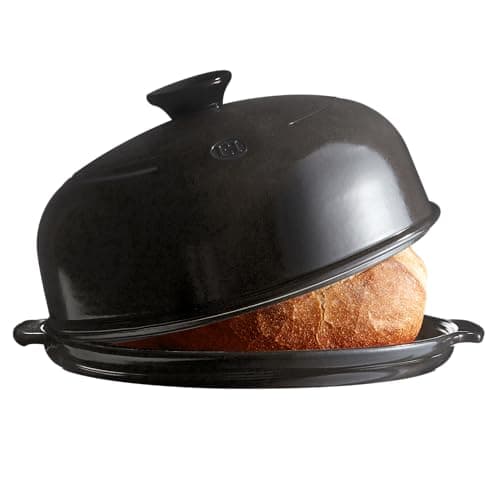
Emile Henry Ceramic Bread Cloche
#ad Disclosure · Price as of October 17, 2026
Buy the modern if
You want the shape and the saving
Same maker, same ceramic family, squarer base that suits a batard, noticeably less money. Emile Henry publishes less about it; assume the line’s 500F limit.
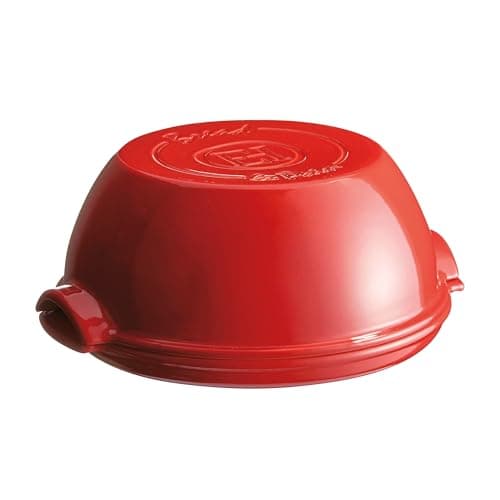
Emile Henry Modern Bread Cloche
#ad Disclosure · Price as of October 17, 2026
What it does not change
One expectation to set, because the category markets itself on crust. A cloche does not make bread rise more than a Dutch oven does, and it will not rescue a loaf with an underdeveloped structure or an over-proofed crumb. Both vessels work by the same mechanism — trapping the steam the dough itself releases for the first part of the bake — and that mechanism is where almost all of the benefit lives. What the cloche changes is the handling, not the chemistry.
Our verdict
A genuinely good object, with better documentation than almost anything in this category, bought for the right reason by a minority of people: those for whom the hot-pot loading is the barrier. At 450F it will bake excellent bread for a decade under warranty.
If you have no fear of the pot, a budget Dutch oven does more for less and has no ceiling. If the loading is the thing stopping you baking, this is the fix, and our cloche versus Dutch oven comparison takes the general question further.
Frequently asked
Questions
+Do you preheat an Emile Henry bread cloche?
+What temperature can an Emile Henry cloche go to?
+Is a bread cloche better than a Dutch oven?
+How big a loaf fits in it?
+Is the Emile Henry cloche dishwasher safe?
+Does it come with a warranty?
Sources
Where the facts on this page came from
Read next